

We may earn a commission when you buy through links on this page, at no extra cost to you. Learn more.
The vintec 150 bottle wine fridge search most closely matches the legacy Vintec V150SG2E-AL model name, but that discontinued Australian cabinet is officially listed as 130 bottles; Vintec’s current U.S. catalog lists a 140-bottle model instead. The older V150 offers single-zone storage or multi-temperature serving, UV-treated glass, adjustable wooden shelves and a reversible door. Its strengths are temperature flexibility and wine-specific storage features; its cautions are discontinued status, an inconsistent historical capacity figure and regional electrical specifications. For a new U.S. purchase, the current 140-bottle VWCM149FAB is the more relevant comparison.
The important buying question is not whether the model name contains “150,” but which exact Vintec cabinet is sold in your market. This review separates the older V150SG2E-AL (also listed as VIN150SG2E-AL) from the current U.S. line, so a buyer does not mistake an imported discontinued cabinet for a current American-market model.
Specs and Key Features
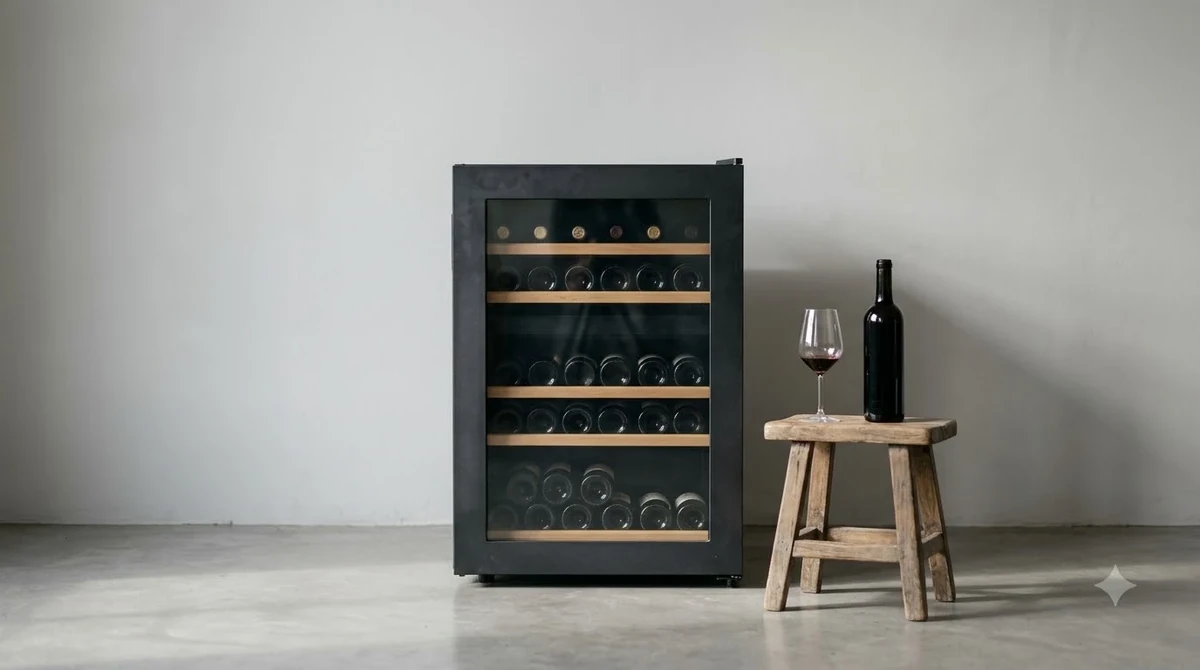
The V150SG2E-AL is a tall wine cabinet designed to switch between a consistent storage temperature and a temperature gradient for serving different wine styles. Vintec’s product page identifies it as a discontinued 130-bottle cabinet, so the V150 model code should not be read as proof that it holds 150 bottles.
| Specification | V150SG2E-AL details |
|---|---|
| Published capacity | 130 bottles maximum in Vintec’s product listing |
| Older technical-guide figure | 148 bottles maximum listed in an earlier Vintec guide |
| Operating temperature range | 6–18°C (about 43–64°F) |
| Temperature configuration | Single-zone or Multi-Temp setting |
| Shelving | 5 adjustable wooden shelves |
| External dimensions | 1,560 mm high × 595 mm wide × 600 mm deep |
| Door | Double-glazed, UV-treated glass; reversible opening |
| Cabinet features | Digital display, interior LED light, lock and audible/visual alarm |
| Electrical use | 1 kWh per day listed; 240 V / 10 A supply |
| Refrigerant and room range | R600a; stated ambient range 5–35°C |
| Unloaded weight | 72 kg |
Capacity deserves a closer look because older Vintec documents are not perfectly consistent. The current Vintec Australia product page and retailer listings call the V150SG2E-AL a 130-bottle cabinet, while an older Vintec technical guide lists 148 as a maximum for the model. Treat 130 as the conservative published capacity unless the exact unit’s label and original documentation confirm otherwise. Vintec bases maximum counts on standard 750 ml Bordeaux-style bottles; wider Burgundy, Champagne and sparkling-wine bottles take more room, and some shapes will not sit neck-to-neck on the same shelf. A mixed collection can therefore hold fewer bottles than the headline figure.
The two temperature functions serve different jobs. In single-zone use, Vintec recommends a steady 12–14°C for cellaring reds, whites and sparkling wine together. Multi-Temp creates a top-to-bottom gradient for serving, with cooler positions low in the cabinet and warmer settings higher up; the stated operating range is 6–18°C. The Vintec V150SG2E-AL product page lists the model’s features and downloads, including its reversible door, lock, digital display, LED lighting and alarm. Its brushed-aluminum finish and glass front also give it a display role in a dining room or entertaining area.
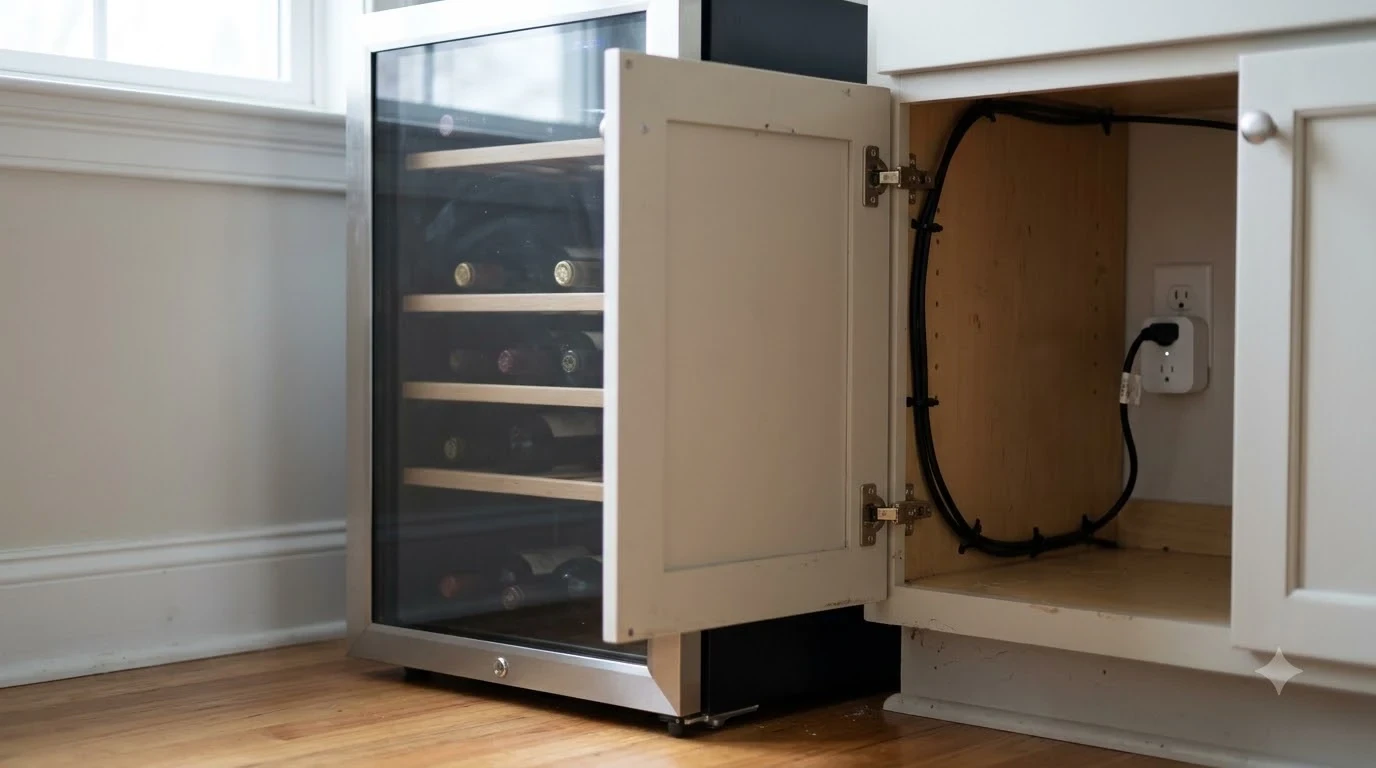
The cabinet measures 1,560 mm high, 595 mm wide and 600 mm deep, with a 1,200 mm door-open depth in the published specifications. Plan for the door swing and the required ventilation rather than treating the 600 mm cabinet depth as the complete installation space. Retailer specifications state that it can be built into cabinetry only with ventilation and cannot be fully integrated; it weighs 72 kg unloaded, so check the delivery route and final floor position before installation.
Tip: Before buying a used V150, measure the largest bottle in your collection and compare it with the shelf openings; then measure the full door-swing and ventilation space, not just the 595 mm cabinet width.
What Owners Like
The available owner feedback is positive, but the sample for this discontinued model is small, so it is best read as a set of individual experiences rather than proof that every unit will perform identically. The recurring positives are reliable temperature holding, useful storage for a growing collection and a finish that suits a visible living space.
One long-term owner review reproduced on Appliances Online describes a Vintec V150 cabinet bought in 2013 and still working well more than a decade later. The reviewer says it commonly held close to 130 bottles in a garage and stored wines from Australia, France and Italy. Other comments on the same retailer page are brief but favorable: one owner says the cabinet keeps wine at the desired temperature throughout the year and reports being happy with the humidity, while another recommends it after owning Vintec appliances. The sample is small, but these comments point to the practical benefits owners value: consistent storage and useful room for a varied collection.
Owners who use the cabinet as a display piece may also value its tall, narrow footprint. At 595 mm wide, it occupies less wall width than many wide-format cellar units, while the glass door keeps the collection visible. The lock, reversible door and LED lighting add convenience, and the five adjustable wooden shelves let owners adapt the arrangement to bottle shapes or remove a shelf when a wider bottle needs extra headroom. Shelf adjustment does not erase the capacity limit, but it can make the cabinet easier to organize.
Common Complaints
The clearest limitations are capacity uncertainty, bottle-shape fit and installation sensitivity. The owner comments available for this exact model do not establish a widespread defect pattern, so it would be misleading to label the V150 unusually noisy or unreliable; the manual does, however, identify common conditions that can create noise or affect operation.
The advertised bottle count is the first likely frustration. A cabinet filled with standard Bordeaux bottles is different from a mixed collection of broad-shouldered Pinot Noir, tall Riesling and sparkling bottles with wider bases. With all shelves installed, the real-world total may be lower than a maximum figure based on uniform bottles. Removing shelves and stacking more bottles can increase capacity, but it reduces access and means moving bottles to reach those at the back.
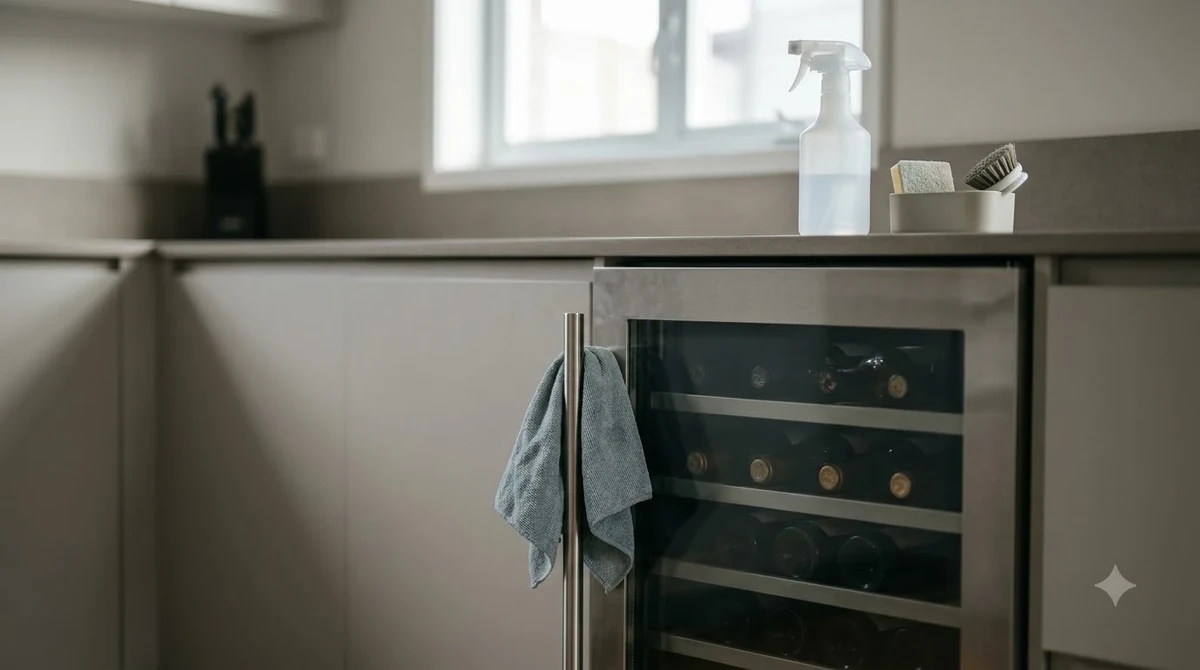
Noise is another point to understand before placing the cabinet in a quiet room. Vintec’s user manual lists vibration or bothersome noise when the unit is not level, touches nearby kitchen elements, or contains bottles rattling against one another. It advises leveling the cabinet, leaving it clear of adjacent fixtures and separating rattling bottles. The manual connects continuous compressor operation with high room temperature and advises adequate ventilation; these are operating conditions, not proof that every V150 has a noisy compressor.
The discontinued status can be a greater inconvenience than any single feature. For a used or clearance unit, verify the model label, temperature controls, door seal, shelves, lock, alarm and local service options before committing. Check the door swing and ventilation gaps too: a cabinet pressed tightly against furniture or sealed inside a decorative enclosure can run longer and create avoidable noise. Missing shelves or a worn gasket can change the usefulness of an otherwise sound cabinet.
Who Should Buy and Who Should Skip
The V150SG2E-AL makes the most sense for a wine drinker who needs a tall, dedicated cabinet for a mixed home collection and values the choice between cellaring and serving modes. It is less suitable for someone who needs a guaranteed 150-bottle load, wants a fully integrated kitchen appliance or expects to buy a new unit with current-model support.
It suits an entertainer who rotates through reds, whites and sparkling wines and wants several styles ready at useful temperatures. In Multi-Temp mode, cooler positions can hold sparkling wine and crisp whites, while warmer positions can suit lighter and fuller reds. Bottles for an Aperol Spritz recipe can stay cold while a red intended for dinner sits higher in the cabinet.
For long-term storage, use the cabinet as a single-temperature cellar rather than leaving naturally corked bottles in a serving-temperature gradient indefinitely. Vintec recommends 12–14°C for cellaring and warns that Multi-Temp cabinets do not provide the humidity conditions needed for long storage of wines under natural cork; its support guidance suggests turning over wines stored in Multi-Temp mode within about six months. Buyers who regularly serve wine with a chicken Marsala recipe may appreciate the option to hold the bottle at cellar temperature and bring it to serving range before dinner.
Skip this model if 150 bottles is a firm minimum, if the collection is dominated by oversized bottles, or if the only available location lacks ventilation. It is also a poor match for a buyer who wants a fully integrated kitchen appliance or expects current-model parts and documentation for a new unit. The Australian V150 specification lists a 240 V / 10 A supply, so a U.S. buyer should not assume an imported unit is plug-and-play; confirm its voltage, frequency, plug, certification and service coverage before purchase. Used V150 cabinets can still make sense, but inspect the cabinet closely and measure the delivery route, floor position and final clearances before purchase; the unit weighs 72 kg unloaded and stands 1,560 mm tall.
How It Compares to Alternatives
For a U.S. buyer, the most useful comparison is Vintec’s current 140-bottle VWCM149FAB, followed by the larger 201-bottle VWCM201FAB. Those are current U.S.-catalog models; they should not be confused with the older V150SG2E-AL, which Vintec lists as discontinued on its Australian site.
The VWCM149FAB is the closest capacity match in the current U.S. range. Vintec lists 100 bottles as its easy capacity and 140 as its maximum, with fully extendable white-oak Perfect Cradle shelves, a stated 41–64°F range, 10 shelves, a matte-black border and an integrated handle. The official listing gives its dimensions as 72.8 inches high, 23.4 inches wide and 24 inches deep, and describes installation as built-in or freestanding. The shelves are designed for a range of 750 ml bottle shapes, including Champagne, and the cabinet includes a lock, audio/visual alarm and humidity recycling system.
For a collection that genuinely needs more than 150 spaces, Vintec’s current U.S. catalog lists the VWCM201FAB at 174 easy bottles and 201 maximum. That gives a larger buffer than a unit marketed around 130 or 140 bottles, particularly if the cellar contains broad bottles or if every supplied shelf must remain in place. The trade-off is a larger cabinet, so check the dimensions and delivery path before choosing capacity on paper alone.
Before buying an imported V150SG2E-AL, pay close attention to the regional specification. Its Australian product sheet lists a 240 V / 10 A electrical supply, whereas the current U.S. Vintec catalog describes models built for the U.S. market. Voltage, frequency, plug type, electrical certification, warranty and service coverage all need confirmation with the seller; an adapter alone does not resolve a voltage or frequency mismatch. The current U.S. Vintec 140-bottle cabinet page is the better starting point for a new domestic purchase.
When comparing the V150 with any alternative, check the exact maximum capacity, supplied shelves, temperature arrangement, ventilation and door clearance. A broader overview of wine cabinet brand and capacity reviews can help frame the choice. If an existing V150 cools consistently and its layout suits the collection, replacing it solely because it is discontinued may not be necessary; if the collection has outgrown it, a genuine higher-capacity model is preferable to crowding the shelves.
Frequently Asked Questions
These answers cover practical ownership details that are easy to miss when comparing headline capacity and temperature settings. They are especially useful when buying a used cabinet or planning its first installation.
Should the cabinet stand upright before it is switched on after delivery?
Yes. The V150/V190 user manual says that if the cabinet has been laid down during transport, or stored in surroundings colder than 5°C, it should remain upright for at least one hour before being switched on. Allowing that settling time is a simple precaution before loading the shelves.
Can the V150 be installed outdoors?
No. The user manual says the appliance should not be installed outdoors and calls for a dry, well-ventilated room away from heat sources and direct sunlight. It also gives climate-class room-temperature ranges, so the rating plate on the individual cabinet is the best guide to its permitted ambient conditions.
Can wine bottles touch the rear wall?
Vintec’s support guidance says they should not. Condensation runs down the rear panel, and a bottle touching that surface can have its label affected while also interfering with the cabinet’s moisture-recycling process. Leave a small gap instead of pushing every bottle as far back as it will go.
What do P1 and P2 mean on the display?
The V150/V190 manual identifies P1 as an upper temperature-sensor fault and P2 as a lower sensor fault. It directs owners to call for service; until the issue is corrected, the cabinet maintains the whole interior at the higher of the two set temperatures. Record the displayed code and model details before contacting support.
Is frost inside the cabinet always a sign of failure?
No. The user manual describes frost on the interior evaporator wall and upper parts as a natural occurrence. It says the cabinet should be defrosted during normal cleaning or maintenance, rather than treating every appearance of frost as a component failure.
The Vintec V150SG2E-AL remains an interesting option for buyers who value flexible wine storage, but it should be judged as a discontinued 130-bottle cabinet, not assumed to be a true 150-bottle model. Confirm the exact unit, its shelf package and ventilation needs before buying; for a full mixed-bottle cellar, choose capacity with room to spare rather than relying on the maximum count.
More in Model Reviews
 Lanbo Dual Zone Wine Fridge Review: Features, Capacity, and DrawbacksUpdated Nov 20, 2026
 Lanbo Beverage Cooler Review: Features, Capacity and ReliabilityUpdated Nov 20, 2026
 Haier Wine And Beverage Center Review: Capacity, Cooling, and FitUpdated Nov 20, 2026
 Haier Countertop Wine Cooler Review: Features and Buying AdviceUpdated Nov 20, 2026
 KitchenAid Built In Wine Fridge Review: Features, Fit and Bottle CapacityUpdated Nov 20, 2026
 KitchenAid 24 Inch Wine Fridge: Features, Capacity, and Buying AdviceUpdated Nov 20, 2026