

We may earn a commission when you buy through links on this page, at no extra cost to you. Learn more.
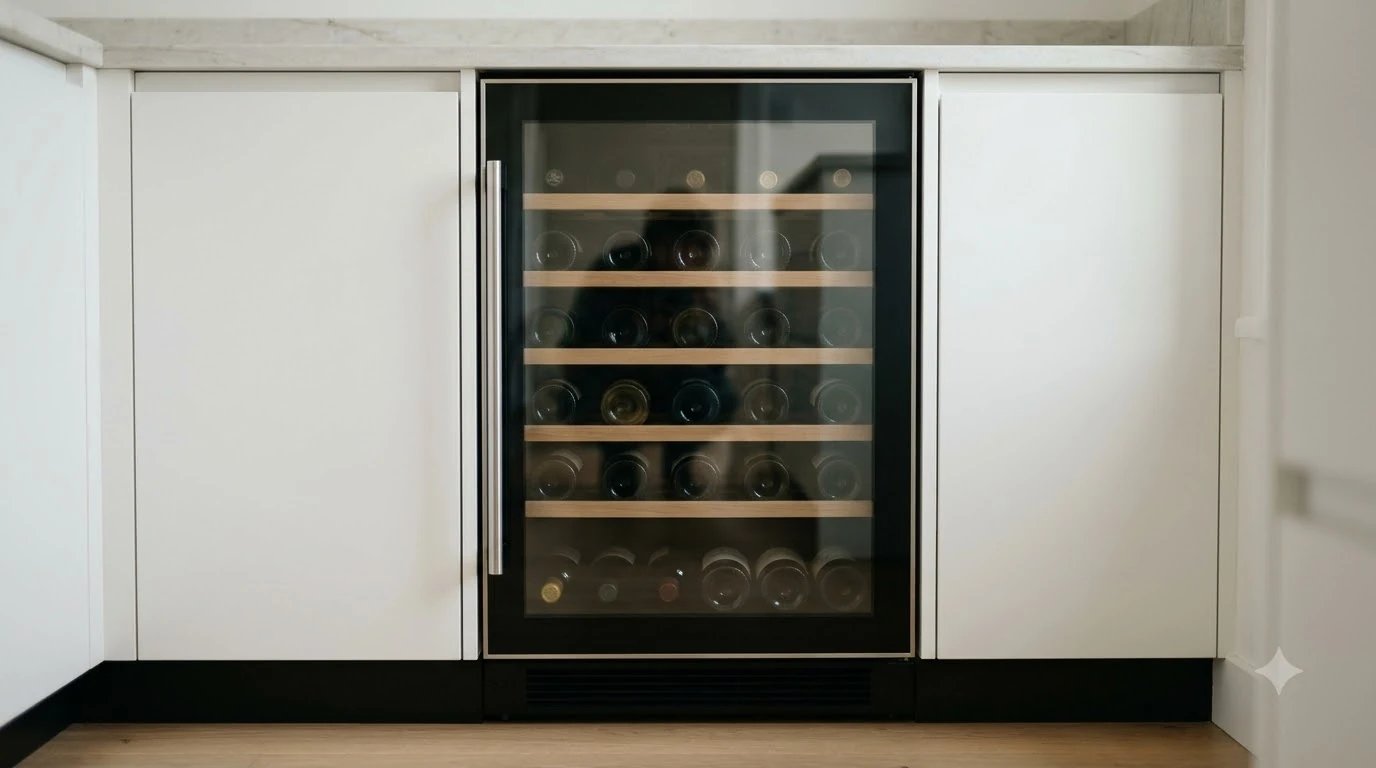
The KitchenAid built in wine fridge is a stylish undercounter storage option for households that want dual-zone cooling, an integrated kitchen appearance and room for a substantial wine collection. The KUWR204ESB offers a stated capacity of 46 bottles, six wood-front racks, a UV-protected glass door and automatic LED lighting. Its biggest drawbacks are potential bottle-fit limitations, mixed reports about compressor noise and questions about long-term reliability, making careful inspection particularly important when considering an older or previously owned unit.
KitchenAid’s 24-inch wine cellar combines the appearance of a premium kitchen appliance with features intended for everyday wine storage. It is designed to fit beneath a counter or operate as a freestanding unit, giving homeowners some flexibility when planning a kitchen or entertaining area. However, its advertised capacity and attractive exterior do not tell the entire story. Rack dimensions, installation clearances, operating noise and the availability of replacement parts deserve equal attention. This review examines the KUWR204ESB, its closely related configurations, and the practical considerations that determine whether this wine cellar makes sense for a particular home.
Specs and Key Features of the KitchenAid Wine Cellar
The KUWR204ESB is a 46-bottle, 24-inch undercounter wine cellar with dual-zone temperature control and a stainless-steel exterior. Its combination of wood-front shelving, glass-door presentation and automatic lighting makes it particularly appealing for kitchens where the appliance remains visible.
KitchenAid’s published specifications identify six SatinGlide wood-front racks, interior touch controls, two temperature-controlled zones and a UV-protected thermal glass door. These features address three important wine-storage priorities: organization, temperature separation and protection from unwanted light exposure. The automatic interior lighting also makes it easier to identify bottles without leaving the door open for extended periods.
The stainless-steel KUWR204ESB is the main model considered here. KitchenAid also identifies a panel-ready glass-door configuration, the KUWR204EPA, for homeowners who prefer a more integrated cabinetry appearance. The two configurations should not be confused when checking availability, replacement components or installation requirements.
| Specification | KitchenAid KUWR204ESB |
|---|---|
| Appliance category | Undercounter wine cellar |
| Nominal width | 24 inches |
| Stated bottle capacity | 46 bottles |
| Temperature zones | 2 |
| Wine racks | 6 |
| Rack construction | SatinGlide wood-front racks |
| Lighting | Automatic interior LED |
| Door | UV-protected thermal glass |
| Controls | Interior-front touch controls |
| Alarms | Door and over-temperature alarms |
| Product height | 34-1/4 inches |
| Product width | 23-3/4 inches |
| Product depth | 26-3/4 inches |
| Door-open depth | 47-3/4 inches at 90 degrees |
| Electrical supply | 115 volts, 15- or 20-amp circuit |
One particularly useful feature is the dual-zone arrangement. Instead of requiring every bottle to share one temperature setting, the appliance allows different wine categories to occupy separate cooling environments. This is convenient for households that regularly drink both red and white wine. It also makes the cellar more practical for entertaining because chilled white wine and bottles intended for cooler-than-room-temperature red service can be kept together.
The UV-protected thermal glass door is another meaningful addition. Wine exposed to strong light for extended periods can develop undesirable changes, so filtering ultraviolet radiation is a sensible feature for a display-oriented appliance. The glass also lets homeowners see the collection without opening the door.
For the complete manufacturer specification, consult the KitchenAid KUWR204E product specification sheet. It provides the original dimensional and feature information needed when comparing an existing installation with a replacement appliance.
What Owners Like About Its Design and Everyday Performance
Owners who appreciate the KitchenAid wine cellar generally point to its coordinated kitchen appearance, attractive interior presentation and convenient dual-zone arrangement. The wood-front racks and automatic lighting also contribute to an appliance that looks more like an integrated kitchen feature than a basic beverage cooler.
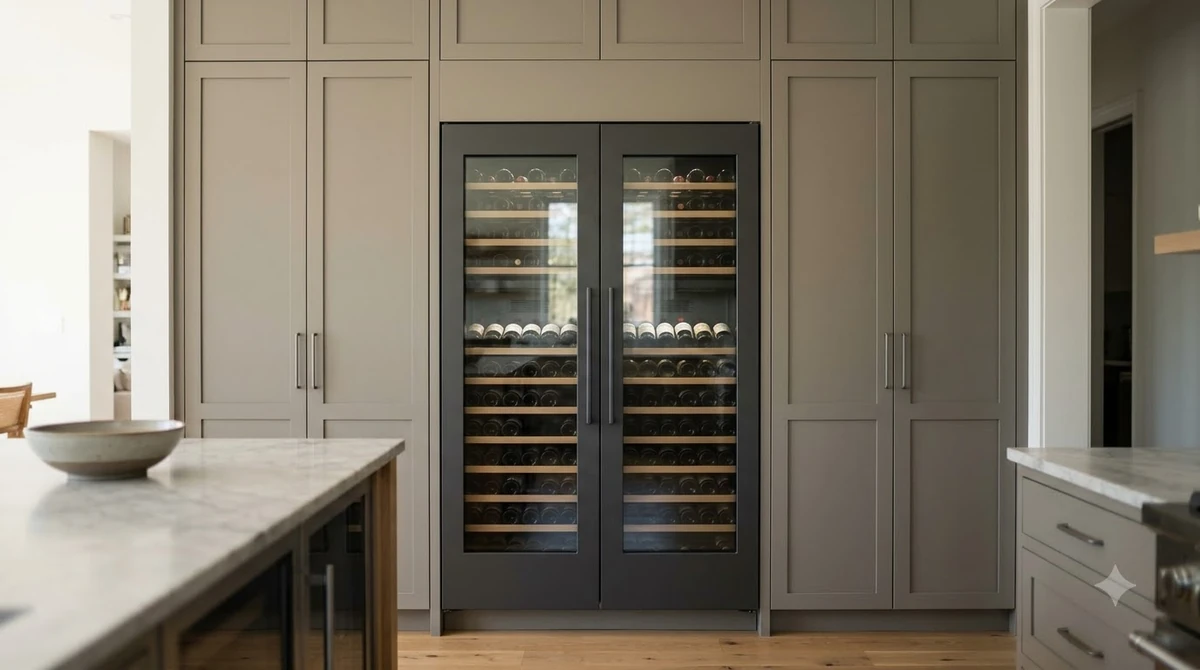
The stainless-steel exterior is one of the model’s most recognizable advantages. A wine cellar installed alongside a stainless-steel refrigerator, dishwasher or other kitchen appliances can create a consistent visual arrangement. The glass door adds another layer of presentation by displaying the bottles inside, while the wood-front shelving creates a warmer contrast against the dark interior.
The automatic LED lighting is particularly useful in kitchens with limited ambient lighting. Rather than relying on a separate lamp or leaving the door open while searching for a bottle, the illuminated interior makes it easier to identify different labels and positions. This is a practical convenience for people who regularly select wines for dinner or entertaining.
Owner feedback also indicates that the dual-zone function is an important reason people choose this model. Best Buy’s customer review summaries identify temperature control and dual-zone operation as positive features. Individual reviews describe the convenience of keeping different wine categories in the same appliance, although personal experiences with noise and cooling performance vary.
Why the wood-front racks matter
The six SatinGlide wood-front racks give the interior a more finished appearance than basic metal shelving. Their sliding construction is intended to make bottle access easier, reducing the need to rearrange several bottles whenever someone wants a particular vintage.
For everyday use, organization matters almost as much as raw capacity. A household might separate sparkling wines from still wines, keep frequently served bottles near the front, or organize the collection by grape variety. The KitchenAid’s six-rack layout provides a framework for this arrangement.
However, a wood-front rack does not automatically guarantee that every bottle shape will fit. The stated 46-bottle figure represents a manufacturer capacity rather than a promise that 46 unusually shaped bottles can be stored simultaneously. This distinction is important for buyers whose collections contain substantial numbers of sparkling wines, Champagne bottles or wider Burgundy formats.
Presentation and entertaining
The glass door and interior lighting make the appliance attractive in an open kitchen, dining area or entertaining space. A bottle can be selected without opening the door simply to inspect the collection, and the stainless-steel finish can coordinate with other KitchenAid appliances.
It can also be useful for households that enjoy preparing wine-based cocktails. A chilled bottle of sparkling wine or Prosecco can be ready for an Aperol Spritz recipe, while other bottles remain in a separate storage zone. The cellar is not a cocktail station, but its two-zone configuration can help keep different wine styles organized for occasions when guests arrive.
The overall impression is one of convenience and visual appeal rather than specialist cellar engineering. Buyers who value a coordinated kitchen and straightforward access to their collection will find more to appreciate than those who prioritize maximum bottle flexibility above everything else.
Common Complaints: Bottle Capacity, Noise and Reliability
The most important concerns surrounding the KUWR204ESB involve the difference between advertised capacity and practical bottle fit, compressor noise and inconsistent individual reports about long-term operation. These concerns deserve attention before purchasing an older unit, particularly if it will be installed in a frequently occupied room.

Best Buy’s review information identifies bottle fit as a recurring complaint, alongside noise and shelf design. Some customers report that larger bottles are difficult to position, while others describe satisfactory everyday operation. The mixed feedback suggests that buyers should evaluate the actual bottle collection rather than relying exclusively on the 46-bottle specification.
The 46-bottle capacity limitation
The advertised capacity is useful as a general indication of storage scale, but bottle dimensions influence the number that can actually be accommodated. Standard Bordeaux-style bottles are relatively narrow and uniform. Burgundy bottles, Champagne bottles and certain sparkling wine formats can have wider bodies that require more clearance between adjacent racks.
One Best Buy reviewer specifically describes difficulty fitting anything other than relatively thin bottles in some rack positions. Another customer reports having to rearrange bottles to accommodate larger formats. These are individual experiences, but they identify a practical issue that should not be ignored.
Consider a household that regularly purchases California Chardonnay, Oregon Pinot Noir and traditional-method sparkling wine. Those bottles may not all have the same diameter or shoulder shape. A cellar that accommodates a large number of standard bottles could hold considerably fewer mixed-format bottles in normal everyday use.
The safest approach is to inspect the rack spacing and test representative bottles before committing to a purchase. This is especially important for secondhand appliances, where a missing rack, damaged glide or substituted shelf can further affect storage flexibility.
Compressor noise and vibration
Noise is another recurring point of disagreement. Some Best Buy customers describe their units as very quiet, while others report noticeable buzzing or compressor noise during cooling cycles. One reviewer describes a particularly intrusive sound when the compressor operates.
These differences matter because a wine cellar is often installed in a kitchen, dining area or living space rather than a garage. A sound that seems minor in a utility room may become distracting when the appliance sits next to a breakfast table or open-plan seating area.
Installation conditions can also influence perceived noise. An uneven floor, poorly secured surrounding cabinetry or contact between the appliance and nearby panels can contribute to vibration. Before concluding that a compressor is defective, an installer should verify that the appliance is level and positioned according to the manufacturer’s instructions.
Nevertheless, persistent buzzing, rattling or unusually loud cycling should not be dismissed as normal. A prospective buyer should listen to an operating unit and ask about any previous service visits or unresolved noise complaints.
Cooling consistency and component concerns
Some customer accounts raise questions about temperature consistency and compressor longevity. One Best Buy reviewer reports compressor failure after approximately two years and describes difficulty reaching the expected temperatures before the failure. This is a single reported experience, not evidence that every KUWR204ESB will experience the same problem.
Other customers report satisfactory cooling and positive everyday use. This difference reinforces the importance of evaluating the condition of an individual appliance rather than assuming that every used unit has the same service history.
For a secondhand purchase, ask the seller whether the compressor, temperature sensors, electronic controls or door components have been replaced. Request any available repair documentation, and verify that the two zones can maintain stable temperatures over an extended operating period.
There is also a distinction between a feature being present and that feature functioning correctly. Automatic lighting, alarms and touch controls are attractive specifications, but they should all be tested individually when inspecting an older appliance.
Who Should Buy This Wine Cellar and Who Should Skip It?
The KitchenAid KUWR204ESB makes the most sense for homeowners who want an attractive 24-inch undercounter wine cellar with two temperature zones and a manufacturer-rated capacity of 46 bottles. It is less suitable for buyers who need flexible storage for unusually large bottles or who are particularly sensitive to appliance noise.
Its strongest appeal is the combination of kitchen integration and convenient wine organization. A homeowner renovating a kitchen may appreciate the stainless-steel exterior, glass display door and wood-front racks. The ability to keep reds and whites in different temperature environments also offers more flexibility than a basic single-zone cooler.
For a household with a collection dominated by standard Bordeaux-style bottles, the advertised capacity may be a reasonable starting point. The model is also attractive to occasional entertainers who want several wine styles available without dedicating an entire room to storage.
Good candidates for the KitchenAid
- Kitchen renovators: Homeowners with an existing 24-inch undercounter opening may appreciate the appliance’s integrated appearance.
- Mixed-wine households: People who regularly keep red and white wines can benefit from the two temperature-controlled zones.
- Entertainers: The automatic lighting and glass door make bottle selection convenient during dinner parties and gatherings.
- Standard-bottle collectors: Collections dominated by conventional bottle shapes are more likely to make practical use of the stated capacity.
- KitchenAid design enthusiasts: People coordinating stainless-steel kitchen appliances may appreciate the matching visual style.
Buyers who should consider another appliance
- Collectors with many large bottles: Frequent purchases of Champagne, sparkling wine or wide Burgundy bottles can make rack compatibility a significant limitation.
- Noise-sensitive households: Mixed owner feedback about compressor noise makes this a less predictable choice for quiet open-plan rooms.
- Large wine collections: A stated 46-bottle capacity may be inadequate for serious collectors who need substantially more storage.
- Buyers seeking a new current-production model: The KUWR204ESB appears in older product listings, and Best Buy identifies its listing as no longer available in new condition.
- People seeking long-term warranty certainty: Buyers considering an older or secondhand appliance should establish what coverage, if any, remains available before purchasing.
The intended installation location should influence the decision as much as the wine collection. A kitchen island surrounded by cabinetry may conceal some operating sound, but it will not eliminate compressor noise. A separate dining area may make sound levels more noticeable, particularly during quiet evenings.
Wine storage needs also change over time. Someone who currently owns 20 bottles may eventually accumulate 40 or more, especially when buying wine for special occasions. It is sensible to estimate future collection size rather than selecting an appliance based only on the number of bottles currently in the house.
For households that entertain frequently, wine selection can be tied to the food being served. A chilled white wine may accompany lighter seafood dishes, while a suitable red can complement a richer meal such as one prepared with a chicken Marsala recipe. A two-zone cellar makes it easier to keep both categories organized and available.
How It Compares to Alternative Wine Storage Options
The KitchenAid KUWR204ESB occupies a middle ground between basic single-zone wine coolers and larger dedicated wine cabinets. Its main selling points are the undercounter format, dual-zone organization and finished kitchen appearance, rather than an unusually large storage capacity.
A conventional freestanding wine cooler may offer similar storage functions without requiring an integrated kitchen opening. However, its exterior design and ventilation arrangements may make it less suitable for a flush cabinetry installation. Buyers comparing these categories should evaluate the installation instructions rather than assuming that every freestanding cooler can safely operate beneath a counter.
A larger wine cabinet, on the other hand, can be more appropriate for collectors with substantial inventories. Some larger cabinets provide additional shelving, greater storage capacity and more room for bottles with different shapes. They may also require considerably more floor space.
| Storage option | Main advantage | Main limitation | Best suited to |
|---|---|---|---|
| KitchenAid KUWR204ESB | Dual zones and integrated 24-inch design | Potential bottle-fit and noise concerns | Kitchen-based collections |
| Single-zone wine cooler | Simpler temperature arrangement | One shared cooling environment | Collections with similar serving requirements |
| Freestanding wine refrigerator | Flexible placement | May not suit built-in installation | Rentals, utility rooms and flexible spaces |
| Large wine cabinet | More room for growing collections | Greater space requirements | Enthusiasts with larger inventories |
| Traditional wine cellar | Potentially larger long-term storage environment | Requires dedicated space and planning | Serious collectors |
The KitchenAid’s strongest comparison is against other premium undercounter wine refrigerators. A similarly sized appliance with adjustable shelves or more accommodating bottle spacing might be a better choice for someone whose collection includes many large-format bottles. Conversely, a less expensive freestanding unit may be entirely adequate for someone who prioritizes basic cooling over kitchen aesthetics.
There is also an important distinction between storing wine and serving wine. A wine refrigerator provides a controlled environment for bottles, but it does not automatically guarantee that every wine is at its ideal serving temperature. For example, sparkling wines generally benefit from serving temperatures around 40 to 50 degrees Fahrenheit, while full-bodied red wines are commonly served around 60 to 65 degrees Fahrenheit.
The dual-zone arrangement helps accommodate different preferences, but buyers should understand the actual operating range and temperature settings of the specific appliance before deciding how to divide the collection.
Another alternative is to separate storage and entertaining needs. A dedicated cellar can hold the main collection while a smaller beverage refrigerator keeps mixers, sparkling water and other drinks ready for guests. This arrangement may be more practical for households that regularly prepare cocktails such as a Hugo Spritz recipe and need space for ingredients beyond wine bottles.
For a broader look at other appliance categories and product evaluations, the Brand x Type appliance reviews section can help establish which features deserve priority before choosing a replacement.
Installation, Maintenance and Ownership Considerations
Correct installation is essential for the KitchenAid wine cellar because the appliance depends on appropriate clearances, electrical supply and unobstructed ventilation. Its compact undercounter dimensions may make it appear easy to install, but the surrounding cabinet opening must still meet the manufacturer’s requirements.
The published product dimensions are 34-1/4 inches high, 23-3/4 inches wide and 26-3/4 inches deep. These measurements describe the appliance itself, not every clearance required for installation. The separate dimension guide specifies a minimum 24-inch opening width, a minimum opening height of 34-3/8 inches and a maximum opening height of 35 inches.
The depth requirement is particularly important. The installation guide specifies a minimum opening depth of 24 inches, while the product itself extends 26-3/4 inches deep. Cabinet construction, electrical positioning and the intended finished alignment therefore need to be assessed together rather than relying on one measurement alone.
Electrical and ventilation requirements
KitchenAid specifies a 115-volt electrical supply with a 15- or 20-amp requirement. Its installation guidance recommends a separate circuit for the wine cellar and advises against using an extension cord. A qualified installer should verify that the electrical arrangement is suitable before the appliance is connected.
Ventilation is equally important. The manufacturer warns against blocking the bottom grille, which is part of the appliance’s ventilation arrangement. Installing decorative trim or positioning other objects in front of this area can interfere with airflow and should be avoided.
The installation guide also advises against placing the cellar near ovens, radiators or other heat-producing appliances. It recommends avoiding locations where the ambient temperature falls below 55 degrees Fahrenheit. These instructions are particularly relevant for kitchens with limited cabinetry space, where an undercounter appliance might otherwise be positioned beside a heat-producing oven.
Tip: Before purchasing an existing or replacement KUWR204ESB, measure the cabinet opening at several points, confirm the electrical supply, inspect the bottom ventilation grille and account for the full 47-3/4-inch door-open depth. A cabinet that looks wide enough may still create problems if the door cannot open properly.
Cleaning and routine inspection
Routine maintenance begins with keeping the exterior, door glass and accessible interior surfaces clean. Dust around the bottom grille should be addressed without pushing debris into the ventilation area. Cleaning procedures should follow the manufacturer’s instructions, with the appliance disconnected from power whenever the guide requires it.
The glass door deserves regular attention because fingerprints, spills and dust can affect its appearance. A suitable nonabrasive cleaning method helps maintain the presentation of the appliance without damaging its finish. The stainless-steel exterior should also be cleaned using products appropriate for that surface.
Inside the cellar, bottles should be arranged without forcing them into narrow spaces. Sliding racks should move freely, and their wood fronts should remain securely attached. If a rack becomes difficult to operate, inspect it for misplaced bottles or obstructions rather than pulling it forcefully.
Temperature monitoring
The two cooling zones should be checked periodically to confirm that they are operating as intended. A separate thermometer can help verify actual cabinet temperatures, especially if the appliance has been purchased used or has previously undergone repairs.
For reference, light-bodied white wines and rosé are generally served around 45 to 50 degrees Fahrenheit, while fuller-bodied whites are often served around 50 to 55 degrees Fahrenheit. Light reds commonly benefit from serving temperatures around 55 to 60 degrees Fahrenheit. These serving recommendations are useful starting points, but long-term storage temperature and serving temperature are not identical requirements.
Wine intended for longer storage should generally be kept in a stable environment near 55 degrees Fahrenheit, away from direct sunlight and unnecessary temperature fluctuations. The appliance’s dual-zone design can make everyday organization easier, but consistent operation remains more important than frequently changing settings.
Finally, pay attention to changes in sound. A compressor cycling on and off is part of normal refrigeration operation, but new rattling, unusually loud buzzing or inconsistent cooling deserves investigation. Addressing installation-related vibration early may prevent unnecessary wear and make the appliance more comfortable to use.
Frequently Asked Questions
Is the KitchenAid KUWR204ESB still available new?
Availability depends on the retailer and remaining inventory. Best Buy identifies its KUWR204ESB listing as unavailable in new condition, so buyers may encounter discontinued stock, open-box units or secondhand examples. Check the exact model number rather than assuming that another KitchenAid wine cellar is an identical replacement.
Can the KitchenAid wine cellar store beer and other beverages?
Some owners report using spare interior space for beer, although the appliance is designed and configured primarily as a wine cellar. Bottle dimensions and shelf clearance determine whether other containers fit safely. For mixed beverage storage, inspect the actual container sizes before relying on the stated wine-bottle capacity.
Does the KitchenAid wine cellar have a reversible door?
Door swing and hinge configuration should be confirmed using the installation documentation for the exact model and production configuration. Do not assume that a replacement hinge or a modification used on another KitchenAid refrigerator will work with this cellar. Cabinet clearance and neighboring appliances should also be considered when planning the door orientation.
Can a KitchenAid wine cellar be transported lying down?
Refrigeration appliances should be transported according to their manufacturer’s handling instructions, rather than assuming that a wine cellar can safely travel in any position. Compressor oil movement and the refrigeration system can be affected by improper handling. Ask the manufacturer or a qualified appliance technician for the correct upright-position and settling instructions before reconnecting a transported unit.
What should buyers inspect when purchasing a used KitchenAid wine refrigerator?
Check the model and serial identification label, original purchase documentation and any available service records. Also inspect the door gasket, hinge alignment, electrical cord, rack hardware and control-panel response. Confirm that the seller can demonstrate normal operation and that no error indicators remain after the appliance has completed its initial cooling cycle.
The KitchenAid KUWR204ESB remains an attractive option for homeowners who value dual-zone wine storage, a polished undercounter appearance and convenient kitchen integration. Its 46-bottle specification and wood-front racks are appealing, but bottle compatibility, operating noise and the condition of an older appliance deserve careful attention. For buyers considering this wine cellar, the best decision comes from checking the installation measurements, testing the actual cooling performance and confirming that the racks suit the bottles in the collection.
More in Model Reviews
 Lanbo Dual Zone Wine Fridge Review: Features, Capacity, and DrawbacksUpdated Nov 20, 2026
 Lanbo Beverage Cooler Review: Features, Capacity and ReliabilityUpdated Nov 20, 2026
 Haier Wine And Beverage Center Review: Capacity, Cooling, and FitUpdated Nov 20, 2026
 Haier Countertop Wine Cooler Review: Features and Buying AdviceUpdated Nov 20, 2026
 KitchenAid 24 Inch Wine Fridge: Features, Capacity, and Buying AdviceUpdated Nov 20, 2026
 Vintec 150 Bottle Wine Fridge: Know the Real Capacity Before You BuyUpdated Nov 20, 2026