

We may earn a commission when you buy through links on this page, at no extra cost to you. Learn more.
The taurasi wine region is an appellation in Campania, southern Italy, famous for structured, age-worthy red wines made primarily from Aglianico. Located in the inland province of Avellino, it covers 17 municipalities in the historic Irpinia area. Its combination of high-altitude vineyards, varied clay and volcanic soils, and a demanding aging requirement gives Taurasi a distinctive identity among Italian reds.
Taurasi is often called the Barolo of the South because its firm tannins, lively acidity, and ability to develop over many years recall the structure of some celebrated northern Italian wines. The comparison is useful, but the grape behind Taurasi is different: Aglianico rather than Nebbiolo. Understanding the variety, the landscape, and the rules behind the DOCG designation makes it easier to choose a bottle and appreciate the character of this Campanian wine.
Where Taurasi Sits in Campania
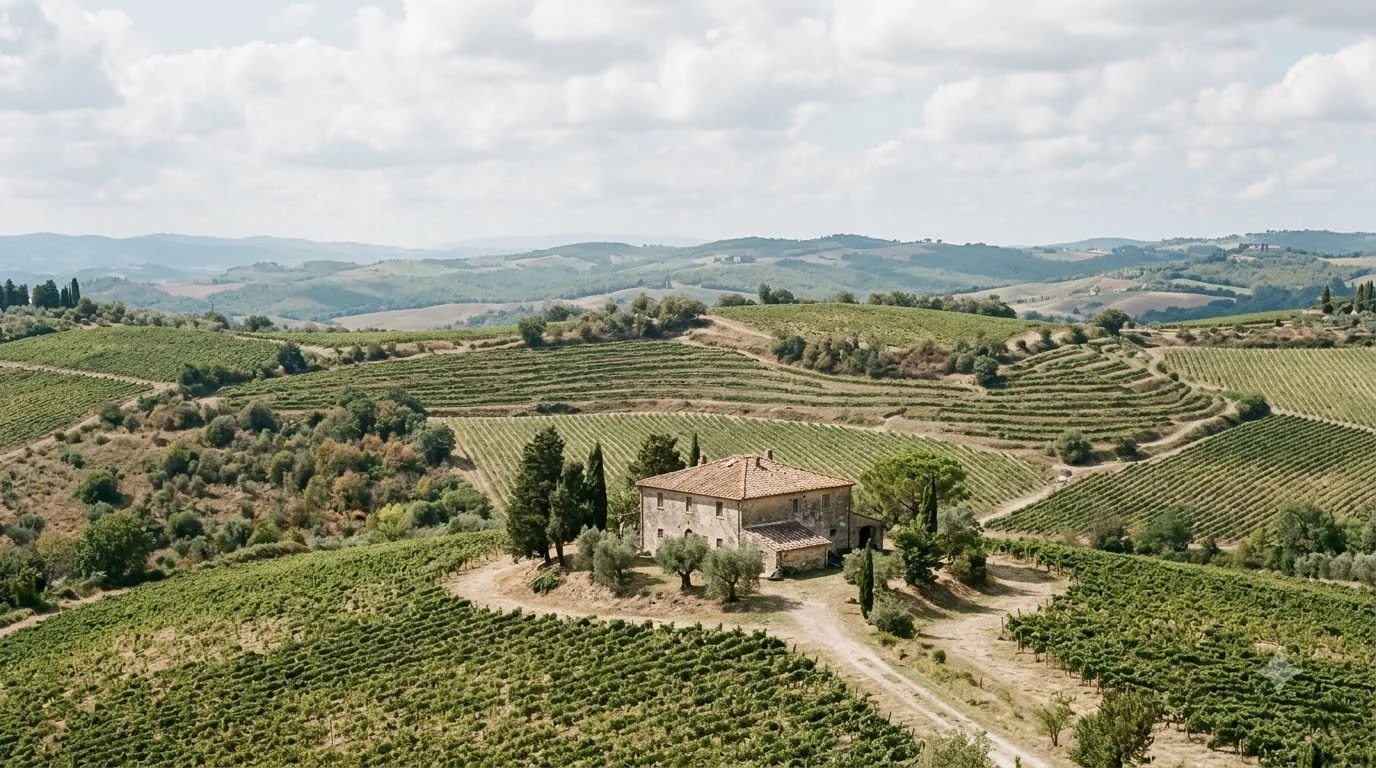
Taurasi belongs to inland Campania, east of Naples, in the province of Avellino. Its 17-municipality appellation follows the hills and valleys of Irpinia, where the Calore River and the surrounding Southern Apennine landscape help shape the vineyard environment.

The production area includes Taurasi, Bonito, Castelfranci, Castelvetere sul Calore, Fontanarosa, Lapio, Luogosano, Mirabella Eclano, Montefalcione, Montemarano, Montemiletto, Paternopoli, Pietradefusi, Sant’Angelo all’Esca, San Mango sul Calore, Torre le Nocelle, and Venticano. The town of Taurasi gives the appellation its name, but the wine is not restricted to vineyards immediately surrounding that town. Each municipality contributes its own combination of elevation, exposure, and soil conditions.
The Calore River is an important geographical reference. It separates the denomination into eastern and western sections, while hillsides rise and fall on both sides of the valley. Decanter describes vineyards at roughly 300–700 meters above sea level and notes that slopes face all four compass directions. These variations matter because Aglianico ripens late and responds noticeably to differences in sunlight, temperature, and growing-season length.
Taurasi is part of a wider wine culture in which local grape varieties are central to regional identity. Campania also produces the white DOCG wines Greco di Tufo and Fiano di Avellino, both associated with the province of Avellino. Taurasi stands apart as the area’s defining structured red. For readers exploring Italian and international appellations more broadly, the site’s Wine Regions overview provides a useful starting point for understanding how geography and local regulations shape wine styles.
The denomination’s modern recognition followed two important milestones: DOC status in 1970 and DOCG status in 1993. That DOCG recognition was a landmark for southern Italian wine. Taurasi had already built a reputation for substantial red wines, but the stricter designation gave its regional identity a defined legal framework.
Irpinia is also distinct from the coastal image many visitors associate with Campania. Its inland position brings cooler conditions, cold winters, and noticeable temperature differences between day and night. That setting helps explain why a southern Italian wine can have both ripe dark-fruit flavors and the freshness required for long aging.
Aglianico: The Grape Behind Taurasi
Aglianico is the principal grape of Taurasi and must account for at least 85% of the finished wine. It is a late-ripening variety with naturally firm tannins and high acidity, giving Taurasi the structure to develop beyond its early fruit-driven stage.
Aglianico’s growing cycle is central to its character. The grape takes a long time to reach full maturity, so vineyard location and autumn weather can have a strong influence on the finished wine. Growers must allow the fruit enough time to ripen while preserving the acidity that gives the wine definition. Aglianico harvested too early can produce hard, austere tannins, while fruit picked at suitable maturity can combine concentration with freshness.
The grape’s tannin level is one reason young Taurasi can feel firm and tightly wound. Tannins create a drying sensation along the gums and inside the cheeks, especially when the wine is young. Acidity provides another structural element, balancing ripe fruit and helping the wine remain lively rather than heavy. The combination can make Taurasi seem more demanding in its youth than softer reds made from Merlot or Grenache.
Although the rules permit up to 15% of other authorized red grapes, many producers choose to make Taurasi entirely from Aglianico. The permitted varieties identified by Decanter include Piedirosso, Sciascinoso, and Greco Nero. The option to blend exists within the appellation rules, but Aglianico remains the clear center of the wine’s identity.
Its aromas commonly begin with dark fruit, particularly black cherry, plum, and other ripe berry notes. Violet, licorice, and dark spice can add detail. With bottle age, the fruit may become less direct, making room for savory characteristics such as leather, tobacco, truffle, dried herbs, and balsamic notes. The precise combination depends on the site, vintage, producer, and time spent in bottle.
Aglianico’s reputation for longevity does not mean every bottle must be kept for decades. A younger Taurasi can be enjoyable when its fruit is expressive and the tannins have begun to soften. More concentrated wines, especially Riserva bottlings from suitable vintages, can reward longer cellaring. The important distinction is between a wine that is structured enough to age and one that has already reached the stage at which its elements feel harmonious.
The grape’s southern Italian setting also makes it interesting to compare with varieties from other mountainous European regions. The Savoie wine region, for example, has its own distinct relationship between altitude, local grapes, and individual vineyard sites, though its climate and wine styles differ substantially from Irpinia.
Irpinia’s Altitude, Soils, and Climate
Taurasi’s landscape is not a single uniform vineyard. Elevations commonly fall around 300–650 meters, and the mix of clay, limestone, sandstone, and volcanic material creates meaningful differences from one site to another.
Clay and limestone are important components of the area’s soils, while volcanic material adds another layer of complexity. Wine Enthusiast describes deposits that include tuff, pumice, lapilli, and ash associated with ancient eruptions of Mount Vesuvius. The Avellino eruption, which occurred thousands of years ago, is particularly relevant to the region’s geological history. These materials are distributed unevenly, so the proportion of volcanic material can change substantially between vineyards and municipalities.
The soils around the town of Taurasi are especially associated with volcanic ash. Wine Enthusiast reports that some loose ash-rich soils helped protect old vines from phylloxera, the root-feeding pest that devastated European vineyards. Some surviving Aglianico vines in the area remain on their original rootstocks. Such old-vine sites are a notable part of the denomination’s history, although they are not representative of every Taurasi vineyard.
Altitude is another major influence. Higher vineyards generally experience cooler conditions and slower ripening, while lower sites can produce fruit that ripens earlier and often emphasizes a more immediately approachable fruit character. Wine Enthusiast identifies Castelfranci and Montemarano, along with sites in Paternopoli, among the denomination’s higher areas. Their proximity to the Picentini mountains contributes to marked day-to-night temperature changes.
Those temperature changes are important for a late-ripening variety. Warm daytime conditions allow grapes to develop flavor, while cooler nights can help preserve freshness as the fruit approaches harvest. Wine Enthusiast reports that the growing season in Castelfranci and Montemarano can extend by approximately 20 days compared with lower parts of the appellation. That longer period can support additional aromatic development while retaining the acidity that gives Taurasi its firm structure.
Exposure adds further variation. A south-facing hillside receives a different pattern of sunlight from a north-facing slope, and differences in wind and drainage can influence vineyard conditions. Even within one municipality, two producers working at different heights or on different soil types may make wines with distinct expressions of Aglianico. This is why the appellation should be understood as a group of related sites rather than a single flavor profile.
For a drinker, these differences can be useful when comparing bottles. A wine from a cooler, higher site may emphasize aromatic detail, freshness, and firm structure. A wine from a warmer or lower site may show more immediate dark fruit and a softer impression in its youth. Neither profile automatically signals higher quality; both can be persuasive expressions of a suitable vineyard and a thoughtful harvest.
DOCG Rules and the Difference Between Taurasi and Riserva
Taurasi DOCG has specific requirements for grape composition and maturation. Standard Taurasi must age for at least 36 months, while Taurasi Riserva requires at least 48 months, with a longer minimum period in wood for the Riserva category.
| Requirement | Taurasi DOCG | Taurasi Riserva |
|---|---|---|
| Minimum Aglianico | 85% | 85% |
| Maximum other authorized grapes | 15% | 15% |
| Minimum total aging | 36 months | 48 months |
| Minimum time in wooden barrels | 12 months | 18 months |
These requirements are minimums, not recommended drinking ages. A producer can keep a wine in wood, stainless steel, or bottle for additional time according to the applicable production rules and the desired style. The legal distinction is the minimum maturation period and the amount of time that must be spent in wooden barrels. The Riserva category therefore signals a longer required maturation, but it does not guarantee that every Riserva will taste the same or age better than every standard bottling.
The grape requirement is equally important. At least 85% of the wine must come from Aglianico, with a maximum of 15% available for other permitted red grapes. Some producers use the full flexibility of the rules, while others use 100% Aglianico. This means that the label Taurasi identifies a protected origin and production standard, not one mandatory recipe beyond the legal minimum.
The European Commission’s published specification records the same minimum maturation requirements and sets a maximum grape yield of 10,000 kilograms per hectare for both Taurasi and Taurasi Riserva. These limits help define the denomination’s production framework. The full legal document is available through the European Commission’s Taurasi specification.
Taurasi’s DOCG rules also sit within a wider family of regional appellations. Irpinia Aglianico DOC and Irpinia Campi Taurasini DOC can offer Aglianico-based wines with different maturation requirements. Decanter notes that Campi Taurasini requires at least 85% Aglianico and a minimum of 10 months of aging, while Irpinia Aglianico DOC has no comparable minimum aging requirement. These categories can be useful alternatives for drinkers who enjoy the grape but want a less demanding style.
When reading a wine list or shop shelf, it helps to distinguish the appellation name from the grape name. Aglianico appears across several southern Italian denominations, but Taurasi DOCG indicates fruit from the defined Avellino production area and compliance with its stricter rules. The word Riserva adds a higher minimum maturation requirement. Those details are more reliable starting points than assuming that every wine labeled Aglianico has the same structure or intended drinking window.
Flavor, Winemaking, and Taurasi’s Aging Potential
Taurasi is usually dry, full-bodied, and firmly structured, with dark fruit and savory notes supported by high acidity and substantial tannin. Its flavor profile can shift significantly between its early years and a more mature stage in bottle.
In younger wines, black cherry, plum, violet, licorice, and dark spice are common reference points. The fruit can feel concentrated, but the structure may still be prominent, particularly in wines made from higher-altitude sites or from particularly firm vintages. With time, fruit aromas can move toward dried cherry and plum, while leather, tobacco, truffle, earth, and balsamic notes become more noticeable. These are broad tendencies rather than a fixed checklist for every bottle.
Winemaking choices also influence the style. Oak barrels can contribute spice and texture, while the size and age of the vessel affect how noticeable those influences become. Some producers use smaller barrels for part of the maturation; others prefer larger casks that allow the wine’s fruit and savory character to remain more prominent. A combination of vessel types may be used to balance the different lots before bottling.
Decanter describes an evolution in local viticulture from older, tall vine-training systems toward cordon training, denser planting, and more careful control of yields. The traditional Raggiera system could produce vines reaching around 3.5 meters high. The move toward vines trained closer to the ground, improved plant material, and more selective grape harvesting helped producers seek more consistent ripening. Modern cellar practices have also placed greater emphasis on careful extraction of tannins rather than relying on sheer concentration.
Producer history is part of the region’s development. Mastroberardino, founded in 1878, has played an important role in preserving and promoting Campania’s traditional grapes. Producers such as Mastroberardino helped demonstrate that Aglianico could make wines with the structure, identity, and aging capacity associated with Italy’s established fine-wine regions. More recent vineyard work has given the denomination a broader range of expressions, from powerful and traditional wines to more aromatic, polished bottlings.
Age-worthiness should be considered in relation to the individual wine. Some Taurasi can develop over many years, and the Consorzio identifies 20–30 years as a possible aging range for the best vintages. That figure is a potential, not a guarantee for every bottle. Storage conditions, vintage quality, producer decisions, and the wine’s concentration all matter. A bottle kept near 55°F in a dark, stable environment is more likely to mature evenly than one exposed to repeated temperature swings.
Tip: Give a young, structured Taurasi 30–60 minutes in a decanter before serving when its tannins feel tight. Older bottles may need less time, so begin by pouring a small glass and observing how the wine develops.
Decanting is not a requirement for every vintage. A younger wine can benefit from some air, but an older bottle may be more delicate and lose its most expressive aromas if left exposed for too long. Opening the bottle ahead of a meal and tasting a small amount is a practical way to decide whether further aeration will help.
Serving Taurasi and Choosing Food Pairings
Taurasi is best served slightly cooler than a typical room temperature, around 60–65°F. Its firm tannins and high acidity make it particularly suited to richly flavored dishes, including roasted red meat, braised game, lamb, and aged hard cheeses.
Serving temperature has a practical effect on the wine’s balance. At approximately 60–65°F, the fruit and savory aromas can show clearly without making the alcohol feel overly prominent. A warm room can push the glass above that range, so a short period in a cool place before serving may help. Avoid serving a full-bodied red directly from a warm kitchen or dining room if it has been sitting near a heat source.
Use a large red-wine glass with enough room to allow the aromas to gather. A pour of about 5 ounces gives the wine space to develop and leaves room for gentle swirling. The shape of the glass is less important than having a bowl large enough to let the wine breathe. For a bottle shared across a meal, pour moderate amounts first and return to the glass as the food changes.
Roasted beef is a natural match because its savory richness meets the wine’s body and tannins. Braised short ribs, slow-cooked beef, and grilled steak can all work well, especially when the dish includes herbs, browned vegetables, or a concentrated cooking sauce. Lamb is another strong choice, whether roasted with rosemary or served as a slow-cooked preparation. These foods have enough flavor to stand alongside Taurasi without overwhelming its dark-fruit and spice character.
Game dishes are traditional partners. Braised venison, pheasant, and other strongly flavored game can complement the wine’s savory side, particularly as it develops leather, dried herbs, and earthy aromas with bottle age. A slow-cooked meat sauce served with pasta is another good option. The wine’s acidity helps cut through the richness of the sauce, while its structure holds up to the concentrated flavors.
Aged cheeses also deserve attention. Firm sheep’s-milk cheeses such as aged Pecorino can match Taurasi’s intensity, while other mature hard cheeses provide enough savory depth to balance the tannins. Salt and fat soften the perception of tannin, which can make a young wine seem more approachable alongside a cheese course. Serve the cheese at a suitable temperature so that its aroma and texture are not muted by refrigeration.
Not every dish is a good match. Very hot chili preparations can make the alcohol and tannins feel more aggressive, while delicate oily fish can clash with a strongly tannic red. If seafood is on the menu, a white wine may be the more natural choice. Taurasi is most convincing when the food has enough body, seasoning, and savory richness to meet it on equal terms.
For a full meal, consider a sequence that gives the wine room to show its strengths: begin with a modest serving alongside aged cheese, move to a slow-braised beef or lamb main course, and finish with a savory cheese plate. Very sweet desserts are usually a poor match for a dry red, since the sweetness can make the wine seem harsher. Keeping the meal focused on savory flavors will make the pairing more satisfying.
Frequently Asked Questions
Beyond its grape variety and aging categories, Taurasi has several less familiar details in its production specification and history. The following answers cover label terms, regulatory limits, and the region’s historic wine trade.
What is the minimum alcohol level for Taurasi?
The European Commission’s specification sets a minimum total alcohol level of 12% for standard Taurasi and 12.5% for Taurasi Riserva. These are legal minimums rather than descriptions of the alcohol level in every bottle. Individual wines may have higher alcohol levels depending on grape ripeness and the producer’s approach.
What does Vigna mean on a Taurasi label?
Vigna is an Italian term used to identify a vineyard. The Taurasi specification allows this type of topographical indication when the wine is made exclusively from grapes originating in the particular vineyard identified. It can help distinguish a vineyard-designated bottling from a wine blended from several sites.
Is there a maximum grape yield for Taurasi?
Yes. The European Commission’s product specification sets the maximum yield at 10,000 kilograms of grapes per hectare for both Taurasi and Taurasi Riserva. This is a vineyard-production limit, not a measurement of the amount of bottled wine that a producer must make. Actual yields can be lower, depending on vineyard conditions and producer decisions.
Are there restrictions on Taurasi bottle formats?
The published specification requires Taurasi and Taurasi Riserva to be presented in dark-glass bottles or other glass containers with a capacity of no more than 5 liters. It also describes Bordeaux- or Burgundy-style bottle shapes and a flanged stopper. The dark glass requirement is part of the denomination’s presentation rules rather than an indication of the wine’s exact aging potential.
Why was the railway near Taurasi called the Wine Railway?
The historic railway passing through Taurasi became known as the Ferrovia del vino, meaning Wine Railway. In the nineteenth century, wine production in the wider Irpinia area was estimated at more than one million hectoliters, and local wine helped supply markets in northern Italy and elsewhere in Europe. The railway became an important part of the area’s commercial wine history.
Taurasi rewards attention to grape, place, and time. Aglianico gives it firm tannins and fresh acidity, while Irpinia’s varied elevations and soils explain the differences between individual wines. Whether choosing a younger DOCG or a more mature Riserva, look for a bottle that suits the meal and the drinking occasion, and give its structure the time and serving conditions it deserves.
More in Wine Regions
 Willcox Wine Trail: Discover Arizona’s High-Elevation Wine CountryUpdated Nov 20, 2026
 Yakima Valley Wine Region: Find the Best Styles to TryUpdated Nov 20, 2026
 Vosne Romanee Wine Tasting: Identify Aromas and Choose Better PairingsUpdated Nov 20, 2026
 Yakima Valley Wine Festival: Find the Best Seasonal Wine EventsUpdated Nov 20, 2026
 Wales Vineyards: Discover Cool-Climate Wines and Where to VisitUpdated Nov 20, 2026
 Yountville Wine Festival: Discover Napa Wines and Local FoodUpdated Nov 20, 2026