

We may earn a commission when you buy through links on this page, at no extra cost to you. Learn more.
The Le Creuset Decanter WA 148 is a distinctive 1.5-liter glass wine decanter with an integrated funnel designed to aerate wine as it pours. Its wide, circular base, elevated glass funnel, and substantial construction make it an appealing centerpiece for serving younger red wines. However, its large footprint, hand-wash-only care, and discontinued retail status mean it suits presentation-focused wine enthusiasts better than buyers seeking a simple everyday carafe.
Le Creuset is widely associated with cookware, but its wine accessories include several different decanter designs. The WA 148 stands out because it combines a traditional glass vessel with a fountain-style pouring system. Rather than simply transferring wine into a container, its funnel directs the liquid against the interior walls, creating additional contact with air during the pour. Understanding that design, its capacity, and its practical limitations helps determine whether this particular decanter deserves a place on your dining table.
Specs and Key Features of the Le Creuset WA 148
The WA 148 is a large-format glass decanting fountain designed to combine wine aeration with distinctive table presentation. Its 1.5-liter capacity provides considerably more room than a standard 750 ml wine bottle, while the elevated funnel creates the defining feature of its pouring system.
According to Le Creuset’s Australian product listing, the WA 148 is made entirely from glass, manufactured in Romania, and covered by a five-year warranty. The manufacturer lists its width, height, and length at 25 cm each, with a weight of 1.27 kg. These measurements make it a substantial piece of serving equipment rather than a compact bottle accessory.
An independent retailer identifies the glass as lead-free crystalline glass and provides additional information about the funnel’s construction. Two openings direct wine against the inside wall of the vessel as it travels downward. This arrangement spreads the liquid over a larger area before it collects in the broad base, increasing its contact with oxygen during transfer.
| Specification | Le Creuset WA 148 |
|---|---|
| Product name | Wine Decanter with Glass Funnel |
| Model reference | 59150010005401 |
| Capacity | 1.5 liters / 1,500 ml |
| Width | 25 cm |
| Height | 25 cm |
| Length | 25 cm |
| Weight | 1.27 kg |
| Material | Glass |
| Manufacturing country | Romania |
| Warranty | 5 years |
| Cleaning | Hand wash |
The capacity deserves particular attention. A standard 750 ml bottle occupies half the stated capacity, leaving considerable room for wine to circulate. Two standard bottles would theoretically fill the vessel to its nominal capacity, although allowing extra room during pouring is more practical than filling it completely. The additional volume also accommodates larger servings and gives the wine room to spread across the base.
The funnel is the feature that separates the WA 148 from an ordinary glass carafe. Its elevated position makes the pouring process more visible, and the directed flow is intended to distribute wine across the interior rather than allowing it to fall straight into the bottom. The wide base then provides space for the wine to collect and remain exposed to air.
One important distinction concerns the product’s market availability. An independent specialist retailer identifies the WA 148 as discontinued, while Le Creuset’s regional product listing provides its specifications. Buyers should therefore distinguish between the model’s published features and its current availability in the United States. A discontinued listing does not establish that every remaining example is unavailable, but it does make replacement parts, current stock, and warranty arrangements worth investigating.
For buyers comparing this piece with ordinary wine glasses, the WA 148 serves a different purpose. It prepares wine for serving rather than replacing the individual glasses used to enjoy it.
What Owners Like About the Design
The WA 148’s main appeal is its combination of visible aeration, generous capacity, and decorative presentation. Its fountain-style arrangement gives guests something interesting to watch during pouring, while the broad glass vessel makes it possible to serve wine from a single central container.
The first attractive feature is the funnel-assisted pouring arrangement. Instead of using a narrow neck and conventional opening, the WA 148 places an additional glass component above the decanter. According to the independent product description, two holes direct the wine against the inside wall. This creates a spreading action that increases the area exposed to air as the wine enters the vessel.
That arrangement has a practical purpose for younger red wines. A youthful Cabernet Sauvignon or Syrah can sometimes seem tightly structured immediately after opening. Pouring it through the WA 148 gives the wine more contact with oxygen before it reaches the glass. It also creates an opportunity to serve a bottle more deliberately during a dinner rather than passing it around the table.
The second attraction is its generous 1.5-liter capacity. A typical 750 ml bottle fills only half the vessel’s nominal volume. That leaves room for circulation and makes the decanter suitable for serving wine to several people without repeatedly returning to the original bottle.
The proportions also make the WA 148 a presentation piece. Its 25 cm dimensions in each listed direction create a broad, balanced appearance, and the transparent glass allows the color of the wine to remain visible. Burgundy-colored Pinot Noir, deep Cabernet Sauvignon, and bright garnet-colored Syrah all create a different visual effect inside a clear decanter.
Its construction is another point of appeal. The independent retailer describes the material as lead-free crystalline glass, while Le Creuset identifies Romania as its manufacturing country. The five-year warranty listed by the manufacturer is also a useful ownership consideration, although buyers of secondhand examples should establish whether the original warranty documentation and applicable terms are available.
There is also an entertaining aspect to the design. Traditional decanters can be beautiful, but many look similar at a glance. The WA 148’s raised funnel creates a recognizable silhouette and gives the serving process more ceremony. For a formal dinner, wine-focused gathering, or carefully arranged dining table, that visual difference can be as important as the functional benefits.
Nevertheless, these advantages describe the product’s design and intended use rather than a verified consensus from individual owner testimonials. A retailer’s product description and a list of technical specifications cannot establish that every purchaser prefers the fountain system or finds it easier to use than a conventional decanter.
Common Complaints and Practical Limitations
The WA 148 has several characteristics that may frustrate buyers who prioritize convenient storage and straightforward cleaning. Its broad shape, multiple glass components, substantial weight, and manual washing requirement all introduce considerations that a simple carafe avoids.
Its footprint is the first limitation. A vessel measuring 25 cm across requires a reasonably spacious serving area. That is manageable on a large dining table but less convenient on a small kitchen counter, crowded drinks trolley, or compact restaurant table. The circular shape also means that storing it inside an ordinary kitchen cabinet may require more shelf space than expected.
The weight is another consideration. At 1.27 kg before adding wine, the WA 148 is not particularly lightweight. A full 1.5-liter vessel contains approximately 1.5 kg of wine, so the combined weight becomes substantial. A person pouring from it needs a stable grip and sufficient clearance around the serving area.
The funnel introduces another cleaning challenge. Unlike a single-piece carafe, the system has additional surfaces and openings where wine residue can remain. Red wine pigments may leave visible traces if the components are left unwashed after use. The narrow passages around the funnel also require more attention than the broad interior of a simple pitcher.
Le Creuset specifies hand washing for the WA 148. That means owners should not assume that either the main vessel or the funnel can safely go into a dishwasher. Hot water, unsuitable detergents, and contact with other kitchen items can create unnecessary risks for delicate glass components.
Availability is arguably the biggest concern for new buyers. The independent retailer’s listing identifies the WA 148 as discontinued. That does not automatically make an existing example undesirable, but it means a buyer may need to rely on remaining stock or the secondhand market. The condition of the glass, completeness of the funnel, and availability of original packaging become especially important.
Another limitation is that aeration is not beneficial for every wine. A delicate older Pinot Noir may lose some of its aromatic detail if exposed to too much oxygen. The WA 148 is therefore not a universal improvement over opening a bottle and pouring it directly into suitable glassware.
Finally, its fountain design should not be mistaken for a guarantee of better wine. Oxygen exposure can help some wines reveal their aromas, but it cannot repair poor-quality wine, reverse excessive oxidation, or make an immature bottle taste like a mature vintage. Buyers should see the aeration system as a serving tool rather than a substitute for selecting suitable wine.
Who Should Buy and Who Should Skip the WA 148
The Le Creuset WA 148 is most appropriate for wine enthusiasts who regularly serve structured red wines and appreciate distinctive glassware. Its large capacity and fountain-style funnel are particularly attractive for formal entertaining, although its size and care requirements make it less appealing as an everyday kitchen accessory.
Who should consider buying it
People who regularly serve younger Cabernet Sauvignon, Syrah, or Bordeaux-style blends are among the strongest potential buyers. These wines can benefit from additional air exposure, particularly when their tannins and aromas seem restrained immediately after opening. The WA 148 provides a visible and repeatable way to transfer wine into a broad vessel.
Hosts who entertain several guests may also appreciate the 1.5-liter capacity. A standard 750 ml bottle occupies approximately half the available volume, leaving space for wine to circulate. When serving a group, a central decanter also reduces the need to place multiple bottles around the table.
Design-conscious buyers have another reason to consider it. The raised glass funnel, wide base, and transparent construction give the WA 148 a more distinctive appearance than an ordinary serving pitcher. It works particularly well as a centerpiece when the rest of the table setting includes coordinated glassware and serving accessories.
Collectors of Le Creuset wine accessories may also find the design interesting because of its specialized fountain arrangement. Its Romanian manufacture, crystalline-glass description from the independent retailer, and listed five-year warranty provide useful details when evaluating an individual example.
Who should skip it
Buyers who primarily drink light, delicate wines may find the WA 148 unnecessarily elaborate. A young Sauvignon Blanc or uncomplicated rosé generally does not need extensive aeration. A smaller carafe or direct pouring into appropriately shaped glasses is often more practical.
People who have limited storage space should also think carefully before purchasing. A vessel measuring 25 cm across requires a dedicated location, and its funnel adds another component to store safely. The WA 148 is not the most convenient choice for someone who prefers equipment that can be quickly packed away after dinner.
Busy households that rely on dishwasher cleaning may prefer a simpler product. Since Le Creuset specifies hand washing, the WA 148 requires more attention after use. Its glass construction also makes careful handling important during washing and storage.
Finally, shoppers who want a currently supported, readily available product should be cautious. The discontinued listing means that availability and warranty eligibility deserve verification before buying. A complete, undamaged secondhand decanter can still be attractive, but missing components or uncertain condition can change the value considerably.
How It Compares to Alternatives
Le Creuset has offered more than one glass decanter design, and the WA 148 is not necessarily the most practical choice for every wine drinker. The smaller Vitesse set emphasizes a more compact format and includes cleaning accessories, while the WA 149 focuses on conventional wine service and pouring presentation.
The most useful comparison is not simply which product looks better. Capacity, construction, cleaning arrangements, and intended use determine which design is likely to fit a particular household.
| Feature | WA 148 Fountain | Vitesse Set | WA 149 Carafe |
|---|---|---|---|
| Capacity | 1.5 liters | 750 ml | Not specified in the cited listing |
| Construction | Glass | Crystalline glass | Hand-blown crystal glass |
| Aeration feature | Glass funnel | Aerating fountain | Conventional carafe |
| Cleaning accessories | Not specified | Stainless steel cleaning balls | Not specified |
| Pouring design | Funnel-assisted | Fountain-assisted | Laser-cut edge |
| Cleaning guidance | Hand wash | Hand wash | Follow product care instructions |
WA 148 versus Le Creuset Vitesse
The Vitesse decanter set is a more compact alternative for people who do not need a large serving vessel. John Lewis lists its capacity at 750 ml, compared with the WA 148’s 1.5 liters. The difference is significant: the Vitesse is sized around one standard wine bottle, while the WA 148 offers room for two bottles at its nominal capacity.
The Vitesse also includes additional cleaning equipment. Its set contains stainless steel cleaning balls, a flexible silicone collection pouch, and a cleaning device intended to help remove wine residue from inside the glass. Those accessories are particularly useful for buyers who want a more complete package rather than a standalone fountain-style decanter.
Its listed dimensions are 25.5 cm high and 6.5 cm in diameter, making its overall profile much narrower than the WA 148’s broad 25 cm footprint. For smaller kitchens and limited storage areas, that difference may be decisive.
WA 148 versus Le Creuset WA 149
The WA 149 is a more traditional wine carafe. Le Creuset describes it as hand-blown crystal glass with a laser-cut edge intended to support drip-free pouring. Unlike the WA 148, its product description emphasizes serving presentation rather than an integrated fountain system.
That makes the WA 149 an interesting option for people who want to transfer wine into an attractive vessel without requiring an elaborate aeration process. Le Creuset also describes it as suitable for juice and infused water, giving it a broader serving role than a specialized wine fountain.
The WA 149 may therefore suit households that use a carafe regularly for several types of drinks. The WA 148 is the more specialized design for people who specifically want a funnel-assisted wine transfer.
For buyers who are still comparing the complete serving setup, the distinction between decanters and individual glasses matters. A decanter prepares wine for pouring, while the shape and capacity of the glass affect how it is presented and enjoyed. Comparing appropriate red wine glasses alongside a decanter can help create a more coherent serving arrangement.
Using and Caring for Your Le Creuset Decanter
Good handling and appropriate aeration make a considerable difference to the usefulness of the WA 148. Its fountain system works best when used with wines that benefit from oxygen exposure, and its glass construction requires careful cleaning and storage.
Start by selecting a wine that is likely to benefit from aeration. Young Cabernet Sauvignon, Syrah, and structured Bordeaux blends are sensible candidates. These varieties can have substantial tannin and concentrated aromas that may become more expressive after exposure to air.
Decanter’s guidance on letting wine breathe explains that full-bodied young reds generally benefit more from oxygen exposure than older, delicate wines. Its discussion also identifies Bordeaux, Super Tuscans, and Napa Cabernet as examples of wines that can respond well to aeration. The article is useful background for understanding why a fountain-style decanter is not equally appropriate for every bottle: Decanter’s advice on when and how to let wine breathe.
Before pouring, place the WA 148 on a level, stable surface. Make sure the funnel is correctly positioned and that there is sufficient clearance around the vessel. Pour steadily rather than rushing the bottle, allowing the wine to follow the intended path through the funnel and along the interior wall.
For young, full-bodied reds, a starting aeration period of approximately 30 to 60 minutes is reasonable. The ideal duration depends on the wine’s age, structure, and condition. A particularly concentrated young Cabernet may benefit from more time, while a lighter red may need very little.
Older wines require a different approach. Their aromas can be delicate, and extended exposure to oxygen may reduce freshness. If an older bottle contains sediment, careful conventional decanting may be more appropriate than an aggressive aeration process. Stand the bottle upright beforehand so sediment can settle, then pour slowly while watching the wine near the neck.
Tip: Treat 30 to 60 minutes as a starting point for young, structured red wines, not a universal instruction. Taste the wine after pouring and adjust the aeration period to its condition. Older or delicate bottles should receive much less oxygen exposure.
Temperature also matters. Serving a full-bodied red around 60 to 65 degrees Fahrenheit helps preserve its balance. Light reds are generally better around 55 to 60 degrees Fahrenheit. A decanter does not replace temperature control, so avoid leaving the vessel beside a hot oven, sunny window, or heating appliance.
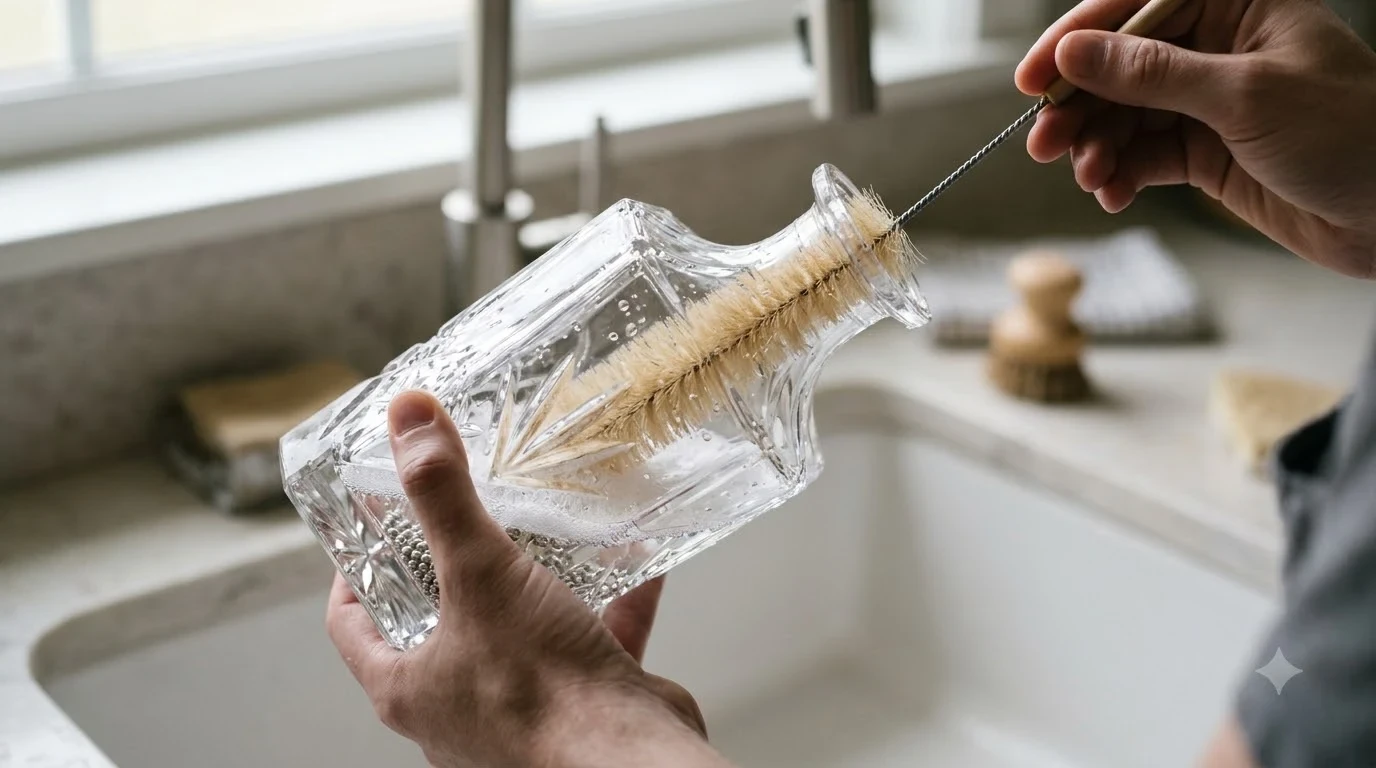
After serving, wash the decanter by hand as instructed by Le Creuset. Use clean, lukewarm water and a suitable gentle cleaning approach. Avoid abrasive pads or hard objects that could scratch or damage the glass. Pay particular attention to the funnel openings and the areas where wine collects along the interior walls.
Allow the components to dry thoroughly before storage. Position the vessel somewhere stable, away from crowded shelves and heavy kitchen equipment. Since the funnel is an additional glass component, storing it separately in a protected position can reduce the possibility of accidental impact.
Owners should also retain the original purchase information and warranty documentation. The manufacturer lists a five-year warranty for the WA 148, but coverage conditions may depend on the purchase date, seller, region, and applicable warranty terms. Those details are particularly important when purchasing an older or secondhand example.
Frequently Asked Questions
Can the Le Creuset WA 148 be used for white wine?
Yes, the glass vessel can physically hold white wine, but extensive aeration is not necessary for most crisp, uncomplicated styles. A complex, full-bodied Chardonnay may benefit from a short period of air exposure, while fresh Sauvignon Blanc generally needs little additional aeration. Chilling the wine before serving remains important.
Can the WA 148 be used to serve nonalcoholic drinks?
Its glass construction makes it suitable for holding other beverages, provided they are compatible with the product’s cleaning requirements. However, the funnel system is specifically designed around wine pouring and aeration. For juice or infused water, a conventional serving carafe may be simpler to use and clean.
Does the WA 148 remove sediment from older wine?
The fountain system is primarily designed for aeration, not sediment separation. Older red wines containing deposits are better handled through careful pouring with a clear light source behind the bottle. This allows the sediment to remain in the original bottle instead of entering the serving vessel.
How many standard wine servings can a 1.5-liter decanter hold?
At a conventional 5-ounce serving size, 1.5 liters contains approximately 10 servings. A standard 750 ml bottle provides approximately five such servings. Actual serving quantities depend on how much wine is poured into each glass and whether the decanter is filled to its full nominal capacity.
Can the WA 148 be used for sparkling wine?
It is not an ideal choice for preserving sparkling wine’s carbonation. The fountain arrangement increases exposure to air, which is contrary to the goal of retaining bubbles. Champagne and sparkling wine are generally better served directly from a properly chilled bottle into suitable flutes or sparkling wine glasses.
The Le Creuset WA 148 remains an interesting choice for wine enthusiasts who value distinctive presentation and fountain-assisted aeration. Its 1.5-liter capacity, glass construction, and wide base make it particularly suited to serving younger, structured red wines at gatherings. However, its large footprint, hand-washing requirement, and discontinued retail status deserve careful consideration. Buyers who want a decorative centerpiece and are comfortable with its maintenance requirements may find it appealing, while those prioritizing everyday convenience may prefer the smaller Vitesse or a conventional carafe. For a complete serving setup, pairing a decanter with suitable champagne flutes or other dedicated glassware is another practical consideration.
More in Wine Glasses
 Spiegelau Crystal Wine Glasses That Bring Clarity to Every PourUpdated Nov 21, 2026
 Zalto Crystal Wine Glasses: Are They Worth the Investment?Updated Nov 21, 2026
 Villeroy And Boch White Wine Glasses for a More Cohesive TableUpdated Nov 21, 2026
 Zalto Wine Glasses On Sale: Find the Right Denk’Art GlassUpdated Nov 21, 2026
 Zwiesel Glas Champagne Glasses: Features, Quality and Buying AdviceUpdated Nov 21, 2026
 Zwiesel Glas Decanter Review: A Durable, Elegant Choice for Wine ServiceUpdated Nov 21, 2026