

We may earn a commission when you buy through links on this page, at no extra cost to you. Learn more.
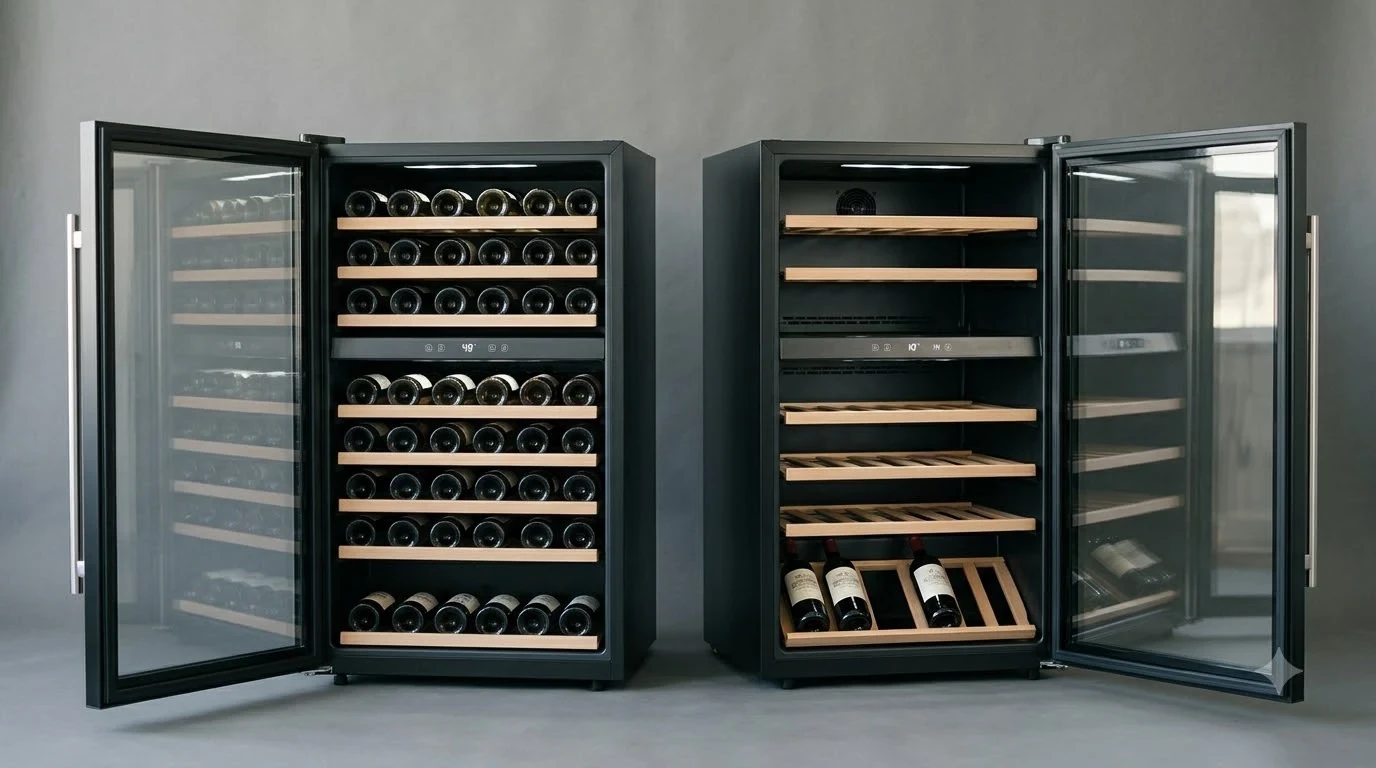
The Hisense dual zone wine fridge, model HWD46029SS, is a 46-bottle wine cooler designed for households that want separate red and white wine storage in a flexible built-in or freestanding appliance. Its two temperature zones, five soft-close shelves, UV-protected glass, and reversible door make it a practical option for a developing home collection. However, its advertised capacity, installation measurements, and potential long-term reliability concerns deserve attention before purchasing.
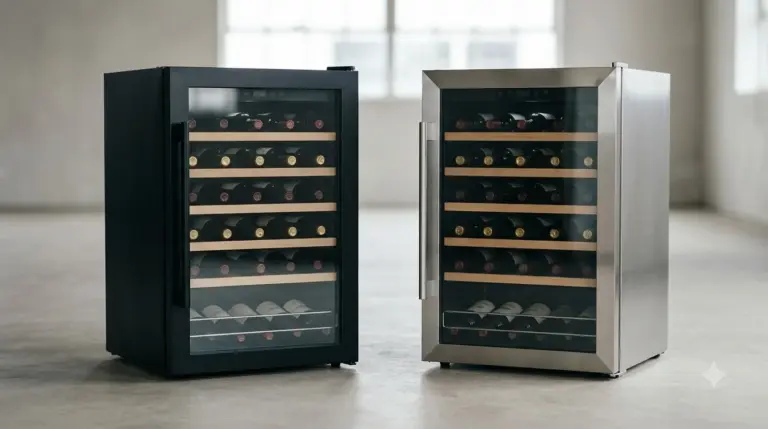
The Hisense HWD46029SS combines a stainless-steel exterior with a glass-fronted cabinet and independently controlled cooling compartments. It targets wine drinkers who want more organization than a standard refrigerator provides without committing to a much larger cellar cabinet. This review examines its specifications, owner feedback, installation requirements, and suitability for different collections.
Specs and Key Features of the Hisense HWD46029SS
The HWD46029SS offers a useful combination of storage capacity, adjustable temperatures, and installation flexibility. Its strongest specifications are the 46-bottle capacity, 41°F to 68°F temperature range, and five wooden-front shelves.
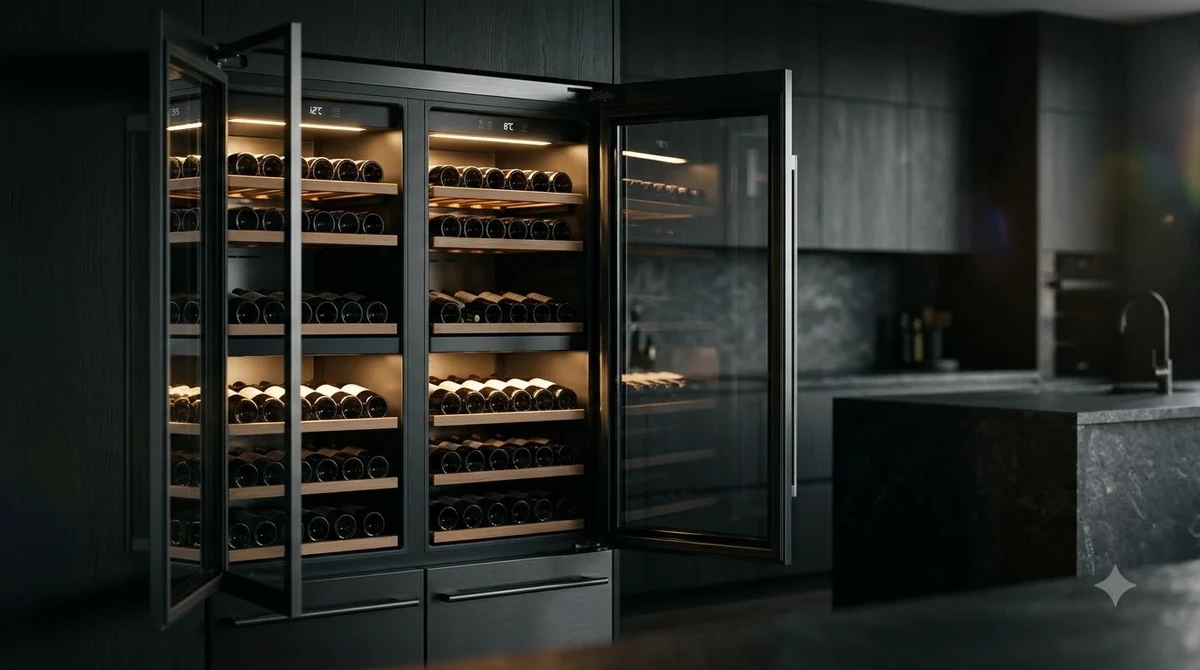
According to Hisense’s published specification sheet, the appliance has 4.9 cubic feet of capacity and two independently controlled cooling zones. The temperature range accommodates both chilled white wines and reds that benefit from cooler storage than a typical room-temperature environment. This makes the cabinet useful for households that regularly purchase several wine styles rather than keeping only one type on hand.
The five shelves combine steel construction with wooden fronts. Hisense describes their soft-close operation as a way to reduce noise and vibration during access. A frost-free cooling system, electronic controls, blue LED display, and interior LED lighting complete the main feature set. The manufacturer also identifies Low-E and UV-protected glass as part of the door design.
| Specification | Hisense HWD46029SS |
|---|---|
| Model | HWD46029SS |
| Advertised capacity | 46 bottles |
| Cabinet capacity | 4.9 cubic feet |
| Cooling zones | 2 independently controlled zones |
| Temperature range | 41°F–68°F |
| Shelves | 5 soft-close shelves |
| Cooling system | Frost-free |
| Door | Two-layer glass construction |
| Glass protection | Low-E and UV protection |
| Display | Electronic blue LED |
| Interior lighting | LED |
| Door design | Reversible |
| Installation | Built-in or freestanding |
| Noise specification | 45 dB |
| Refrigerant | R600a |
| Width | 23.43 inches |
| Height to hinge | 33.94 inches |
| Depth with door | 23.62 inches |
| Net weight | 113 pounds |
One particularly useful feature is the reversible door. Depending on the kitchen layout, changing the opening direction can make accessing bottles easier and prevent the open door from interfering with nearby cabinets or appliances. This flexibility is especially relevant when the cooler is positioned beneath a countertop or beside a kitchen island.
The manufacturer’s installation diagram also provides specific clearance requirements: 0.5 inches at each side, 0.5 inches above, and 0.5 inches behind the cabinet. These measurements should be considered alongside the actual cabinet opening and door-swing requirements rather than treating the appliance’s external dimensions as the entire installation footprint.
For additional product information, the official Hisense HWD46029SS product page describes the reversible door, protected glass, frost-free operation, and installation options.
What Owners Like About the Wine Cooler
Owner feedback highlights the cooler’s capacity, appearance, separate temperature zones, and convenient shelving. These characteristics address several common frustrations with storing different wine styles in a conventional refrigerator or a single-temperature wine cabinet.
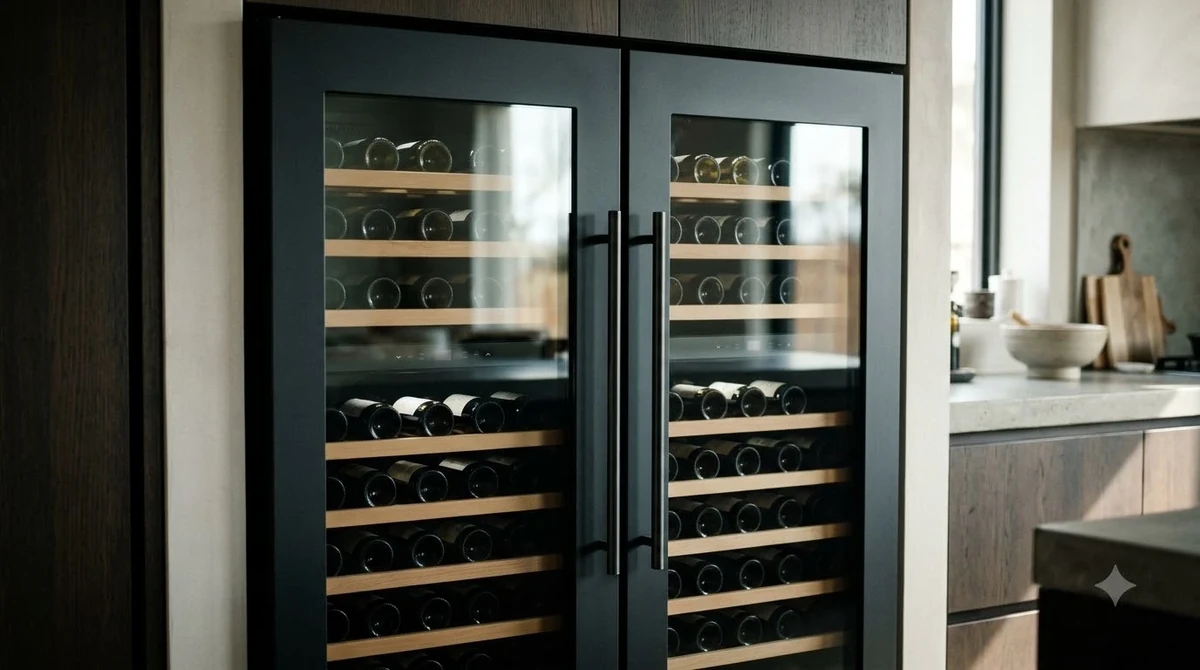
The 46-bottle advertised capacity is a major attraction for households that regularly purchase wine by the case or maintain a rotating selection. Instead of dividing bottles between kitchen storage, pantry shelves, and miscellaneous refrigerator compartments, owners can organize their collection in one dedicated appliance. The separate zones also allow a household to maintain different storage temperatures for reds and whites.
Appearance is another frequently praised characteristic. The stainless-steel door frame and handle provide a contemporary look, while the glass front and interior lighting make the stored bottles visible. The wooden shelf fronts add a warmer visual detail than an entirely metal interior, which can be particularly attractive in kitchens with natural wood cabinets or mixed stainless-steel appliances.
Soft-close shelves are a practical convenience rather than merely a decorative feature. Pulling out a shelf to retrieve a bottle does not require the same abrupt handling associated with basic sliding racks. Gentle movement also helps limit unnecessary disturbance to bottles, particularly wines that have been stored long enough to develop sediment.
Another benefit is the choice between built-in and freestanding placement. A suitable under-counter installation can create a more integrated kitchen appearance, while freestanding placement gives owners more flexibility when renovating a kitchen or changing the location of their wine collection.
UV protection is also relevant for people who display bottles in brighter rooms. Ultraviolet exposure can contribute to undesirable changes in wine, so a protected glass door is a useful design feature. It does not eliminate every environmental risk, however, and the appliance should still be kept away from prolonged direct sunlight and excessive heat.
Lowe’s published customer-review summaries identify capacity, dual-zone temperature control, attractive styling, and soft-close shelving as recurring positive themes. These observations provide useful insight into the features that owners value, although individual experiences can differ according to installation conditions, bottle selection, and usage.
The cooler’s 41°F to 68°F operating range also provides reasonable flexibility for everyday wine service. For example, a household can keep Sauvignon Blanc and sparkling wine colder than Cabernet Sauvignon while maintaining separate settings for each compartment. The appliance therefore serves both storage and preparation-for-serving purposes.
For households that frequently entertain, this arrangement can be more convenient than repeatedly moving bottles between a kitchen refrigerator and a wine rack. A chilled bottle of sparkling wine for an Aperol spritz recipe can share the appliance with bottles intended for dinner, provided the available zone settings and shelf arrangement suit the collection.
Common Complaints and Potential Drawbacks
The Hisense HWD46029SS has several practical limitations that deserve consideration, particularly concerning bottle capacity, installation, temperature displays, and long-term reliability. Its advertised features make it attractive, but they do not guarantee that every owner will have the same experience.
The first consideration is the 46-bottle capacity. This figure should be understood as an advertised storage capacity rather than a promise that every combination of bottle shapes will fit. Standard Bordeaux-style bottles are relatively uniform, but Champagne bottles, Burgundy bottles, and wider specialty bottles require more room. Some larger bottles can reduce the number of standard bottles that fit on a shelf.
Owners who collect sparkling wines or larger-format bottles should pay particular attention to shelf spacing. A collection containing many Champagne bottles may be less compatible with the advertised capacity than a collection dominated by standard 750 ml Bordeaux bottles. The number of shelves also limits how much flexibility is available for rearranging the cabinet.
Temperature-display concerns appear in Lowe’s customer-review summaries. An electronic display makes settings convenient to read and adjust, but the displayed setting should not automatically be treated as proof that every bottle is consistently experiencing that exact temperature. Placement, loading patterns, air circulation, and how frequently the door opens can influence actual cabinet conditions.
A separate thermometer can help owners understand how the cabinet behaves under normal operating conditions. This is particularly useful after installation and after loading the shelves with bottles. Allow the cooler time to stabilize before judging whether the selected settings are being maintained.
Some customers also mention handle-installation difficulties. This is a relatively minor issue compared with a cooling-system problem, but it can complicate the initial setup. Careful handling of the door and following the supplied installation instructions are sensible precautions.
Long-term durability deserves attention as well. Lowe’s review summaries include occasional reports of units failing after a couple of years. These reports do not establish a general failure rate, and isolated experiences should not be treated as proof that the model is unreliable. Nevertheless, buyers should examine the applicable warranty, service arrangements, and availability of replacement components before committing to the appliance.
The published noise specification is 45 dB. This gives buyers a measurable reference point, but the actual sound experienced in a kitchen can depend on the floor, cabinetry, surrounding surfaces, and installation. People planning to place the cooler in a quiet open-plan living area should consider its operating noise rather than assuming that every wine refrigerator is silent.
Finally, the unit weighs 113 pounds before packaging. Moving it into a kitchen, particularly one with narrow hallways or stairs, requires planning. A heavy appliance should not be moved by its door handle or shelves, and the installation instructions should guide its positioning and leveling.
Tip: Before purchasing, measure the complete cabinet opening, including height, width, depth, rear ventilation space, and door clearance. Also compare the shelf layout with the widest bottles in your collection rather than relying exclusively on the 46-bottle headline capacity.
Who Should Buy and Who Should Skip the Hisense
The HWD46029SS is most suitable for households that want a medium-capacity wine refrigerator with separate temperature controls and a contemporary appearance. It is less compelling for collectors who need extensive capacity, specialized bottle storage, or detailed cellar-management features.
Who should consider buying it?
Regular wine drinkers with a collection of approximately 20 to 40 standard-sized bottles are a natural audience. Although the manufacturer advertises space for 46 bottles, leaving some spare capacity makes organizing different bottle shapes easier and reduces the temptation to overcrowd the shelves.
Households that enjoy both red and white wines can benefit from the independent zones. A wine enthusiast might reserve one section for Chardonnay, Riesling, and Sauvignon Blanc, while using the other for Pinot Noir, Merlot, and Cabernet Sauvignon. The exact arrangement depends on the desired storage temperatures and the wines being prepared for service.
People planning a kitchen renovation may also appreciate the built-in installation option. The front-venting design, reversible door, and relatively narrow 23.43-inch width offer useful placement flexibility. However, the complete installation requirements still need to be checked against the cabinetry design.
Entertainers may find the appliance especially useful. Having sparkling wine, chilled whites, and bottles intended for dinner in one organized location makes hosting easier. For a dinner featuring chicken in a rich mushroom sauce, for example, the cooler can keep a bottle of Pinot Noir ready to accompany a chicken Marsala recipe.
Who should skip it?
Serious collectors with extensive cellars may find 46 bottles restrictive. A larger cabinet or dedicated wine cellar may be more appropriate for people who routinely purchase multiple cases, keep long-term vintages, or need space for unusual bottle formats.
Buyers who prioritize precise cellar monitoring should also compare alternatives with more detailed temperature-monitoring systems. The HWD46029SS offers electronic controls, but the published feature list does not establish advanced remote monitoring or comprehensive collection-management functionality.
People with very limited installation space should be cautious. The cabinet requires more consideration than its nominal width suggests because door opening, ventilation, and access for installation all affect whether the appliance will fit comfortably.
It may also be unsuitable for buyers who expect completely silent operation. The listed 45 dB specification is a concrete point of comparison, but those particularly sensitive to appliance noise should consider where the cooler will be located.
For households that only keep a handful of bottles, a smaller wine refrigerator may be more sensible. Paying for a 46-bottle cabinet does not provide much practical benefit if most of its storage capacity will remain unused.
How It Compares to Alternative Wine Storage Options
The Hisense HWD46029SS is designed to combine a substantial household capacity with separate cooling zones and flexible installation. Its advantages become clearer when compared with a standard kitchen refrigerator, a single-zone wine cooler, and a larger dedicated cellar cabinet.
Compared with a regular refrigerator
A conventional refrigerator is designed for general food storage rather than maintaining different wine temperatures in separate compartments. Its colder environment may be suitable for chilling bottles before serving, but it does not offer the same dedicated organization as a wine cabinet.
The Hisense provides two independently controlled zones and shelving specifically designed for horizontal bottle storage. Its Low-E and UV-protected glass door also offers a feature that is not generally part of ordinary kitchen refrigerator storage.
Another difference is accessibility. A dedicated wine refrigerator allows bottles to remain organized by grape variety, region, drinking occasion, or storage temperature. This is particularly useful for people who keep several styles of wine available throughout the week.
Compared with a single-zone wine cooler
A single-zone wine cooler uses one general temperature setting throughout the cabinet. This arrangement can work well for a collection dominated by one wine style or for bottles intended primarily for longer-term storage at a consistent temperature.
The Hisense dual-zone arrangement is more flexible for mixed collections. For example, one compartment can be configured for white wines and another for red wines intended for cooler service. The difference is especially noticeable in households that regularly alternate between sparkling wine, aromatic whites, and fuller-bodied reds.
However, dual-zone functionality does not automatically make an appliance superior for every collection. Someone who stores mostly red wine at a consistent cellar temperature may have little need for independently controlled compartments. A simpler single-zone appliance could meet that requirement.
Compared with a larger wine cellar cabinet
A larger wine cabinet is generally better suited to collectors who have more bottles, a broader range of formats, or plans to expand their collections. More space can make it easier to separate wines by region and drinking window while leaving room for future purchases.
The Hisense is better positioned as a household wine refrigerator than a comprehensive cellar-management system. Its 46-bottle capacity is sufficient for many regular drinkers, but it does not provide the same storage flexibility as a substantially larger cabinet.
Its under-counter dimensions and reversible door are appealing for kitchen integration. A larger cellar cabinet may require a separate room, more floor space, or a different installation arrangement. Buyers should therefore compare the available space and actual collection size before deciding which category makes sense.
Comparison by storage requirement
| Storage option | Temperature arrangement | Best suited to |
|---|---|---|
| Hisense HWD46029SS | 2 independent zones, 41°F–68°F | Mixed collections up to the advertised 46-bottle capacity |
| Standard refrigerator | General refrigerator cooling | Temporary chilling and everyday food storage |
| Single-zone wine cooler | 1 shared temperature setting | Collections with similar storage requirements |
| Large wine cellar cabinet | Varies by cabinet design | Growing collections and longer-term organization |
For a closer look at other appliance categories and buying considerations, the wine and appliance model reviews section provides a useful starting point. The most important comparison is not simply the number of advertised bottles, but whether the appliance’s actual shelf arrangement, temperature capabilities, and installation design suit the collection.
Installation, Wine Storage, and Everyday Care
Correct installation and sensible temperature settings are important for getting the most from the Hisense HWD46029SS. The reversible door and front ventilation provide placement flexibility, but careful preparation is still necessary.
Measure before installing
The specification sheet lists an overall width of 23.43 inches and a height of 33.94 inches to the top of the hinge. Its depth is 23.62 inches with the door, while the case depth without the door is 21.65 inches. These measurements matter when planning an under-counter installation, particularly where cabinet fronts and adjacent appliances create tight clearances.
The published diagram specifies 0.5 inches of clearance on both sides, above, and behind the cabinet. Check the current installation manual for the complete requirements and make sure the finished opening provides enough space for ventilation and service access.
Also account for the door opening. The specification sheet lists a depth of 45.80 inches when the door is open to 90 degrees. This is important in narrow kitchens where a nearby island, wall, or cabinet could restrict access to the shelves.
Choose practical temperature settings
The two temperature zones allow owners to organize bottles according to their preferred storage and serving requirements. A useful everyday arrangement is to dedicate one compartment to whites and sparkling wines and the other to reds.
For serving, sparkling wine is generally best at 40°F to 50°F, light whites and rosé at 45°F to 50°F, and fuller-bodied whites at 50°F to 55°F. Light reds generally benefit from 55°F to 60°F, while fuller-bodied reds are commonly served at 60°F to 65°F.
These serving ranges are not identical to ideal long-term storage conditions. A household that wants to store wine for extended periods should prioritize a stable, appropriate storage environment rather than repeatedly changing temperatures to match individual serving occasions.
Remember that a wine refrigerator has practical limitations. Its maximum setting of 68°F is not intended to replace climate-controlled cellar storage for every type of valuable collectible wine. The appliance is most useful when operated within a consistent range suited to the collection.
Organize bottles carefully
Horizontal storage is a practical arrangement for traditional cork-closed bottles. It helps keep the cork in contact with the wine and makes bottles easier to identify and retrieve. Organizing shelves by wine style or drinking occasion can also reduce unnecessary handling.
Try placing frequently served bottles in the most accessible positions. Sparkling wine for weekend entertaining, Sauvignon Blanc for seafood dinners, and Pinot Noir for lighter meals can each have a predictable location. Less frequently opened bottles can occupy the less accessible shelves.
Do not force oversized bottles into spaces that are too narrow. Champagne and Burgundy bottles can have wider shoulders than standard Bordeaux bottles, reducing the number of bottles that fit on a shelf. Leave enough space to slide shelves without catching neighboring bottles.
Keep the appliance in good condition
Clean the glass and stainless-steel exterior with appropriate nonabrasive materials. Avoid harsh chemicals and abrasive pads that could damage the finish. Keep the door seal clean so it can close properly, and check that the appliance remains level.
Limit unnecessary door openings, particularly when the cabinet is heavily loaded. Allow the cooler to stabilize after a substantial change in bottle quantity or temperature settings rather than making repeated adjustments based on short-term readings.
It is also sensible to monitor how the appliance operates during the first few weeks. Pay attention to unusual sounds, inconsistent cooling, or a door that does not close correctly. Addressing installation problems early can prevent avoidable operating issues.
Finally, retain the product documentation and warranty information. Hisense maintains a dedicated support page for the HWD46029SS that provides access to product documentation and service resources.
Frequently Asked Questions
Does the Hisense HWD46029SS have a door lock?
The manufacturer’s specification sheet lists a door-open alarm but does not list a lock and key for this model. Buyers who need restricted access should not assume that the glass door includes a locking mechanism. Confirm the supplied hardware and current documentation before purchasing if security is essential.
Can the Hisense wine cooler store Champagne bottles?
Champagne bottles can require more shelf width than standard Bordeaux bottles because of their wider bodies and different shapes. The advertised 46-bottle capacity should therefore not be treated as a guaranteed count for a collection dominated by sparkling wine. Test the shelf dimensions and spacing against your largest bottles before loading the cabinet fully.
Does the HWD46029SS have Wi-Fi or smartphone controls?
The published US specification sheet identifies electronic temperature controls and a blue LED display but does not list Wi-Fi or smartphone connectivity. Buyers looking for remote temperature adjustments or app-based collection management should consider this limitation. Do not confuse electronic controls with connected smart-appliance functionality.
What type of refrigerant does this Hisense wine fridge use?
The manufacturer’s specification sheet identifies R600a as the refrigerant. Refrigerant handling and sealed-system repairs should be left to appropriately qualified appliance service professionals. The specification is useful when discussing technical servicing or replacement requirements.
Can the wine cooler be moved after installation?
It can be repositioned, but its published net weight of 113 pounds makes moving it a substantial task. The unit should be emptied and handled according to the manufacturer’s transportation instructions. Allow the appliance to settle and follow the manual’s restart guidance before returning it to normal operation.
The Hisense HWD46029SS is a capable option for wine drinkers who want 46-bottle advertised capacity, two temperature zones, soft-close shelving, and flexible kitchen installation. Its bottle-size limitations, installation measurements, and mixed reliability feedback should be weighed carefully against the needs of the collection. For a household with a moderate selection of reds, whites, and sparkling wines, it offers a useful combination of organization and everyday convenience.
More in Model Reviews
 Lanbo Dual Zone Wine Fridge Review: Features, Capacity, and DrawbacksUpdated Nov 20, 2026
 Lanbo Beverage Cooler Review: Features, Capacity and ReliabilityUpdated Nov 20, 2026
 Haier Wine And Beverage Center Review: Capacity, Cooling, and FitUpdated Nov 20, 2026
 Haier Countertop Wine Cooler Review: Features and Buying AdviceUpdated Nov 20, 2026
 KitchenAid Built In Wine Fridge Review: Features, Fit and Bottle CapacityUpdated Nov 20, 2026
 KitchenAid 24 Inch Wine Fridge: Features, Capacity, and Buying AdviceUpdated Nov 20, 2026