

We may earn a commission when you buy through links on this page, at no extra cost to you. Learn more.
cote rotie vineyards are steep, terraced hillside plots on the right bank of France’s Rhône River, where Syrah grows across schist, gneiss, and migmatite soils. The appellation runs through Saint-Cyr-sur-Rhône, Ampuis, and Tupin-Semons, with many vines planted on south- or southeast-facing slopes. Its best-known contrast is between the darker schist soils associated with Côte Brune and the paler gneiss soils associated with Côte Blonde. Those labels offer a useful starting point, but slope, drainage, exposure, and the grower’s choices all shape the wine.
Few wine regions make the physical work of viticulture as visible as Côte-Rôtie. Narrow terraces cling to steep hills above the Rhône, dry-stone walls hold the soil in place, and individual vineyard names often carry as much interest for wine drinkers as the appellation name itself. Understanding the geography makes it easier to interpret those names and to see why two Syrah wines from the same small region can feel quite different.
Three Communes and a 180–325-Meter Rhône Hillside
Côte-Rôtie is a compact Northern Rhône appellation on the river’s right bank, north of the better-known southern Rhône vineyards. The official landscape description places its vines between 180 and 325 meters above sea level and identifies 75 classified lieux-dits, or named vineyard localities. Its territory crosses Saint-Cyr-sur-Rhône, Ampuis, and Tupin-Semons, with the town of Ampuis at the center of the vineyard landscape.
The slopes rise from the river in a narrow, broken band rather than spreading across a broad plateau. Small folds, gullies, and ridges interrupt the hillside, changing the angle at which each parcel receives sunlight and the degree to which it is sheltered from wind. A vineyard near the river can have a different exposure and growing rhythm from one higher on the slope, even when the two are close together on a map.
This geography explains why Côte-Rôtie should be understood as a collection of sites rather than a single uniform hillside. The appellation is the legal origin; a lieu-dit gives a more precise place-name; and the producer determines whether the bottle combines several parcels or emphasizes one. For a wider overview of its neighboring appellations and northern Rhône setting, the Côte-Rôtie wine region page provides useful context. The regional growers’ organization also outlines the altitude, geology, and climate in its official vineyard landscape description.
Terraces, Chaillées, and Slopes Reaching 60 Percent
The vineyard’s steepness is not a scenic detail; it dictates how the land can be planted, maintained, and harvested. The Côte-Rôtie growers’ organization says the steepest slopes can reach a 60 percent incline, and it describes the dry-stone retaining walls and narrow terraces known locally as chaillées. These structures turn a difficult hillside into a sequence of small, workable planting shelves.
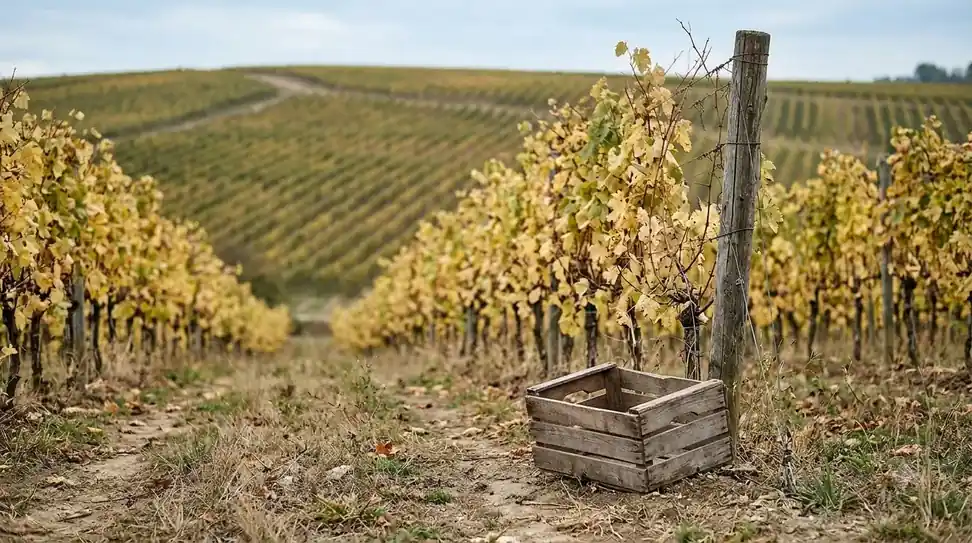
Many terraces are only a few rows or a few dozen vines wide, so equipment that works in flatter vineyards is of limited use. Decanter’s account of the appellation describes mechanization as effectively out of the question on the most imposing slopes. Vineyard workers must manage pruning, canopy work, soil maintenance, and picking in tight spaces where footing and access matter as much as the task itself.
The walls have a practical purpose beyond preserving the region’s distinctive appearance. They slow the movement of loose soil down the slope, help keep planting surfaces intact, and define the narrow bands in which vines can grow. Their upkeep is continuous: rain, frost, erosion, and gravity all test the terraces. A grower’s work therefore includes caring for the supporting structure as well as the grapevines.
That labor helps explain why vineyard parcels can be small and fragmented. A producer may work several separate plots instead of one large block, each with its own wall, access path, aspect, and soil depth. The resulting wine can combine fruit from different exposures to gain balance, or it can be bottled from one parcel to show a narrower expression of the slope.
Côte Blonde and Côte Brune: Gneiss, Schist, and Migmatite
The familiar Blonde and Brune distinction reflects the main geological contrast across the appellation. In broad terms, the southern sector is associated with pale gneiss and the northern sector with darker mica schist; migmatite also appears in the far southeast. These are not separate appellations, and the names describe both specific vineyard localities and wider parts of the hillside.
The ODG’s geological overview explains that Côte-Rôtie lies on the eastern edge of the Massif Central and that most vines grow on metamorphic rock. The bedrock is fractured, allowing roots to follow cracks in search of water and nutrients. The growers’ organization also notes that stony mica-schist soils drain efficiently and can store warmth from the sun before releasing it during the night, while its description of gneiss highlights minerals including potassium, calcium, magnesium, and iron.
Decanter’s reporting on the soils adds an important qualification: the difference is not simply “light soil equals light wine” and “dark soil equals powerful wine.” Blonde-side soils are often stonier and freer-draining, with less clay, while Brune-side soils commonly contain more clay and decomposed schist. Clay can provide vines with a steadier water supply, which may matter in dry growing seasons; highly draining soils can be an advantage in wetter conditions.
Those broad patterns can guide expectations, but individual parcels vary in soil depth, clay content, limestone, slope position, and exposure. Winemaker interviews reported by Decanter stress that the neat division between Blonde and Brune is a simplification, not a complete map of every vine’s conditions. The site name is a clue, not a tasting guarantee, and cellar decisions such as extraction and aging can influence the finished wine just as strongly.
La Landonne, La Mouline, and La Turque as Landmark Sites
Several vineyard names have become widely recognized because producers have bottled their fruit separately. La Landonne, La Mouline, and La Turque are often grouped under the nickname “La Las” for E. Guigal’s celebrated single-vineyard wines, but each refers to a different place and a different blend. Their labels show how a named site can communicate more detail than the appellation name alone.
Decanter’s collector’s guide gives the following details for the three Guigal bottlings. The percentages describe the grape composition of those wines, not a universal recipe for every producer working in the same lieu-dit.
| Named bottling | Sector or lieu-dit | Grape blend | First vintage listed | Average vine age listed |
|---|---|---|---|---|
| La Mouline | Côte Blonde | 89% Syrah, 11% Viognier | 1966 | 75 years |
| La Landonne | La Landonne, Côte Brune | 100% Syrah | 1978 | 35 years |
| La Turque | Côte Brune | 93% Syrah, 7% Viognier | 1985 | 30 years |
These examples are useful comparisons, not a ranking of all Côte-Rôtie vineyards. La Mouline is associated with the more perfumed Blonde side, while La Landonne is associated with the deeper, more structured Brune side. La Turque is also classed on the Brune side, although Decanter notes that its parcel lies very close to the Blonde sector.
Other producers bottle wines from famous localities such as La Viallière, Les Grands Places, Fongeant, Côte Rozier, and Maison Rouge. The exact parcel and producer matter: a lieux-dit may contain varied soils and aspects, and two growers working within the same named locality do not necessarily farm identical conditions. A single-site label tells you where the fruit came from, but it does not remove the influence of farming, harvest decisions, blending, or cellar technique.
Syrah and Viognier: The Appellation’s Two Grapes
Syrah is the defining red grape of Côte-Rôtie, producing wines known for dark or red berry fruit, violet, spice, color, and firm but often finely textured tannins. The appellation is distinctive in the Northern Rhône because Viognier, a white grape, may be planted and blended with Syrah in its red wines. This small white-grape component can contribute floral fragrance and a sense of lift.
Appellation rules permit up to 20 percent Viognier, although Decanter reports that blends above 10 percent are uncommon in practice. The grape is more often associated with the Blonde side, where it fits the reputation for fragrant, graceful Syrah. La Mouline’s 89 percent Syrah and 11 percent Viognier blend is one well-known example; La Landonne, by contrast, is listed as 100 percent Syrah.
Co-planting and blending Viognier with Syrah is different from making a white wine or a rosé. The finished Côte-Rôtie remains a red wine, and the amount of Viognier varies among producers and bottlings. For a deeper look at the varieties and how they contribute to aroma and structure, see Côte-Rôtie wine grapes. The grape mix on a label can be especially helpful when comparing two single-vineyard wines from different parts of the hillside.
South-Facing Sites, Northern Winds, and Seasonal Ripening
Côte-Rôtie has a semi-continental climate with Mediterranean influences. Many slopes face south or southeast and receive strong sunlight, while the shape of the valley can shelter vines from cold northerly winds. Warm southerly winds also influence the growing season, sometimes bringing dry conditions that help limit disease pressure but can increase vine water stress.
Exposure affects how quickly grapes ripen, but the steep terrain makes it impossible to describe every parcel with one compass point. The rows of vines follow a complicated series of folds and ridges; some face southeast, others turn more east or southwest, and sheltered positions can behave differently from exposed upper slopes. Decanter notes that the apparent broad southeast-facing hillside contains many small changes in direction.
Soil and aspect interact over the season. More clay in some Brune-side parcels can help maintain a more regular water supply during dry spells, while the freer-draining Blonde-side soils can be useful in wetter conditions. Elevation, shade, wind exposure, soil depth, and the timing of harvest all affect the final balance of ripeness, acidity, and tannin. A warm year does not make every site taste the same, and a cooler year does not affect every parcel equally.
For wine drinkers, the practical lesson is to compare wines across more than one vintage before deciding that a vineyard always makes a certain style. A producer’s choices about picking date, whole bunches, extraction, and oak can reinforce or soften the character suggested by a site. That is why two wines carrying the same lieu-dit name can differ in body, aromatic intensity, and readiness to drink.
Reading 75 Lieux-Dits and Comparing Vineyard Labels
A named lieu-dit is a useful geographical marker, but it is not automatically a formal quality grade. Counts also vary among references: the Côte-Rôtie growers’ landscape page lists 75 classified lieux-dits, while Inter Rhône and some wine-trade reporting refer to 73 officially registered sites. The difference is a reminder to use vineyard counts as a guide to the region’s detailed mapping, not as a measure of wine quality.
When comparing bottles, start with the producer and the vintage, then consider whether the wine names a single site or blends several parcels. A single-vineyard label can be revealing, but a blended Côte-Rôtie may be more representative of a grower’s overall style and can combine different slopes for balance. The place-name gives context; it does not tell the entire story of the wine.
This is also a useful way to compare Côte-Rôtie with Burgundy. Readers familiar with Côte de Nuits vineyards may expect every named plot to correspond to a clear quality tier, but Côte-Rôtie’s localities are not arranged in a Burgundy-style hierarchy. Decanter’s recent reporting describes ongoing debate about a cru system and explains that site boundaries can follow roads or historic property lines rather than one uniform soil type.
Tip: When a label names La Landonne, La Mouline, or another lieu-dit, use that name as a starting point. Then compare the producer, vintage, and grape blend before assuming that every wine from the same place will taste alike.
Maps and producer descriptions are most useful when read together. A site map shows where a parcel sits in relation to Ampuis, the river, and neighboring slopes; a technical note can explain its soil, vine age, or blend; and a tasting note describes the winemaker’s interpretation. For a wider framework for placing French appellations on a map, browse the site’s Wine Regions reference.
Frequently Asked Questions
The questions below clarify the name, the scale of the hillside, and the way vineyard status is described. They add historical and practical details that are useful alongside the geography and site comparisons above.
What does Côte-Rôtie mean?
Côte-Rôtie is commonly translated as “roasted slope,” a reference to the sunny, warm hillsides above the Rhône. The name captures the southern exposure that is common across many of the region’s most prized parcels, although individual rows can face in several directions.
How long does it take to walk across the appellation?
Decanter reports that walking from one end of the appellation to the other takes about two hours. The route crosses three villages and steep vineyard terrain, so the actual time depends on the paths used and whether the walk includes stops at viewpoints or producers.
Does Côte-Rôtie have a premier cru or grand cru ranking?
No Burgundy-style premier cru or grand cru system currently governs Côte-Rôtie. Producers have discussed such a classification, but agreement has not been reached; Decanter reported that the appellation’s co-presidents had no current plan to establish one. A named lieu-dit identifies a place rather than a legally assigned quality rank. Read Decanter’s reporting on the proposed cru system.
When is the Ampuis Wine Market held?
The Ampuis Wine Market is held in January and is a major annual gathering for the appellation. It gives visitors a chance to meet local growers and compare wines from several estates in the town at the center of Côte-Rôtie.
How much vineyard land remained planted in 1960?
Decanter’s Rhône collector’s guide reports that only 60 hectares remained planted in Côte-Rôtie in 1960. The vineyard area expanded again after interest in Northern Rhône wines returned, helping restore the appellation’s prominence.
Côte-Rôtie is best understood as a mosaic of steep parcels shaped by geology, exposure, and painstaking vineyard work. Learn the main contrasts between Blonde and Brune, then let the producer, site name, and vintage refine the picture rather than treating any single label as a complete explanation.
More in Wine Regions
 Willcox Wine Trail: Discover Arizona’s High-Elevation Wine CountryUpdated Nov 20, 2026
 Yakima Valley Wine Region: Find the Best Styles to TryUpdated Nov 20, 2026
 Vosne Romanee Wine Tasting: Identify Aromas and Choose Better PairingsUpdated Nov 20, 2026
 Yakima Valley Wine Festival: Find the Best Seasonal Wine EventsUpdated Nov 20, 2026
 Wales Vineyards: Discover Cool-Climate Wines and Where to VisitUpdated Nov 20, 2026
 Yountville Wine Festival: Discover Napa Wines and Local FoodUpdated Nov 20, 2026