


We may earn a commission when you buy through links on this page, at no extra cost to you. Learn more.
The best cheap wine box is a simple corrugated cardboard or kraft bottle box that fits your bottle without requiring unnecessary decorative materials. For inexpensive gifts, a single-bottle carrier or folding presentation box is usually sufficient. For shipping, choose a purpose-built carton with a fitted inner insert rather than relying on a decorative gift box. The right choice depends on whether presentation, portability, storage, or protection during delivery matters most.
A wine box does not need elaborate construction or expensive finishes to make a bottle look presentable. Basic cardboard packaging can work well for birthdays, holiday gifts, dinner invitations, small business promotions, and wine collections. However, the cheapest packaging is not automatically the most practical: a lightweight gift carrier and a protective shipping carton serve different purposes.
This roundup compares five useful types of affordable wine packaging, from straightforward kraft carriers to molded-pulp shipping systems. It also explains which features justify spending a little more, how to select the correct capacity, and what to check before putting a glass bottle inside.
Quick Comparison of Affordable Wine Box Types
The best value depends on how the bottle will be handled. A single-bottle presentation box is appropriate for hand-delivered gifts, while a corrugated shipping kit or molded-pulp insert is a better choice when a parcel must travel through a delivery network.
| Wine box type | Typical capacity | Main advantage | Best application |
|---|---|---|---|
| Kraft cardboard carrier | 1-3 bottles | Simple construction and carrying convenience | Casual gifts and parties |
| Folding presentation box | 1-3 bottles | Neater appearance | Birthdays and holiday gifts |
| Corrugated shipping kit | 1-12 bottles, depending on configuration | Separate protective packaging | Parcel shipping |
| Molded-pulp wine shipper | 1-12 bottles, depending on configuration | Individual bottle positioning | Fragile bottle shipments |
| Multi-bottle storage carton | 6-12 bottles | Organized transportation and storage | Moving and wine collection organization |
These capacities describe commonly available packaging formats rather than a guarantee that every box accommodates every bottle shape. Champagne bottles, sparkling wine bottles, and unusually wide Burgundy bottles may require different dimensions. A standard 750 ml capacity designation alone does not establish that a container will fit every bottle.
It also helps to distinguish three terms. A gift box prioritizes appearance, a carrier adds convenient handling, and a shipper is engineered to separate and protect glass during transportation. Some products combine these functions, but an ordinary presentation box should not be treated as a shipping carton without additional protective packaging.
Best for Casual Gifts: Kraft Cardboard Wine Carriers
A kraft cardboard carrier is the practical starting point for inexpensive wine gifting. Its straightforward appearance suits a dinner invitation, casual birthday present, or host gift without requiring decorative packaging that costs more than the bottle’s presentation needs.
These carriers generally use natural-brown cardboard, folded panels, and an opening or handle for carrying. Single-bottle versions keep the package compact, while two- and three-bottle formats accommodate small collections or coordinated gifts. Wine-n-Gear lists corrugated gift boxes in all three configurations, demonstrating how simple cardboard packaging can serve different gifting needs.
The most useful feature is the balance between appearance and portability. A kraft box looks intentional without needing glossy printing, elaborate ribbons, or a rigid decorative shell. It also leaves room for a handwritten note, a small gift tag, or tissue paper around the bottle.
Look closely at the bottom construction before choosing a carrier. A properly folded and secured base is important because a full wine bottle is considerably heavier than an empty cardboard package. The handle should also feel comfortable and should not depend on a narrow, easily torn strip of paperboard.
For a basic gift, a single-bottle carrier is usually the sensible option. Two-bottle carriers work particularly well for a red-and-white pairing, a Champagne and sparkling-wine combination, or two bottles from the same producer. Three-bottle packaging is useful for a small themed collection, although its larger size may require stronger construction and more careful handling.
Choose kraft cardboard when the bottle will be carried directly to its recipient rather than sent through a parcel network. If delivery involves several transfers, stacking, or rough handling, move to a dedicated shipping solution with individual bottle protection.
A useful finishing detail is to match the packaging to the occasion. Plain kraft works for casual entertaining, while a dark ribbon or simple gift tag makes the same basic container look more formal. There is little reason to pay for elaborate printing if a clean, well-fitted carrier already meets the occasion’s needs.
Best for Presentation: Folding Cardboard Gift Boxes
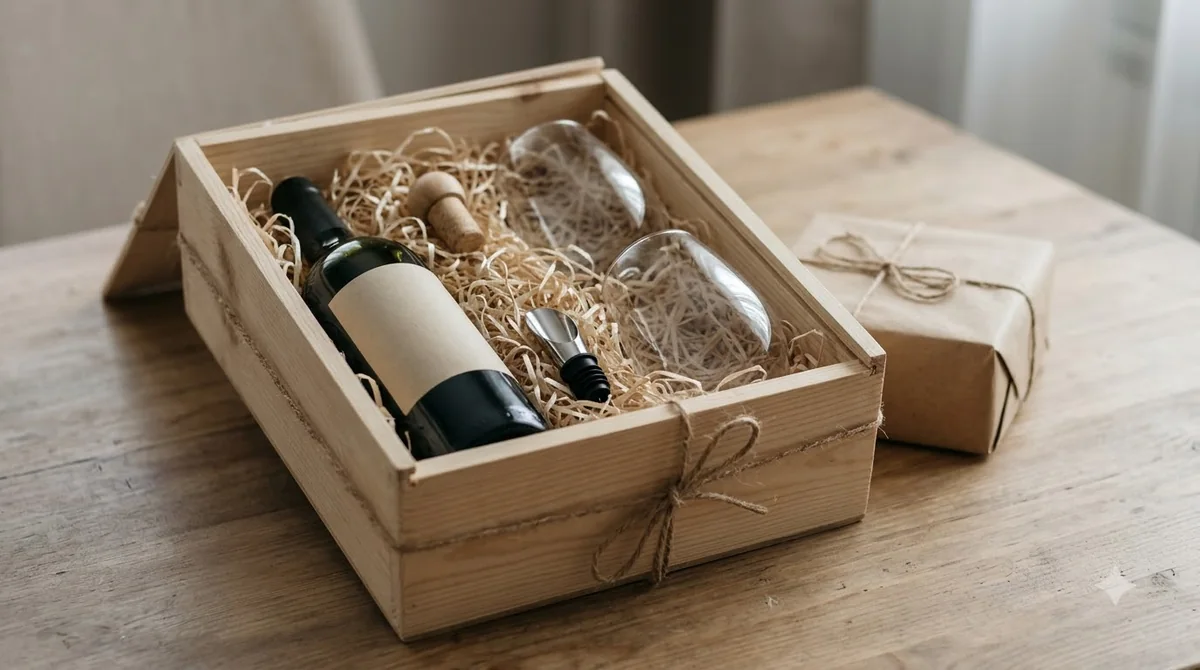
A folding cardboard gift box is a good choice when the packaging needs to look more finished than an everyday carrier. It provides a defined presentation space for one or more bottles and can make an inexpensive gift feel more organized without requiring a heavy wooden case.
Wine-n-Gear lists several corrugated presentation formats, including one-, two-, and three-bottle gift boxes. Its catalog also includes book-style gift boxes, illustrating the difference between basic bottle packaging and a more decorative presentation format.
The principal advantage of a folding gift box is appearance. A structured lid, clean edges, and an interior compartment create a more deliberate presentation than an ordinary shopping bag. This style works for holiday gifts, workplace celebrations, wedding-related presents, and small wine-themed gift sets.
Some presentation boxes also accommodate accessories. A book-style package with tumblers, for example, combines the wine presentation with reusable drinkware. The additional components can make a gift feel more complete, although they also increase the amount of packaging needed.
Pay attention to the interior before buying. A bottle should sit securely rather than slide around when the box is tilted. If the package has space for accessories, dividers or suitable filler should keep those objects away from the glass.
There is also a difference between decorative inserts and protective inserts. A thin paperboard divider can organize a presentation, but it does not necessarily provide the cushioning required for shipping. A decorative box may look substantial while still being vulnerable to crushing or impact.
For a gift that will be delivered personally, presentation quality can be more important than shipping certification. For a gift being mailed, place the presentation box inside a separate shipping carton with appropriate protective material. This helps protect both the bottle and the outer gift packaging from scuffs and crushing.
Choose a folding presentation box when the recipient will notice the packaging as part of the gift. For everyday carrying, a simpler kraft carrier is generally more practical. For postal delivery, a purpose-built shipper should take priority over decorative features.
Best for Single-Bottle Shipping: Corrugated Shipping Kits
A corrugated shipping kit is the more appropriate option for sending one wine bottle through a parcel service. Unlike a simple gift carrier, this format uses an inner corrugated wrap and a separate outer carton to hold the bottle away from the exterior walls.
WineShippingBoxes.com describes a single-bottle kit containing one inner corrugated wrap and one outer shipping box. The manufacturer specifies 44ECT corrugated cardboard, an outer carton measuring 13 x 4 1/4 x 4 1/4 inches, and compatibility with bottles up to 3 5/8 inches wide and 12 1/2 inches tall.
Those measurements are particularly useful when shopping because bottle dimensions can vary even when the stated capacity is 750 ml. A tall bottle, wide sparkling-wine bottle, or unusually shaped Burgundy bottle may not fit a standard package. Measure the bottle rather than assuming that all full-size wine bottles are interchangeable.
The inner wrap is the important part of this arrangement. It positions the bottle inside the outer carton, helping prevent direct contact between glass and the carton walls. The separate outer layer also provides a protective enclosure around the bottle.
WineShippingBoxes.com describes its corrugated shipping kits as lightweight and recyclable. The manufacturer also explains that the individual inner wraps and outer cartons can be purchased separately, which can be useful when replacing only one component of an existing packaging supply.
One ordering detail deserves attention: the listed single-bottle kit has a minimum order of five kits. That requirement matters for someone who only needs to send one bottle. A small gift carrier might be easier to source for occasional personal gifting, while the shipping kit is more suitable for people who regularly package wine.
The same supplier offers configurations for two, four, six, and twelve bottles. Matching the package capacity to the shipment can reduce unnecessary empty space and simplify packing. However, the number of bottle compartments and the suitability of the outer carton still need to be checked for the actual bottles being shipped.
For a more detailed packaging decision, compare the protective requirements with those discussed in this single-bottle corrugated wine shipping kit specifications. The manufacturer’s dimensions and insert details help explain why a dedicated shipping kit is different from a decorative carrier.
A decorative gift box can be placed inside a shipping carton, but it should not replace the inner protective structure. Corrugated kits are especially useful for businesses, wine clubs, and people who send bottles regularly. For someone giving a bottle to a neighbor or bringing it to dinner, the additional shipping construction is unnecessary.
Best for Individual Bottle Protection: Molded-Pulp Wine Shippers
Molded-pulp packaging is worth considering when separating bottles and maintaining their position inside a carton are the main priorities. Its shaped compartments hold individual bottles in place rather than relying on a loose decorative divider.
The molded material is formed into bottle-specific cavities, creating a structure that surrounds the glass. This can make it useful for shipments containing several bottles, especially when the package needs to keep each bottle separated from the others.
Canada Post’s wine packaging guidance illustrates molded pulp as one of the packaging choices for a two-bottle shipment. The same guidance shows corrugated cardboard and Styrofoam options for twelve-bottle shipments, emphasizing that different shipment sizes can call for different packaging structures.
The important feature is not simply the material. It is the way the insert positions the bottle. An appropriate molded-pulp design should prevent bottle-to-bottle contact, reduce unwanted movement, and keep the glass from touching the outside carton.
Before choosing a molded-pulp package, confirm the bottle capacity, shape compatibility, and outer-carton dimensions. A package designed for conventional Bordeaux bottles may not accommodate a wider sparkling-wine bottle or a large-format bottle. The internal shape matters as much as the stated number of bottles.
Another consideration is whether the molded-pulp insert is supplied with the outer box. Some packaging systems sell inserts and cartons as separate components. Buying only the insert without checking the matching outer carton can create an unnecessary sizing problem.
For regular shipments, a dedicated molded-pulp system can simplify packing because the compartments are already shaped for their intended use. It is also a useful option for businesses handling multiple bottles in the same parcel.
However, molded pulp is not automatically the best choice for every shipment. A well-designed corrugated wrap may be lighter and more convenient for a single bottle. The right selection depends on the bottle shape, number of bottles, handling conditions, and the packaging supplier’s specifications.
For a gift that will be handed over directly, molded pulp may be more protection than necessary. It is primarily a functional packaging choice rather than a decorative presentation option.
Best for Multiple Bottles: Storage and Repack Cartons
A multi-bottle wine carton is the practical choice for moving, organizing, or transporting several bottles together. It reduces the need to package each bottle in an individual decorative box and provides a more organized way to handle a small collection.
Wine-n-Gear lists 6-bottle upright storage boxes, 12-bottle layflat storage boxes, and 12-bottle repack boxes. These configurations illustrate three distinct approaches to organizing wine: upright placement, horizontal storage, and repacking for transportation.
The difference between upright and layflat storage matters. A six-bottle upright carton is designed around standing bottles, while a twelve-bottle layflat carton is intended for bottles positioned horizontally. The appropriate design depends on the bottle format, compartment layout, and how the carton will be used.
For a small collection, a six-bottle carton may be easier to handle than a larger twelve-bottle container. It can also make it easier to separate bottles by grape variety, producer, occasion, or drinking preference.
A twelve-bottle format is useful when consolidating a larger group of bottles. However, a full carton becomes heavy, so the base, side walls, closures, and carrying method deserve particular attention. Avoid lifting a loaded carton by a weak flap or an improvised handle.
Repack boxes are particularly useful when the original packaging has been damaged or when bottles need to be transferred into a more organized container. The presence of a box alone, however, does not establish that the bottles are adequately protected. Individual compartments and secure positioning remain important.
For long-term storage, packaging should not be confused with proper cellar conditions. A cardboard carton can keep bottles together and reduce exposure to handling, but it is not a substitute for stable storage conditions. Wine intended for aging is generally best stored on its side near 55 F, away from strong temperature fluctuations.
If the objective is simply to organize bottles in a cupboard or storage area, a basic carton may be enough. If the bottles will travel in a vehicle or through a delivery network, select a package with individual dividers and a protective outer structure.
Think about the loaded weight before choosing a twelve-bottle format. A smaller carton that can be lifted comfortably may be more practical than a large package that becomes awkward to move.
How to Choose an Affordable Wine Box
The easiest way to choose the right wine box is to start with the bottle count and intended use. Once those two details are clear, it becomes easier to compare the package dimensions, material, closure, and protective features.
Use these steps before ordering:
- Decide whether the box is for gifting, carrying, storage, or shipping. A folding gift box suits a hand-delivered present, while a corrugated shipping kit is designed for parcel transportation. Do not assume that a presentation box offers the same protection as a shipping carton.
- Count the bottles. Select a one-bottle carrier for a single gift, a two- or three-bottle package for a small assortment, or a six- or twelve-bottle carton for a larger collection. Avoid leaving bottles loose in an oversized box.
- Measure the bottle. Check its height and widest diameter. The single-bottle kit described by WineShippingBoxes.com accommodates bottles up to 3 5/8 inches wide and 12 1/2 inches tall, providing a useful example of the dimensions manufacturers specify.
- Inspect the internal support. Look for individual compartments, fitted inserts, or corrugated wraps. A decorative divider is not necessarily a protective insert.
- Check the base and closure. The bottom should remain securely closed under the weight of the intended bottles. The top should also stay shut during normal handling.
- Consider the material. Kraft cardboard works well for basic gifting, corrugated cardboard is useful for structured packaging, and molded pulp provides shaped individual compartments.
- Check the ordering requirements. Some suppliers have minimum quantities or sell inner inserts separately from outer cartons. Confirm what is included before placing an order.
- Perform a final fit check. Put the bottle inside the package and check for movement before using it. For shipping, make sure the bottle does not touch the outer carton or another bottle.
Tip: For a shipping carton, perform a shake test after packing. Canada Post recommends shaking the completed package to identify unwanted movement. If a bottle shifts inside, reopen the box and improve the fit before sending it.
Material selection should follow the actual job rather than appearance alone. A plain kraft box may be entirely appropriate for a dinner-party gift, while a molded-pulp shipper is more suitable when individual bottle positioning is essential.
It is also helpful to consider the recipient. Someone receiving a single bottle as a host gift may appreciate a compact presentation box, whereas a wine enthusiast receiving a selection of six bottles may find a practical storage carton more useful.
For additional ideas about presentation, compare the options in this wine gift box resource. If the package is part of a larger present, a cheap wine gift box can also provide a useful starting point for choosing a simple, coordinated presentation.
When a Cheap Box Is Not Enough
Some situations justify choosing a more protective package instead of the least expensive available option. Long-distance transportation, multiple handling stages, unusual bottle dimensions, and extreme temperatures all increase the importance of suitable packaging.
WineShippingBoxes.com notes that foam wine shippers provide additional insulation for shipments in very hot or cold weather. Insulation is a separate consideration from physical cushioning: a package that holds a bottle securely does not necessarily protect it from temperature extremes.
There are also legal and carrier requirements to consider. Shipping alcohol is subject to applicable laws and carrier rules, which vary by location and service. Packaging selection does not establish whether a particular wine shipment is legally permitted.
For a broader selection of bottle-related equipment and packaging ideas, the site’s Accessories Library provides another place to explore practical wine accessories.
Frequently Asked Questions
What size box fits a standard 750 ml wine bottle?
There is no single universal box dimension for every 750 ml wine bottle. Bordeaux, Burgundy, and sparkling-wine bottles can have different heights and diameters. Measure the actual bottle and compare those measurements with the manufacturer’s internal dimensions rather than relying on volume alone.
Can I reuse a wine shipping box?
A previously used carton may be reusable if it remains structurally sound and its inserts still hold the bottles securely. Inspect the corners, bottom seams, closures, and interior compartments for damage. Replace crushed or weakened packaging rather than assuming that its original construction still provides adequate protection.
Are kraft wine boxes suitable for Champagne bottles?
Some kraft carriers accommodate sparkling-wine bottles, but not every design has sufficient width or height. Champagne bottles are often wider than conventional Bordeaux bottles, so the actual internal dimensions matter. A carrier designed specifically for sparkling wine is preferable when the bottle’s measurements exceed the ordinary design.
Does a wine box need a divider for two bottles?
Yes, a two-bottle package should provide individual spaces or another suitable protective structure that prevents the glass from touching. The center divider should remain in position when the carton is moved. A simple empty cardboard box with two bottles placed side by side is not an adequate substitute for a properly fitted carrier.
Can I use a wine box for transporting wine in a car?
A properly fitted wine carton can help organize bottles during vehicle transportation, provided the package is secured and protected from sliding. Keep the carton away from areas where it can fall or be crushed by other cargo. Avoid leaving wine in a parked vehicle for extended periods because temperatures inside vehicles can change substantially.
The best cheap wine box is the one that provides the necessary protection without paying for features the occasion does not require. Choose kraft carriers for casual gifts, folding boxes for presentation, and corrugated or molded-pulp systems when bottles need dedicated shipping protection. Matching the package to the bottle dimensions and intended handling is more important than choosing the most decorative design.
More in Wine Accessories
 Coravin Vs Vacu Vin: Choose the Right Wine Saver for Your BottlesUpdated Nov 21, 2026
 Zwilling Wine Stopper Review: Preserve Open Bottles LongerUpdated Nov 21, 2026
 Wine Enthusiast Wine Preserver Review: Features, Benefits and LimitationsUpdated Nov 21, 2026
 Wine Enthusiast Wine Stopper: An Easier Way to Reseal Open BottlesUpdated Nov 21, 2026
 Vintorio Wine Opener: Two-Step Cork RemovalUpdated Nov 21, 2026
 Zwilling Wine Aerator Review: Aerate, Pour, and Seal With One ToolUpdated Nov 21, 2026