

We may earn a commission when you buy through links on this page, at no extra cost to you. Learn more.
brunello di montalcino tasting notes usually feature ripe cherry, wild berries, savory herbs, earthy depth, bright acidity, and firm but polished tannins. Made entirely from Sangiovese in Tuscany’s Montalcino appellation, the wine combines concentrated red-fruit character with a structure that can reward bottle age. Its aroma and texture vary with vineyard site, vintage, oak choices, and time in the cellar.
Brunello is not a single, identical flavor profile in every bottle. The guide below explains the common aromas, how acidity and tannin shape the palate, why wines from different parts of Montalcino can feel distinct, and what to look for as a Brunello develops.
What Brunello Tastes Like
Brunello di Montalcino is a dry, full-bodied red wine whose signature is the balance between vivid fruit, savory complexity, and substantial structure. Cherry is the most useful starting point: depending on the bottle, it can suggest fresh red cherry, ripe black cherry, sour cherry, or dried cherry. Wild strawberry, raspberry, red plum, and darker berry notes often broaden the fruit profile without making the wine seem sweet.
The wine is made from Sangiovese alone, so its character is not built around the blended black-currant and cassis profile associated with Cabernet Sauvignon. Instead, fruit is often edged with tart citrus, dried flowers, herbs, earth, and spice. The Brunello consortium describes an intense perfume that can include undergrowth, aromatic wood, berries, light vanilla, and jam; the exact combination depends on maturity and cellar choices. Its official Brunello profile also emphasizes the wine’s dry, harmonious character. In a younger bottle, the fruit and acidity may be more immediate. With time, the fruit can become less primary and share the stage with leather, tobacco, tea, dried flowers, and woodland aromas.
Color gives a useful first clue, though it should not be treated as a score of quality. A young Brunello can show an intense ruby or garnet-red center, while bottle age often shifts the rim toward brick or tawny garnet. Sangiovese is not naturally opaque in the way some deeply colored varieties can be, so a clear, luminous appearance is entirely compatible with depth and concentration. The overall impression should be layered rather than simply heavy: fruit at the center, savory notes around it, and freshness holding the elements together.
Aromas: Cherry, Flowers, Herbs, and Earth
The aromatic range of Brunello moves between fruit and savory detail, often revealing more as the wine sits in the glass. Red and black cherry, raspberry, wild strawberry, and plum are common fruit references; violet, rose, orange peel, and dried herbs provide lift. Earth, underbrush, tobacco, leather, and spice tend to become more noticeable with bottle age or with certain oak and maceration choices.
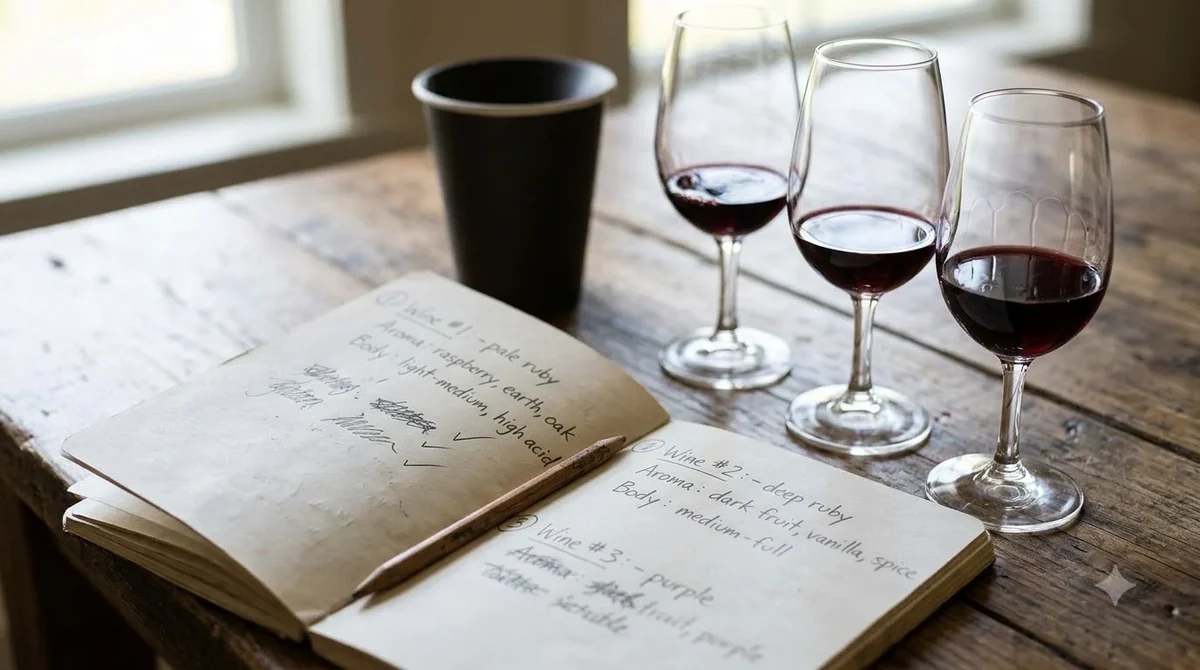
Try separating the nose into three passes rather than searching for every possible descriptor at once. First, look for the fruit: does it resemble fresh cherry, ripe plum, or dried berry? Next, look for the floral and herbal layer, such as violet, dried rose, sage, thyme, or wild fennel. Finally, note the savory details: damp soil, forest floor, leather, tobacco, tea leaf, iron-like mineral impressions, or baking spice. A wine may show only a few of these, and that is normal. The goal is to describe what is actually present, not to force a checklist onto the glass.
Oak can add cedar, vanilla, clove, toast, and sweet spice, but those aromas should sit alongside the grape rather than erase it. A pronounced vanilla note does not automatically mean a wine is better or more mature; it may simply reflect the type and size of the vessels used. Some producers favor larger oak casks, which tend to be less overtly aromatic, while others use smaller barrels that can make wood-derived notes more obvious. The proportion of new oak, time in barrel, and the wine’s fruit concentration all affect how clearly those aromas register.
Acidity, Tannin, Body, and Finish
Brunello’s structure is a major part of its identity. Expect lively acidity, firm tannin, a substantial but not necessarily massive body, and a finish that can carry cherry, herbs, spice, and savory flavors for several moments. The acidity keeps ripe fruit from feeling flat, while tannin gives the wine grip and a drying sensation along the gums and inside the cheeks.
Acidity is often described as fresh, bright, or mouthwatering. It is one reason Brunello can work at the table with rich meat dishes: a sip can refresh the palate between bites. Tannin is more tactile. In a young wine, it may feel fine-grained but assertive, coating the mouth or creating a slightly chalky sensation. With bottle age, the tannins may seem more integrated and less angular, although storage conditions and vintage matter. A wine with firm tannin should not be mistaken for one that is harsh; good structure feels connected to the fruit and acidity rather than detached from them.
Body describes weight and texture, not alcohol alone. Brunello often feels medium-full to full, with enough concentration to stand up to braised beef, lamb, or game. Alcohol warmth may be present, particularly in ripe vintages, but balance is the key. The finish should not collapse as soon as the fruit fades. Look for a lingering sequence of cherry skin, dried herbs, earth, spice, or citrus-like freshness. If the wine feels hot, sour, or aggressively drying without fruit to support it, give it air and revisit it; an overly warm serving temperature can exaggerate alcohol and make the structure seem less harmonious.
Montalcino’s Sites and Winemaking Choices
Brunello’s broad flavor family is recognizable, but individual bottles can differ substantially because Montalcino is not one uniform vineyard. Slope, elevation, exposure, soil, growing-season weather, and cellar practice all shape the finished wine. Decanter’s regional tasting discussion describes a general contrast: wines from farther south can be fuller, softer, and rounder, while wines from the northern area and the ridge east of Montalcino can show a more linear, savory character and evolve more slowly.
Those are broad tendencies, not guarantees that a compass direction predicts every glass. A site name such as Montosoli or Canalicchio can point a drinker toward a particular place, but producer decisions and the conditions of a specific growing season remain important. Higher, cooler slopes can help preserve freshness during hot summers, while warmer exposures may encourage riper fruit and a broader texture. Even neighboring vineyards can produce different results when their elevation, airflow, soil depth, or sun exposure changes.
Winemaking can make those differences more pronounced. Decanter notes that wines aged in smaller barriques or tonneaux can offer a more immediate fruit impression and smoother tannins, while long maceration and aging in large Slavonian oak barrels can produce drier, more restrained wines that take longer to open. Neither approach is a quality label by itself. Smaller barrels may contribute more obvious oak flavor; larger vessels usually allow the grape’s fruit and savory character to remain more prominent. Fermentation choices, extraction, and the length of maturation also affect texture and aromatic definition.
Aging, Riserva, and Bottle Development
Time is built into Brunello’s identity, but legal aging minimums and a wine’s ideal drinking window are two different questions. The denomination requires a lengthy period before release, including at least two years in oak. A Riserva must spend longer in bottle and cannot be released as early as a standard Brunello. These rules create a baseline; they do not mean every bottle will taste fully mature on its release date.
According to the Brunello consortium, standard Brunello must age for at least two years in oak and four months in bottle, while Riserva requires at least six months in bottle. Release is delayed until January 1 after five years counted from the harvest year for standard Brunello, and after six years for Riserva. The table summarizes the minimums; producers may choose longer maturation, and a wine’s development after release depends on vintage, producer, and storage.
| Requirement | Brunello di Montalcino | Brunello Riserva |
|---|---|---|
| Minimum oak aging | 2 years | 2 years |
| Minimum bottle aging before release | 4 months | 6 months |
| Earliest release timing | January 1 after 5 years counted from harvest year | January 1 after 6 years counted from harvest year |
Young Brunello often emphasizes primary fruit, lively acidity, and prominent tannin. In the middle stage of development, those elements can knit together: cherry and plum may become more nuanced, while tobacco, leather, dried flowers, tea, and earthy notes gain definition. Older bottles can develop a softer, more delicate profile, with dried fruit and savory tertiary aromas replacing some of the fresh fruit. The shift is not automatic or identical from bottle to bottle. A strong vintage from a careful producer may develop over a long period, while another wine may reach its best earlier.
The consortium describes a broad aging potential of roughly 10 to 30 years, depending on the vintage, and notes that some bottles can last longer when kept properly. That range is a guide rather than a promise for every wine. Keep bottles on their sides in a cool, dark place with stable conditions; fluctuations in temperature are more damaging than a cellar that is a little warmer or cooler than the ideal. A bottle that has been stored in a hot room or near a sunny window may not develop as intended, even if its vintage is old.
Serving Brunello and Choosing Food Pairings
Brunello shows best when it is cool enough to preserve freshness but not so cold that its aromas and texture seem muted. A practical target is 60–65°F, with a large-bowled red-wine glass that gives the wine room to open. Older bottles may need careful handling, while a young, structured wine can benefit from air before the meal.
For a young full-bodied Brunello, begin with 30 to 60 minutes of decanting and check its progress rather than assuming that more air is always better. Pour a modest 5-ounce serving so there is room to swirl and follow the aroma as it changes. A standard 750 ml bottle yields about five such glasses. For an older bottle, stand it upright beforehand if sediment is likely, open it gently, and pour slowly; prolonged decanting can strip a fragile mature wine of some of its delicate aromas. For a fuller explanation of temperature, glassware, and opening technique, see how to serve brunello di montalcino.
Food should match the wine’s intensity and structure. Roast or grilled beef, braised short ribs, lamb, venison, and other game are natural choices because their savory richness can meet Brunello’s tannin and concentration. Mushrooms, porcini, truffles, rosemary, and thyme echo the wine’s earthy and herbal notes. The Brunello consortium also recommends red meats, game, mushroom and truffle dishes, and aged cheeses, including Tuscan pecorino. Aged hard cheeses can be especially effective because salt and fat soften the perception of tannin.
Acidity matters as much as weight. Tomato-based dishes need a wine with enough freshness to keep the food from making the wine taste dull; Brunello’s acidity can make that pairing work when the sauce is not excessively sharp. Avoid pairing a strongly tannic red with oily fish, whose texture can make tannin seem harsher. Very spicy food can also magnify the impression of alcohol and tannin, so dishes with intense chili heat are usually less comfortable matches than herb-roasted or slowly braised preparations. A simple roast with rosemary may be better than a complex dish loaded with sweet glazes, smoke, and hot spice. A mature bottle can pair beautifully with restrained mushrooms or aged cheese, while a younger wine can take on a richer braise. For a broader look at the grape, appellation, and style, start with what is brunello di montalcino and how to pronounce brunello di montalcino, then browse Wine by Type.
Tip: Taste Brunello in three stages: immediately after pouring, after 15 minutes in the glass, and after another 20 minutes. Note whether the cherry fruit becomes more open, whether the tannin softens, and whether herbs, earth, or spice appear as the wine breathes.
Frequently Asked Questions
These quick answers cover a few technical details that can help when reading a Brunello label or comparing bottles.
What is the minimum alcohol level for Brunello?
The denomination sets a minimum alcohol content of 12.5% ABV. Individual wines may be higher, depending on grape ripeness and the vintage.
Is there a minimum acidity requirement?
Yes. The production rules specify a minimum total acidity of 5 grams per liter. This is a legal analytical threshold, not a promise that every bottle will taste equally sharp or tart.
Does Brunello have to be bottled in Montalcino?
Yes. The consortium’s production rules require bottling within the defined production area. That requirement is separate from the rules governing where the grapes are grown.
Is there a required bottle shape?
Brunello di Montalcino must be sold in a Bordelaise-shaped bottle under the denomination’s packaging rules. The familiar high-shouldered bottle is therefore part of the appellation’s formal presentation, not just a producer preference.
How much fruit can a Brunello vineyard produce?
The consortium lists a maximum grape yield of 80 quintals per hectare. Yield limits help define production standards, although vineyard age, site, weather, and farming choices still influence the character of the grapes.
Brunello is best understood as a structured, food-friendly Sangiovese whose cherry fruit, acidity, tannin, and savory layers change with site and age. Start with the balance in the glass, then consider the vintage, producer, and time in bottle to decide whether its character is youthful and vivid or mature and complex.
More in Wine Types & Grapes
 Zinfandel Sugar Content: Dry Red vs. White Zinfandel GramsUpdated Nov 21, 2026
 Best Zinfandel Substitute Options for Sipping and CookingUpdated Nov 21, 2026
 Zweigelt Food Pairing: Best Dishes, Cheeses, and Serving TipsUpdated Nov 21, 2026
 Zinfandel Tannins Explained: How Structure Shapes Every BottleUpdated Nov 21, 2026
 Zinfandel Sweetness Level: Dry Red vs. Sweet White Zin ExplainedUpdated Nov 21, 2026
 Xinomavro Food Pairing: Best Dishes, Styles, and Serving TipsUpdated Nov 21, 2026