

We may earn a commission when you buy through links on this page, at no extra cost to you. Learn more.
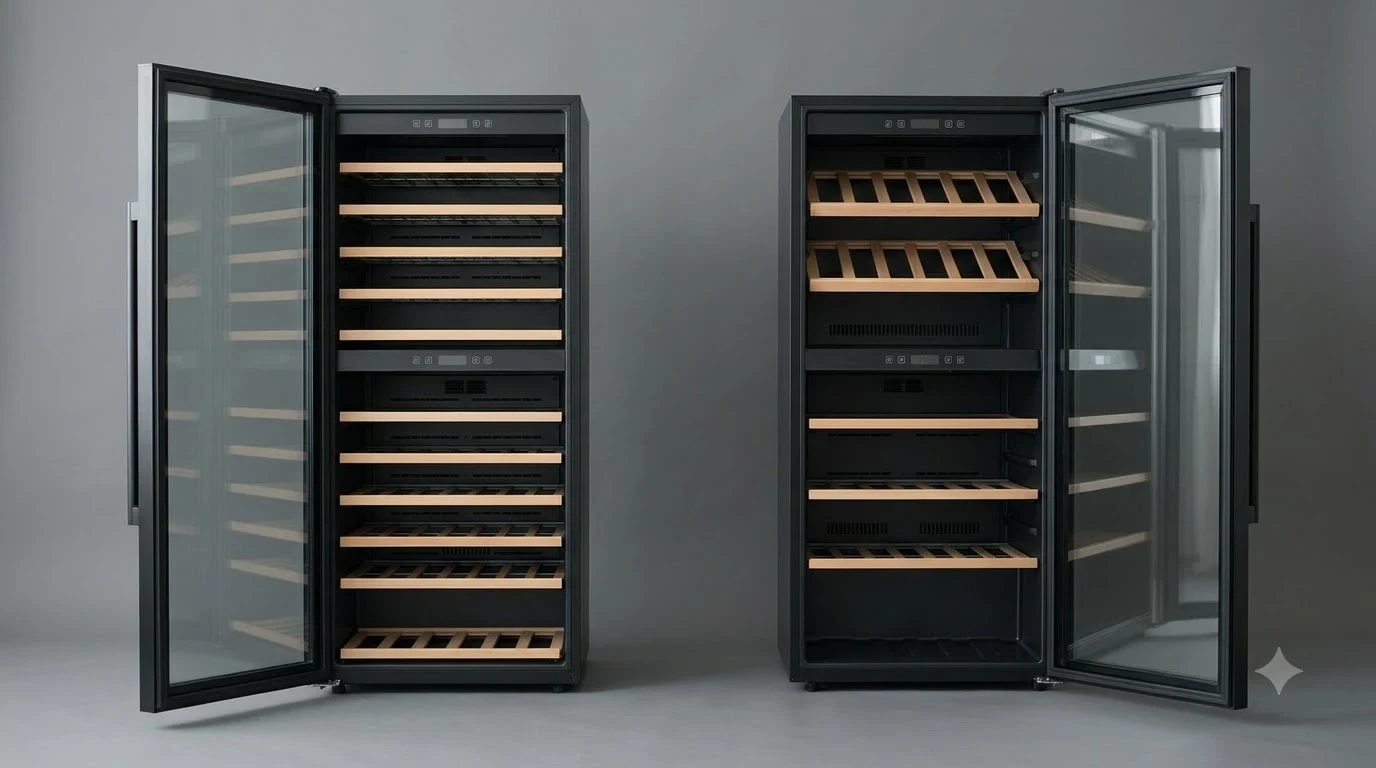
The EdgeStar dual zone wine fridge is a practical choice for wine collectors who want separate temperature settings for red and white wines, with models offering capacities ranging from compact collections to more than 140 standard bottles. Its strongest advantages are independent cooling zones, built-in installation options, and a selection of cabinet sizes. However, owner reports raise legitimate questions about long-term compressor reliability, repair costs, and actual bottle capacity, making model selection and warranty evaluation particularly important.
EdgeStar offers several wine refrigerator configurations rather than one universal dual-zone appliance. The CWR5631FD, for example, is a 56-bottle French-door refrigerator, while the CWR1553DD is a much taller model rated for 142 standard bottles. Understanding these differences helps buyers choose a refrigerator that fits their kitchen, collection, and preferred serving temperatures without paying for capacity they will never use.
Specs and Key Features: What the EdgeStar Dual Zone Wine Fridge Offers
The main attraction of an EdgeStar dual-zone refrigerator is the ability to maintain two different wine-storage environments in one cabinet. This arrangement is useful for households that regularly serve both red and white wine, because the bottles can be kept at different temperatures without requiring two separate refrigerators.
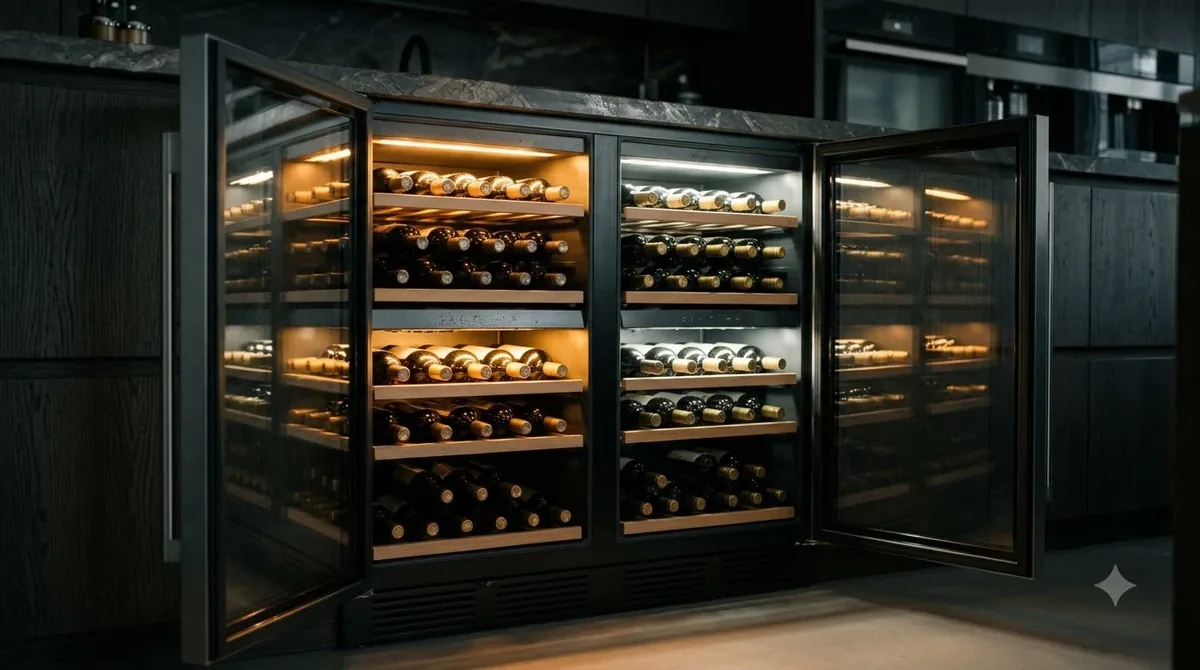
The CWR1553DD provides a useful example of the brand’s larger-capacity approach. According to its owner’s manual, it accommodates up to 142 standard 750 ml bottles, uses R600a refrigerant, and has a temperature range of 40°F to 65°F. Its two-zone arrangement makes it suitable for collectors who want substantial storage capacity while keeping different wine categories separate.
The CWR5631FD takes a different approach. It has a 56-bottle advertised capacity and a width of approximately 29.5 inches. Its French-door design gives it a more furniture-like appearance, while its dual-zone cooling makes it suitable for a kitchen, entertaining area, or dedicated wine-storage space.
These specifications should not be treated as interchangeable. The CWR1553DD and CWR5631FD have different dimensions, capacities, and installation requirements. Before ordering, identify the complete model number rather than relying on a retailer’s general EdgeStar dual-zone description.
| Specification | CWR1553DD | CWR5631FD |
|---|---|---|
| Advertised capacity | 142 bottles | 56 bottles |
| Width | 23.44 inches | 29.50 inches |
| Height | 69.44 inches | 34.31 inches |
| Depth | 29.19 inches | 25.44 inches |
| Temperature range | 40°F–65°F | 40°F–65°F |
| Cooling arrangement | Dual zone | Dual zone |
| Refrigerant | R600a | See model manual |
| Electrical supply | 115V, 60Hz | 115V, 60Hz |
The CWR1553DD dimensions and specifications come from its owner’s manual, while the CWR5631FD dimensions and advertised capacity come from its Lowe’s product listing. Dimensions are particularly important because the first model is considerably taller, while the second occupies a wider horizontal footprint.
Both models have a stated temperature range broad enough to accommodate different wine-storage preferences. Nevertheless, a temperature setting is not necessarily identical to the temperature of every bottle. Allow the cabinet to stabilize, avoid frequent door openings, and use an independent thermometer if accurate internal monitoring is important.
For further technical information, the EdgeStar CWR1553DD owner’s manual provides specifications, operating instructions, installation requirements, and warranty information.
What Owners Like About EdgeStar Wine Refrigerators
Owner feedback highlights three recurring strengths: separate temperature controls, attractive cabinet designs, and convenient wine storage. These advantages explain why EdgeStar models appeal to homeowners who want a dedicated wine refrigerator that also fits into an existing kitchen or entertaining space.
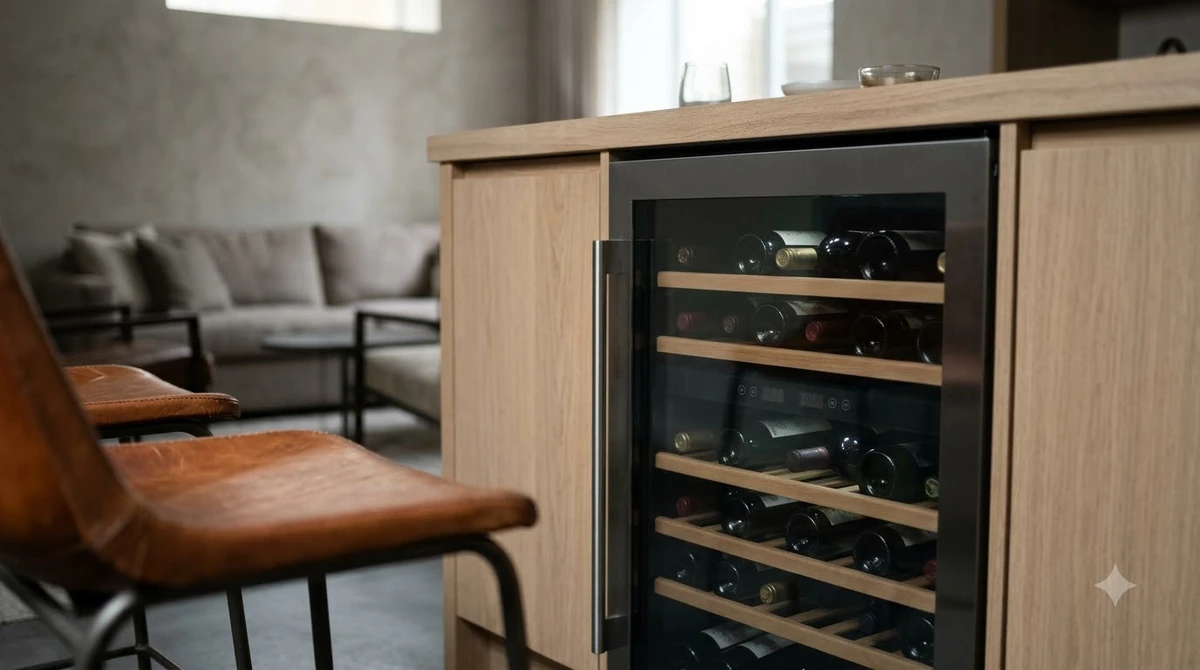
Temperature separation is arguably the most useful feature. A household that regularly drinks Cabernet Sauvignon, Pinot Noir, Chardonnay, and Sauvignon Blanc can organize its collection according to serving requirements rather than keeping every bottle at one compromise temperature.
For example, a collector might set one zone around 46°F for lighter whites and another around 58°F for lighter reds. These settings are practical serving-oriented examples rather than universal long-term storage requirements. The ability to change both zones independently gives owners more flexibility than a single-temperature beverage refrigerator.
Appearance is another recurring positive point in retailer feedback. Owners of the CWR5631FD mention its attractive stainless-steel finish, French-style doors, and interior lighting. These details can make a difference when the refrigerator is installed in a visible kitchen or dining area rather than hidden in a utility room.
Some reviewers also appreciate quiet operation. The CWR1553DD feedback includes positive comments about relatively quiet performance during frequent use. This matters because a wine refrigerator in an open-plan kitchen may operate close to dining and conversation areas.
Sliding shelves and organized storage are additional practical benefits on certain models. The CWR1552DZ, for example, is listed by Home Depot with 14 wire shelves. Its product description also identifies interior LED lighting and an advertised 141-bottle capacity.
Still, individual experiences vary. A positive review of one model should not be treated as proof that another EdgeStar refrigerator has identical construction, performance, or durability. The most useful approach is to compare reviews using the exact model number and pay attention to feedback from owners who have operated the appliance for several years.
For wine drinkers who enjoy preparing cocktails as well as serving bottles, a separate refrigerator can also help organize entertaining supplies. A chilled bottle of sparkling wine, for example, is convenient when preparing an Aperol spritz recipe for guests.
Common Complaints: Reliability, Bottle Capacity, and Temperature Control
The biggest concern surrounding the EdgeStar dual-zone range is long-term reliability. Retailer feedback includes reports of compressors failing, cooling stopping after a few years, and owners having difficulty finding technicians willing to perform repairs.
For the CWR5631FD, Lowe’s displays a mixture of favorable and unfavorable owner experiences. Some buyers praise the refrigerator’s cooling performance and appearance, while others describe units that stopped cooling after approximately two years. One particularly concerning review describes smoke and a burned-plastic smell after the refrigerator reportedly failed.
These reports are individual customer accounts, not evidence that every EdgeStar refrigerator has a safety or reliability defect. Nevertheless, they deserve attention. An appliance that stops cooling can put an entire collection at risk, particularly if it contains expensive bottles intended for long-term storage.
The CWR1552DZ has also received mixed feedback. Some owners appreciate its dual-zone arrangement and sliding shelves, while another customer review describes excessive moisture, mold, and bottle damage. Humidity and condensation problems should therefore be investigated rather than assuming that every unit will perform identically.
Practical capacity is another issue. Manufacturer capacity figures generally use standard 750 ml Bordeaux-style bottles as their reference. Real collections often contain wider Burgundy bottles, Champagne bottles, sparkling wines, and unusually shaped containers.
These larger bottles may occupy additional shelf space or prevent adjacent shelves from sliding normally. One owner of the CWR1553DD reported that certain Pinot Noir bottles did not fit as expected, reducing the usable capacity substantially below the advertised figure.
Temperature displays also deserve attention. A display may communicate the programmed setting rather than provide a complete picture of the temperature throughout the cabinet. Owners should consider using a separate thermometer to check whether the actual environment remains consistent.
Another potential inconvenience is repairability. A compressor replacement may sound straightforward, but finding a qualified technician and obtaining the appropriate replacement components can be difficult. The availability of service is particularly important for a large refrigerator that requires professional handling.
Tip: Before purchasing, search for reviews using the complete model number, not just EdgeStar dual-zone wine fridge. Pay particular attention to reports about compressor failures, condensation, replacement parts, and repair experiences after the original warranty expires.
For a balanced evaluation, give more weight to recurring patterns across multiple owners than to one exceptionally positive or negative review. A refrigerator with attractive styling and excellent initial cooling can still be a poor long-term purchase if replacement parts are difficult to obtain.
Who Should Buy the EdgeStar Dual Zone Wine Fridge and Who Should Skip It?
EdgeStar’s dual-zone refrigerators make the most sense for wine drinkers who genuinely need two temperature environments and have a suitable installation space. They are less attractive for buyers who prioritize proven long-term durability, straightforward repairs, or maximum flexibility for oversized bottles.
Consider an EdgeStar model if:
- You regularly keep both red and white wines available for serving.
- You want one appliance with independently controlled cooling zones.
- You have measured the installation space and confirmed that the selected model fits.
- You prefer a dedicated wine refrigerator rather than a general-purpose kitchen refrigerator.
- You have checked the warranty and confirmed that local service options are available.
- Your collection consists mainly of standard 750 ml wine bottles.
The dual-zone arrangement can be particularly useful for entertaining. For instance, Sauvignon Blanc and Riesling can be kept cooler than Merlot or Pinot Noir, reducing the need to move bottles between different refrigerators before dinner.
Collectors who purchase wine in larger quantities may prefer the CWR1553DD because its advertised 142-bottle capacity provides substantially more room than the 56-bottle CWR5631FD. However, that larger capacity comes with a taller cabinet and a greater need to plan the installation carefully.
Skip or reconsider an EdgeStar model if:
- You want an appliance with an established record of exceptionally long service life.
- You cannot easily obtain appliance repair services in your area.
- You regularly store oversized Champagne, Burgundy, or specialty bottles.
- You need precise temperature monitoring throughout every shelf position.
- Your installation area is unusually hot, humid, or poorly ventilated.
- You are unwilling to accept the possibility of expensive repairs after warranty coverage ends.
There is also little reason to buy a 142-bottle refrigerator if you own only 20 or 30 bottles and do not expect your collection to grow. A smaller refrigerator can reduce wasted space and make bottle organization easier.
Think about the wine you actually purchase. Cabernet Sauvignon, Merlot, Pinot Noir, Chardonnay, and sparkling wines have different serving requirements, but that does not automatically mean every household needs a large dual-zone cabinet.
Wine collectors who mainly buy bottles for long-term aging should also distinguish between a serving refrigerator and a dedicated storage cellar. A dual-zone appliance provides flexibility for different temperatures, but a stable single-temperature environment around 55°F is often more appropriate for storing a mixed collection over extended periods.
How It Compares to Alternatives and Other EdgeStar Models
EdgeStar’s own product range provides several alternatives for different storage needs. The CWR5631FD is aimed at buyers seeking a wider 56-bottle cabinet, while the CWR1553DD is designed for a much larger collection in a narrower, taller configuration.
The CWR1552DZ offers another large-capacity option. Home Depot lists it as a 141-bottle, 24-inch built-in dual-zone wine cooler with 14 wire shelves. Its advertised capacity is close to that of the CWR1553DD, although buyers should not assume that the two models share identical dimensions, shelf arrangements, or controls.
The distinction between built-in and freestanding installation is also important. A refrigerator intended for built-in use generally requires front ventilation so that heat can escape without relying on open space around the cabinet sides. A freestanding unit may have different ventilation requirements.
EdgeStar’s CWB2886FD is a different kind of alternative. It combines wine and beverage storage in one cabinet, with a stated capacity of 28 standard wine bottles and 86 standard 12-ounce cans. Its wine zone is rated for 40°F to 65°F, while the beverage zone has a range of 38°F to 65°F.
This combination makes more sense for households that want wine alongside cans of sparkling water, soft drinks, or other chilled beverages. It is not necessarily a better option for serious wine collectors because its dedicated wine capacity is considerably smaller.
Here is a practical comparison of the available configurations:
| Model | Advertised capacity | Configuration | Best suited to |
|---|---|---|---|
| CWR5631FD | 56 bottles | Dual-zone wine refrigerator | Medium-sized collections |
| CWR1553DD | 142 bottles | Dual-zone wine refrigerator | Larger wine collections |
| CWR1552DZ | 141 bottles | 24-inch built-in dual-zone | Large under-counter installations |
| CWB2886FD | 28 bottles and 86 cans | Wine and beverage refrigerator | Mixed wine and drink storage |
These figures are advertised capacities based on the manufacturers’ stated bottle or can formats. They should not be interpreted as guaranteed real-world storage totals for collections containing unusually large bottles.
Buyers comparing EdgeStar with other brands should use a consistent checklist: actual external dimensions, temperature range, ventilation design, noise, warranty coverage, service availability, and usable shelf spacing. Comparing advertised bottle counts alone can produce misleading results.
For additional appliance comparisons, the wine refrigerator model reviews section can help narrow the choices by product type and intended use.
Installation, Temperature Settings, and Everyday Maintenance
Correct installation is essential for an EdgeStar wine refrigerator to operate properly. Buyers should measure the available space, provide the required ventilation, use a grounded electrical outlet, and allow the cooling system to settle before loading bottles.
The CWR5631FD owner’s manual provides useful installation guidance for this model. It specifies an ambient operating environment above 50°F and below 95°F, at least 2 inches of rear clearance, and at least half an inch at the top and sides for the applicable installation arrangement.
These figures should not automatically be applied to every EdgeStar model. The CWR1553DD has its own installation instructions, including a different set of recommended clearances. Always use the manual corresponding to the exact refrigerator being installed.
Electrical requirements deserve equal attention. The CWR1553DD manual specifies a grounded 115V, 60Hz supply and recommends a dedicated circuit. It also advises against using extension cords or power strips.
Moving and positioning a large wine refrigerator should be treated as a two-person job. Keep the appliance upright, avoid damaging its refrigerant lines, and ensure that the floor or supporting platform can handle the weight of a fully loaded cabinet.
Choosing the right temperature settings
The two zones should reflect the types of wine you keep most frequently. The following temperatures are useful starting points for serving:
- Champagne and sparkling wine: 40°F to 50°F.
- Light white wines and rosé: 45°F to 50°F.
- Full-bodied white wines: 50°F to 55°F.
- Light-bodied red wines: 55°F to 60°F.
- Full-bodied red wines: 60°F to 65°F.
- Sweet white wines: 43°F to 50°F.
These are serving ranges rather than a requirement to maintain different temperatures for every grape variety. A practical household arrangement is to keep the white-wine zone around 46°F to 48°F and the red-wine zone around 58°F to 60°F.
For example, a bottle of Chardonnay can be placed in the cooler zone, while a bottle of Merlot can be kept in the warmer zone. Full-bodied Cabernet Sauvignon may benefit from a slightly warmer serving temperature than lighter Pinot Noir.
Preparing the refrigerator before use
- Measure the space. Check the refrigerator’s width, height, depth, door swing, and required ventilation clearance.
- Prepare the electrical connection. Use the properly grounded outlet specified in the relevant owner’s manual.
- Position the appliance. Keep it upright and level, and avoid placing it near ovens, direct sunlight, or other heat sources.
- Allow settling time. Follow the model-specific instructions for letting the cooling components settle after transportation.
- Set both zones. Choose temperatures appropriate for the wines you intend to store.
- Allow the cabinet to stabilize. The CWR1553DD manual recommends allowing at least 24 hours for the temperature to reach its setting before storing items.
- Load bottles carefully. Distribute the collection without forcing shelves or obstructing the door.
For regular maintenance, keep the door seals clean and inspect them periodically. Wipe up condensation, avoid unnecessary door openings, and do not overload shelves with bottles that exceed their intended dimensions.
The CWR5631FD manual also explains that some unfamiliar sounds are normal. Refrigerant movement, compressor operation, water draining into a collection tray, and condenser-fan activity can all produce audible sounds during normal operation.
If the refrigerator develops an unusual burning smell, emits smoke, or makes alarming noises, unplug it immediately when safe to do so and contact customer service. Do not attempt to open the appliance casing or repair electrical or refrigerant components yourself.
Finally, remember that the refrigerator’s purpose is to protect wine from excessive temperature fluctuations. Store bottles horizontally where the shelf design permits, keep the cabinet away from direct sunlight, and avoid treating the appliance as a substitute for a carefully controlled professional wine cellar.
Frequently Asked Questions
Does an EdgeStar dual-zone wine fridge have separate temperature displays?
The CWR1553DD manual describes temperature displays and separate adjustment controls for its two cooling zones. The CWR5631FD manual also describes independent control panels. Display behavior and control layouts can differ between models, so consult the documentation for the exact appliance.
Can an EdgeStar wine refrigerator be used in a garage?
Garage suitability depends on the ambient temperature and the exact model. For example, the CWR5631FD manual specifies an operating environment above 50°F and below 95°F. An uninsulated garage that experiences extreme summer heat or winter cold may fall outside those conditions.
Does the EdgeStar CWR1553DD have a temperature memory function?
Yes. Its owner’s manual describes a temperature memory function that saves the previous setting during a sudden power loss. The refrigerator returns to that saved setting after power is restored, although the cabinet still needs time to recover its temperature.
Can an EdgeStar wine fridge store Champagne bottles?
Champagne bottles are often wider than standard Bordeaux-style wine bottles. Their fit depends on the shelf spacing and the specific refrigerator configuration. Before purchasing, confirm whether the shelves can accommodate the diameter and height of the bottles in your collection.
How long should an EdgeStar wine refrigerator stand after transportation?
The CWR5631FD manual instructs owners to leave the refrigerator upright for at least 24 hours before connecting it to power so the compressor oils can settle. Transportation instructions may differ by model, so use the relevant owner’s manual rather than assuming every EdgeStar refrigerator has identical requirements.
The EdgeStar dual zone wine fridge range offers useful temperature flexibility, attractive designs, and several storage configurations for different collection sizes. The CWR5631FD is worth considering for a medium-sized collection, while the CWR1553DD offers substantially more advertised capacity. However, mixed reliability reports and potential repair difficulties make warranty coverage, local service availability, and real-world bottle fit essential parts of the buying decision.
Choose the model that fits your available space and actual collection rather than relying exclusively on advertised capacity. A well-positioned refrigerator with appropriate temperature settings and accessible repair support is a more sensible investment than a larger cabinet that cannot meet your long-term storage needs.
More in Model Reviews
 Lanbo Dual Zone Wine Fridge Review: Features, Capacity, and DrawbacksUpdated Nov 20, 2026
 Lanbo Beverage Cooler Review: Features, Capacity and ReliabilityUpdated Nov 20, 2026
 Haier Wine And Beverage Center Review: Capacity, Cooling, and FitUpdated Nov 20, 2026
 Haier Countertop Wine Cooler Review: Features and Buying AdviceUpdated Nov 20, 2026
 KitchenAid Built In Wine Fridge Review: Features, Fit and Bottle CapacityUpdated Nov 20, 2026
 KitchenAid 24 Inch Wine Fridge: Features, Capacity, and Buying AdviceUpdated Nov 20, 2026