
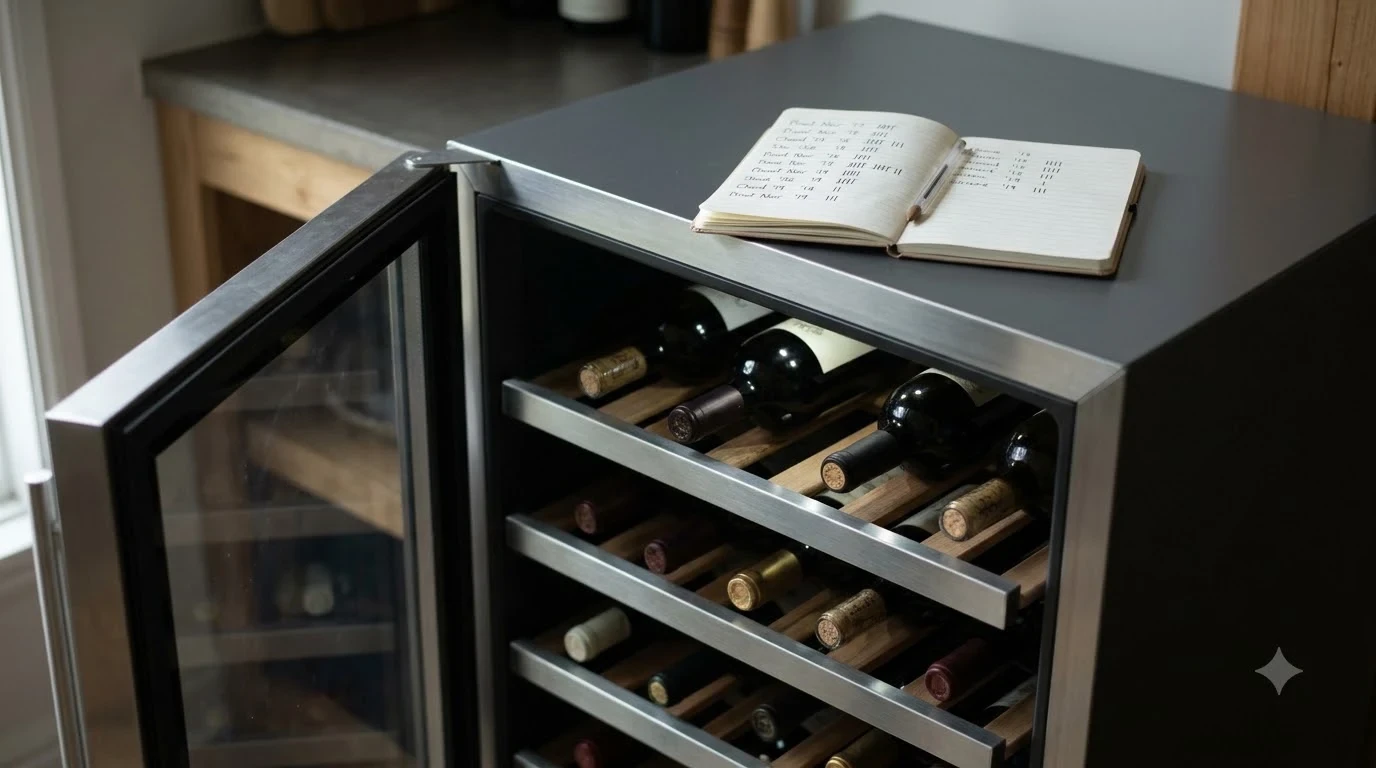

We may earn a commission when you buy through links on this page, at no extra cost to you. Learn more.
Vinotemp wine fridge repair usually starts with simple checks of power, thermostat setting, airflow, and the door gasket, and only then moves on to parts. Vinotemp’s own Wine-Mate chart begins the same way, with the power cord and receptacle before any internal component. Independent repair notes on Vinotemp units follow that same order, so a careful owner can rule out the most common causes before calling for service. The first decision is whether the unit is compressor-based or thermoelectric, because the two need different checks.
A Vinotemp that will not cool, runs without stopping, or makes an unfamiliar sound can seem like a serious failure, but many of these symptoms trace back to settings, room conditions, or a blocked airflow path. This guide organizes those checks in the order that makes sense for a home owner. It draws on Vinotemp’s own troubleshooting chart, WebstaurantStore’s wine fridge guide, a repair write-up on iFixit, and storage advice from Wine Spectator. Treat it as a first-pass diagnosis. The simple checks are safe to run yourself, while high-voltage work and refrigerant handling belong with a qualified technician.
Identify Whether Your Unit Is Compressor or Thermoelectric
Before you troubleshoot anything, confirm which cooling system your Vinotemp uses, because the repair path differs sharply. Compressor models move refrigerant through a sealed loop, while thermoelectric models have no refrigerant at all.
The model designation is the quickest clue. In a repair write-up on iFixit covering a six-bottle countertop model, the author explains that the “TEDS” designation indicates a thermoelectric cooler. That unit had no compressor and no freon or refrigerant, and its only moving parts were the cooling fans. Troubleshooting a thermoelectric unit therefore focuses on the fans, the low-voltage control circuit, and the power supply rather than on refrigerant pressure or a compressor that will not start.
Compressor models behave differently. Vinotemp’s Wine-Mate troubleshooting chart is written for them and includes entries for the compressor, start relay, start capacitor, overload protector, condenser fan, and refrigerant charge. If the symptoms point toward a sealed system, that chart is the right next stop. Owners of other manufacturers’ units with similar symptoms can look at our allavino wine fridge repair page for that brand’s typical patterns.
Check Power, Placement, and the Thermostat First
Power and temperature settings are the fastest checks to run, and they require no tools beyond a thermometer. Work through them before opening any cabinet or reading any wiring diagram.
Start with the basics that Vinotemp’s chart lists first for a unit that will not run. Confirm the power cord is fully seated, then check the receptacle and any fuses, and inspect the wiring connections for looseness. If the circuit trips repeatedly, the chart points to the fuse or breaker rating as the first thing to verify. If the voltage at the outlet seems low, the chart’s advice is direct: contact an authorized electrician rather than trying to correct the supply yourself.
Next, check the thermostat. The chart lists a setting higher than the ambient temperature as a reason the unit will not run, and WebstaurantStore identifies a setting that is too warm as one of the most common reasons a wine cabinet fails to cool. The typical targets are about 55°F for red wine and 45°F for white, according to that guide. Wine Spectator gives a wider storage window of 45 to 65°F, with 55°F often cited as close to perfect. If the unit also serves wine, the targets move upward: light reds sit at 55 to 60°F, full reds at 60 to 65°F, and sparkling wine at 40 to 50°F.
Finally, compare the display with reality. Use a separate thermometer and read it after the unit has run long enough to settle, rather than trusting the panel alone.
Tip: Place the thermometer on a middle shelf, away from the back wall and the cooling coil, so the reading reflects the air your bottles actually sit in. Vinotemp’s chart warns that a probe touching the evaporator can show an acceptable temperature while the cabinet runs warm.
Diagnose a Unit That Runs but Will Not Cool
When the unit has power and the compressor or fans run, but the cabinet stays warm, the cause is usually airflow, heat load, or a sealing problem rather than a dead component. The table below lists typical values to measure against.
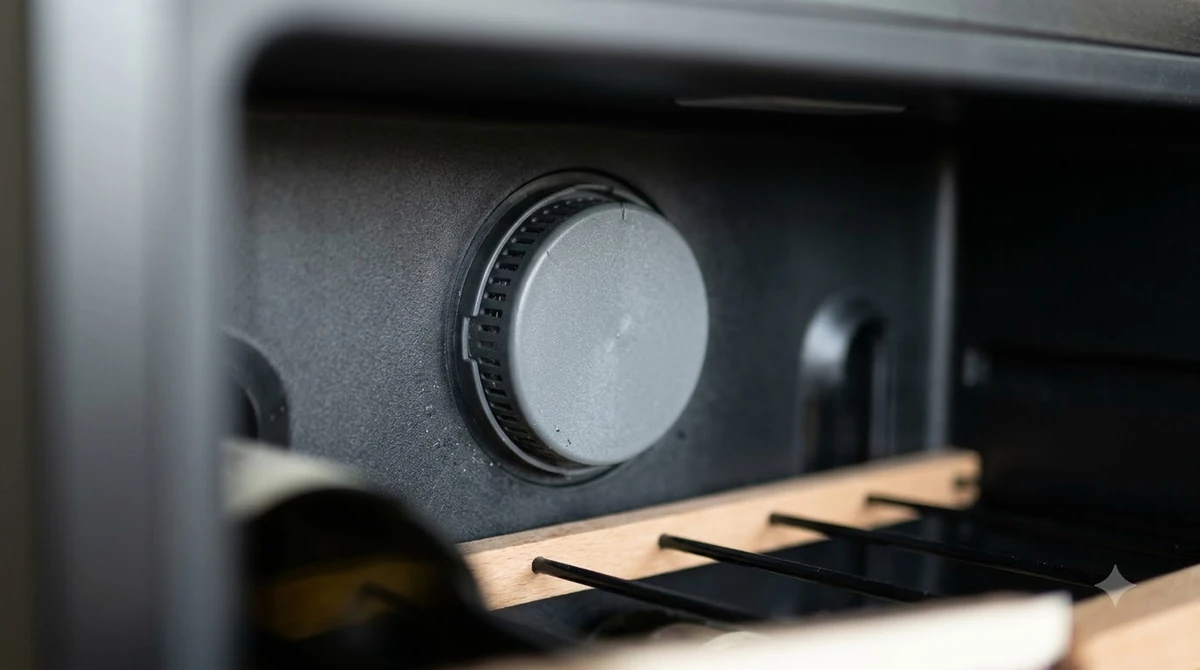
Vinotemp’s Wine-Mate troubleshooting chart lists the causes of a temperature that stays high while the unit runs continually. They include poor cellar insulation and seal, a cellar that is too large for the unit, an ambient temperature that is too high, restricted exhaust, malfunctioning fans, restricted evaporator or condenser airflow, a dirty condenser, an iced evaporator, and refrigerant leaks or charge problems. Several of these are owner-level checks, such as inspecting the gasket and door opening, clearing airflow, and cleaning the condenser. Leaks and charge issues go to a service call.
Load matters as well. WebstaurantStore’s guide says that overloading a cabinet with warm bottles can overwhelm the cooling system, so bottles should be near serving temperature before they go in, with space left for air to circulate. A door left slightly ajar lets warm room air in and keeps the unit working. Before you assume the appliance is failing, place a few bottles at normal cellar temperature into the cabinet and watch whether it recovers over the following hours.
| Check | Typical value | What it tells you |
|---|---|---|
| Red wine storage setting | About 55°F | Standard target for storing red wine |
| White wine storage setting | About 45°F | Cooler target for white wine |
| Ideal overall storage range | 45°F to 65°F | Wine Spectator’s recommended window |
| Exhaust side clearance | At least 3 feet | Hot air must leave the unit freely |
| Intake side clearance | At least 1 foot | Cool room air must reach the unit |
| Ambient room temperature | Below 90°F | Hotter rooms keep the unit running too long |
| Relative humidity | 50% to 80% | Safe range; sustained readings above 60% can cause condensation |
Use the table as a checklist rather than a verdict. If your readings sit within the typical values and the cabinet still runs warm, the next checks are the gasket, the evaporator, and the condenser, covered in the sections that follow.
Clearance, Airflow, and Room Conditions
Placement can decide whether a cabinet runs quietly or never stops. Clearance and room conditions matter as much as any internal part, and they are among the cheapest variables to fix.
Vinotemp’s chart calls for at least 3 feet of clearance on the hot-air exhaust side and at least 1 foot on the ambient air intake side. Blocked exhaust forces the unit to shed heat into a confined space, which makes the compressor and fans work harder. The chart also lists grille direction and air short-circulation as causes of poor airflow, so check that the front grilles do not face a wall, a cabinet door, or another appliance’s exhaust. Air that loops between a unit’s own vents never reaches the cabinet interior.
Room temperature is the other major variable. The chart flags an ambient temperature over 90°F as a reason the unit runs too long, and it lists a cellar that is too large for the unit as another cause. Keep the unit away from a kitchen corner, a laundry room, or any spot that picks up heat from appliances or direct sun. Wine Spectator recommends the same kind of location, advising owners to rule out kitchens, laundry rooms, and boiler rooms where heat can affect wine, and to avoid spots in direct line with light from a window.
Humidity belongs in the same conversation. Wine Spectator considers anywhere from 50 to 80 percent humidity safe for stored wine. WebstaurantStore warns that relative humidity consistently above 60 percent can cause condensation on the cabinet and floor, and it recommends a dehumidifier when that happens. A room that stays in the middle of these ranges avoids both dryness and condensation.
Gaskets, Condensation, and Iced Evaporators
Water and frost are usually symptoms rather than root causes. They tend to point back to a leaking door seal or a blocked evaporator, so inspect those before you replace any electrical part.
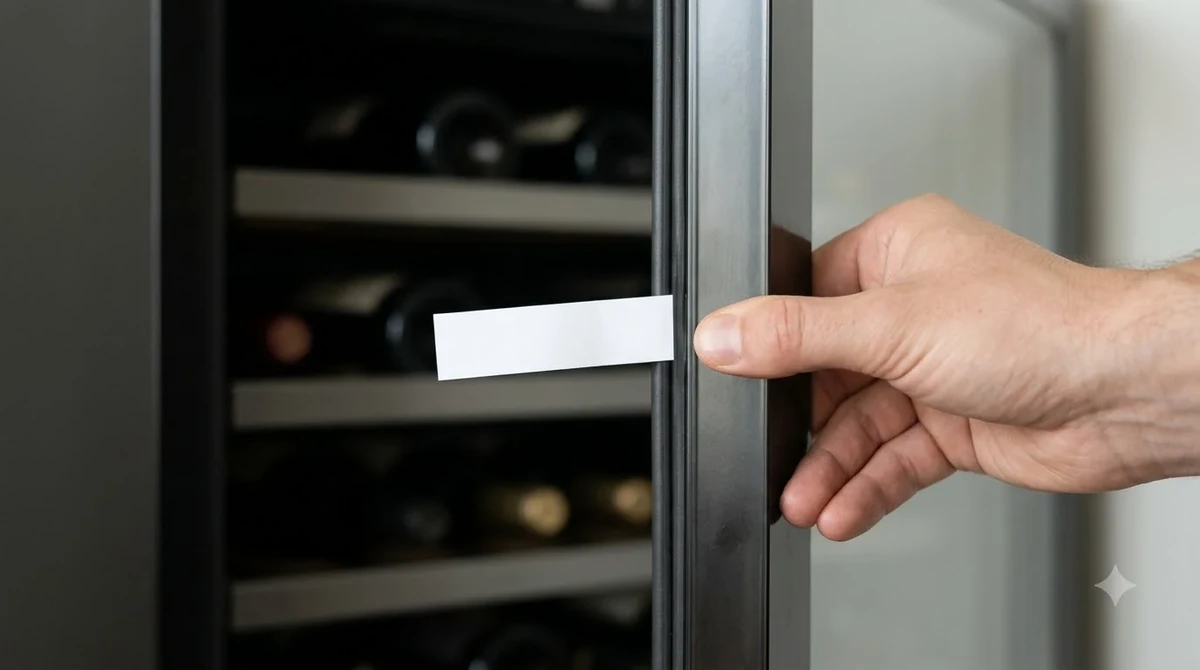
Start with the gasket. WebstaurantStore explains that condensation on the cabinet exterior or on the floor often means the door gasket is not sealing, because warm air then reaches the cold interior surfaces. Inspect the gasket for wear, cracks, or flattened spots, then check the seal by closing the door on a strip of paper and pulling it out. Resistance should be firm all the way around. A gasket that is worn, cracked, or not sealing properly should be replaced to restore an airtight seal, and an ajar door adds to the same problem by letting warm air in.
An iced evaporator is the next suspect. Vinotemp’s chart lists it as a cause of high temperature, with the response to defrost and reset the temperature. WebstaurantStore describes the process: turn the unit off, let the ice melt, restart it, and monitor its operation. Know the difference between a fault and a normal defrost cycle, though. The same guide notes that the compressor may stop for a time during defrost and should resume afterward, so wait for the cycle to finish before assuming something has failed.
Condensation can also come from the room itself. A cabinet in a humid space will sweat even with a good seal, which is why the humidity guidance in the previous section matters here. Before you change parts, trace where the moisture appears, whether on the door, the floor, or the drip path, because each location points to a different starting point for the diagnosis.
Tip: Clean the interior with warm water and a mild detergent, and skip harsh chemicals or abrasive pads, which can damage shelves and interior surfaces. WebstaurantStore recommends this routine to limit mold and odors.
Noise, Vibration, and Fan Problems
Noise usually points to a mounting or loose-part issue, while a fan that runs without the compressor points to the electrical path. Matching the sound and symptom to the component narrows the search quickly.
Vinotemp’s chart treats noise as a mounting problem first. If the mounting area is not firm, the chart says to add support to improve the installation. After that, check the fan blades, bearings, washers, tubing contact, and loose screws. A stuck fan blade should be checked for proper clearance. WebstaurantStore adds that vibration from nearby appliances or HVAC equipment can disturb the bottles, so a stable surface away from those sources is the better location.
When the fan runs but the compressor does not, the chart says to check all wiring and connections first. If the compressor runs but the fan does not, check the wiring again, then call service for failed motors. The chart’s guidance for start relays, start capacitors, overload protectors, and compressor windings is to check them, and those electrical tests are often better handed to a technician. A compressor that keeps starting and stopping with very short run times belongs in the same group.
Safety Limits and When a Technician Is Needed
Some repairs are reasonable for a careful owner, while others involve high voltage or refrigerant and belong with a qualified technician. Knowing where that line sits protects both you and the unit.
The iFixit guide on a six-bottle thermoelectric unit is direct about the hazards. Removing the back cover on that model meant backing out ten Phillips screws, and with the cover off the author warns that 120 volts AC is present, with the AC-to-DC conversion exposing about 160 volts DC. The same guide gives 10 to 12 volts DC as the reference range for a good low-voltage reading, which an owner can check with a voltmeter while the unit is powered. The high-voltage side is a different matter, and the author’s advice to be comfortable with electricity before going in is the right baseline.
Refrigerant work is a separate category. WebstaurantStore advises contacting a professional technician to inspect and recharge refrigerant when levels are low, and Vinotemp’s chart lists refrigerant leaks, undercharge or overcharge, and restrictions in the refrigeration system as items for service. If the cabinet still runs warm after the power, setting, placement, gasket, and airflow checks, stop there and call. For symptoms that do not fit these patterns, the Brand Troubleshooting hub is a good next stop, and for a Zephyr unit the zephyr wine fridge repair guide is the closer match.
Frequently Asked Questions
What do the blinking lights on a Vinotemp Wine-Mate mean?
Vinotemp’s chart says a blinking defrost light means the unit is in defrost mode, and a blinking compressor light means it is in an anti-short cycle delay. Both describe operating modes rather than faults, so give the unit time to clear them before assuming a failure. If a light keeps blinking well after the expected cycle, that is the point to contact service.
How do I reach Vinotemp support by phone?
Vinotemp lists its support line as 1.800.777.VINO, with business hours Monday through Friday, 8:00 a.m. to 5:00 p.m. Pacific time. Plan calls within those hours, and have the unit’s model designation ready so the representative can match it to the right troubleshooting path.
What should I do if my unit runs too cold?
Vinotemp’s chart lists a low temperature setting as the first cause, so raise the setting before anything else. A low ambient temperature can produce the same result, and the chart suggests moving the unit to another location. If neither fixes it, the chart points to a faulty air probe or temperature controller, and it recommends replacing whichever part has failed.
Does a few degrees of warmth ruin wine?
Wine Spectator says temperatures above 70°F age wine more quickly, but a couple of degrees warmer is not worth fretting over if the bottles are opened within a few years of release. Heat can also expand the liquid enough to push a cork out or cause seepage. Even then, the magazine notes that seepage does not always mean the wine is ruined, and the only way to know is to open the bottle.
What causes water to collect near a Vinotemp, and how is it handled?
Vinotemp’s chart separates the causes. Excessive condensate from high humidity is handled with a drain line, while restricted water passages are cleared by cleaning the drip tray. If water appears to leak without overflowing the drip tray, the chart recommends sealing that leak with silicone sealant.
Most Vinotemp problems come down to power, settings, clearance, and the door seal, and a careful owner can check those safely. When symptoms point toward refrigerant, high-voltage components, or a failed control part, bring in a qualified technician rather than guessing. Keeping the area around the cabinet clear, the gasket intact, and the room cool gives the unit its best chance to run as designed.
More in Storage & Fridge Care
 How Long Can You Store Wine in a Wine Fridge? Protect Bottle QualityUpdated Nov 20, 2026
 Can You Store Beer in a Wine Fridge? Keep Both Drinks FreshUpdated Nov 20, 2026
 Is It Worth Repairing a Wine Fridge? Spot the Cheap Fixes Before You ReplaceUpdated Nov 20, 2026
 Wine Fridge Condensation: Identify Causes and Fix Moisture ProblemsUpdated Nov 20, 2026
 Wine Fridge Too Cold: Protect Your Wine and Fix the TemperatureUpdated Nov 20, 2026
 How to Reset Wine Fridge: Restore Cooling and SettingsUpdated Nov 20, 2026