

We may earn a commission when you buy through links on this page, at no extra cost to you. Learn more.
Haier wine fridge troubleshooting starts with three checks: power at the outlet, a sensible thermostat setting, and a door that seals fully. Most complaints about a warm, noisy, or wet cabinet trace back to one of these, and each takes only minutes to rule out. If the unit still underperforms after those checks, the next step depends on whether your model uses a compressor or a thermoelectric cooling system. The steps below follow the order most owners should work through.
Haier builds wine coolers on different cooling designs, so the same symptom can have different causes on different models. A compressor unit that runs but stays warm often points to a dirty coil, a worn gasket, or a setting that is too high. A thermoelectric unit depends on fans and a semiconductor module instead, and its failure pattern looks different. The model number on the rating label tells you which design you own, and that one detail decides which sections of this guide matter most for your cooler.
Start With Power, the Outlet and the Thermostat
Before you open panels or book a visit, confirm that the unit is getting power and that its controls are set to a cold position. Haier’s own support guidance starts with these same basics when a wine cellar is not working at all, and they resolve more complaints than most owners expect.
Start at the wall. Make sure the plug is fully seated in a working outlet, and confirm the outlet has power by testing it with another device. Then check the breaker panel. A tripped breaker or a blown fuse is one of the simplest explanations for a dead unit, and resetting a breaker takes seconds. If the interior light works but nothing is cooling, power is probably reaching the unit, so move on to the controls.
Next, look at the thermostat. Haier advises owners to confirm the unit is switched on and that the thermostat control sits at a cold setting. A control left at a warm setting can make a working cooler look broken, and it is one of the most common reasons a unit seems to fail. Make the adjustment, then give the cabinet several hours to settle before you decide the problem remains.
If power and settings are correct but the unit still behaves oddly, a reset is a reasonable next step. Unplugging the cooler and plugging it back in gives the controls a clean start, which can help after a power interruption or a brief surge. The exact wait time and reset method vary by model, so check your owner’s manual before relying on a specific procedure.
Why Temperatures Swing Even When Nothing Is Broken
A wine fridge that climbs and drops is often behaving normally, and knowing the expected range keeps you from chasing a fault that does not exist. Wine and beverage cooler guidance from TCL’s support team describes the swings owners should expect before they call for help.
Compressor-based coolers operate in cycles. Once the set temperature is reached, the compressor stops, and the inside can rise several degrees before it starts again and pulls the temperature back down. Many units also run a periodic defrost cycle. During defrost the compressor pauses, which can push the displayed temperature up for a short time before the cabinet returns to its target. According to TCL’s note on normal temperature fluctuations, a temporary rise of about 6 to 8°F, followed by a restart and a drop, can be part of normal operation and does not necessarily signal a cooling problem.
Several everyday factors widen those swings. The room temperature around the unit matters most, especially in a warm kitchen, a sunny spot, or a garage. The fullness of the cabinet changes how hard the system must work, and frequent door openings let warm air in. The setting you chose and the location of the sensor inside the cabinet also shape the readings on the display. A cabinet packed with room-temperature bottles has to pull out more heat, so it runs longer and the display may swing further.
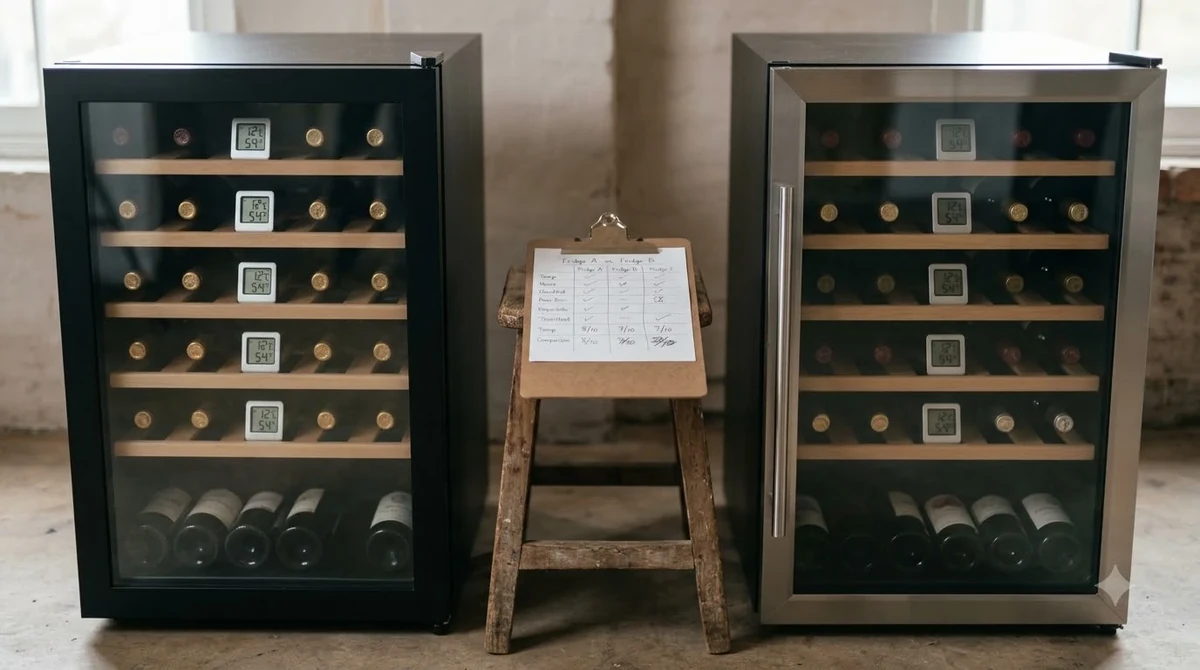
Before troubleshooting a swing, log the readings for a full day. Note the time, the display value, and any door openings. A pattern of short climbs followed by steady recovery points to normal cycling. A steady climb that never reverses, even with the door closed and the room cool, points to a real fault worth investigating.
| Symptom | Most likely cause | First check | Reference figure |
|---|---|---|---|
| Display rises a few degrees between cycles | Normal compressor cycling or defrost | Log readings for 24 hours | A rise of about 6 to 8°F can be normal |
| Cabinet runs warm for long stretches | Door opened often or left ajar | Close the door fully and reduce openings | Full reds at 60 to 65°F |
| Cabinet holds a warm temperature | Setting too high or warm bottles loaded | Lower the setting a few degrees and wait | Light reds at 55 to 60°F |
| Whites read too cool or too warm | Setting not matched to the wine style | Compare against a separate thermometer | Light whites and rosé at 45 to 50°F |
| Moisture on glass or floor | Gasket leak or humid room | Inspect the gasket and check room humidity | Keep room humidity below 60% |
Fixing a Haier Wine Fridge That Will Not Get Cold Enough
When the cabinet never reaches its target, the cause is usually the setting, the load, or a leaking seal rather than a failed component. Work through those three before anything more involved. If the unit is not cooling at all, our guide on haier wine fridge not cooling covers that branch in more depth.
Start with the set point. Haier’s service manual for its HVW18 thermoelectric model lists a preset range from 10°C (50°F) at the low end to 16°C (about 61°F) at the high end. If your target sits near the warm end of that range, or the room is hot, the unit may struggle to hold the temperature you want. The HVW18 troubleshooting article advises lowering the setting in small steps and then waiting several hours for the cavity to stabilize, rather than adjusting again right away.
Next, look at what goes into the cabinet. Warm bottles placed into a cold cabinet heat the interior quickly, and loading too many at once overwhelms the cooling system. Bring bottles to a cool room temperature before storing them, leave gaps between them so air can circulate, and keep stacks from blocking the airflow. The HVW18 manual also lists a high ambient temperature as a reason wine appears too warm, so keep the unit out of direct sunlight and away from ovens, dishwashers, and radiators.
Last, check the door. The HVW18 manual names frequent door openings and a door that does not close completely as the usual reasons a cabinet fails to hold its target, and the troubleshooting article adds a worn gasket. A quick test is to close the door on a sheet of paper and try to slide it out. If the paper pulls free with no resistance, the gasket is not making full contact. Re-adjusting the door position at the hinges can restore the seal, and a cracked or hardened gasket should be replaced.
Noise, Vibration and Leaks: What Is Normal and What Needs Service
Most wine cooler sounds are harmless, and a small number are real warning signs that justify a service call. Learning to tell them apart prevents needless worry and keeps you from ignoring a fan that is about to fail.
Popping and cracking are normal. The inner walls expand and contract as temperatures change, which can create sharp sounds. Mr. Appliance’s wine cooler service guidance treats these noises as expected, and they rarely mean anything is wrong on their own.
Vibration is a different problem. If the cooler buzzes or rattles against the floor, it is probably not sitting level. Adjust the feet until the unit sits flat and does not rock, and make sure it is not touching a wall or cabinet that can carry the sound through the room. A grinding or squealing noise is not a leveling issue. Mr. Appliance advises calling for service in that case, because it can point to a fan or motor with worn bearings or a loose part.
Leaks have their own causes. A clogged drain line lets condensation back up and spill over, a cracked drain pan can send water onto the floor, and very high humidity can produce more moisture than the drain can handle. Work through the causes in order: clear the drain line first because it is the easiest fix, then check the gasket, then check the room humidity. If the leak persists after those steps, the drain pan or internal path may need professional inspection.
Condensation, Humidity and Cleaning Routines
Moisture on the glass or on the floor usually points to a gasket leak or a humid room, and routine cleaning keeps the cooling system working efficiently. Address the room first, then the cabinet, so you do not chase a problem the environment is causing.
Condensation forms when warm, moist air meets cold surfaces. Webstaurant’s wine fridge troubleshooting guide says persistent moisture on the cabinet or floor often signals a door gasket that is not sealing, and that if room humidity stays above 60%, a dehumidifier can help stabilize conditions. The HVW18 manual adds that moisture on a thermoelectric cabinet’s inside or outside is normal during high-humidity periods, and that frequent or prolonged door openings make it worse.
Cleaning comes next. Mr. Appliance recommends cleaning condenser coils at least once or twice a year, and more often if pets shed heavily in the home, because dust blocks airflow and makes the compressor work harder to hold temperature. Unplug the unit before cleaning anything behind or beneath the cabinet, then use a soft brush or a vacuum with a brush attachment to lift debris from the coils without bending the fins. Webstaurant also lists a dirty condenser coil as a common reason for poor cooling, so this is one of the highest-value habits you can adopt.
Put the cleaning on your calendar instead of relying on memory. Pair it with a quick check of the door gasket and the drain line, since those checks take little time and catch most early problems. A short log of readings through the year also makes it easier to see when cooling begins to drift.
Tip: Place a separate thermometer near the middle of the cabinet, not against the glass or the door, and compare its reading to the display. Webstaurant recommends this kind of check to confirm the internal temperature matches what the control panel shows.
Thermoelectric Models: The Haier HVW18 Failure Pattern
Thermoelectric wine coolers fail differently from compressor units, so their troubleshooting follows a different path. The HVW18 troubleshooting article is a useful model for how the parts fit together, and it shows which checks matter before you order anything. For repair options across the brand, see our haier wine fridge repair guide.
The HVW18 uses a semiconductor module instead of a compressor. Electric current through the module creates a temperature difference, moving heat from inside the cabinet to a hot-side radiator outside. Because there is no refrigerant loop to recharge, the checks focus on the fans, the module, and the electronics that drive them.
Fans are the first suspect. An internal fan circulates cold air through the cabinet, and an external fan removes heat from the hot-side radiator. If the external fan fails, heat has nowhere to go and the interior warms. If the internal fan fails, ice can build up on the cold side and block cooling. Check both fans for dust, obstructions, and abnormal sound, since a broken blade or a failing motor can show up as vibration. Clear and clean the fans before assuming a larger failure.
If both fans run and the cabinet still does not cool, the semiconductor module may be failing. The troubleshooting article notes that a module can fail with age or electrical problems, and that replacing the whole cooling module is generally recommended over swapping a single semiconductor, so the thermal contact is right. The thermistor is the last electronic check. It monitors internal temperature, and an open circuit can stop the cooling system from powering up. A technician can measure resistance across its terminals on the circuit board to confirm it.
When to Call Haier Service and What to Have Ready
Some faults need a technician, and knowing the warning signs saves time and protects the bottles inside. Gather your model details before you call, because a service visit moves faster when the technician knows exactly what you are working with.
For Haier-branded units in the United States, the company asks owners to schedule a repair through its website or call 1-877-337-3639 if the problem continues. Its support page for wine cellars that are not working begins with the power and thermostat checks described above, so complete those first and book the visit only if nothing changes.
Call a professional sooner for compressor-related trouble, a sweet odor or hissing sound that suggests a refrigerant leak, or electrical faults involving the cord or the control board. Mr. Appliance lists those situations as ones to hand to a professional, and a qualified technician can test components safely. Do not open a sealed cooling system yourself.
Before you call, write down the brand and model number, the symptom, when it started, and the temperature log you kept. A clear record shortens the diagnosis and helps the technician decide whether the problem is a setting, a seal, or a component. For ways to keep bottles stable while the unit is out of service, see our storage care guides.
Frequently Asked Questions
How long should I unplug a wine fridge to reset it?
Mr. Appliance suggests leaving the unit unplugged for about 45 minutes to an hour before plugging it back in. Some models respond instead to pressing and holding the power button for five to ten seconds. If neither method changes the display after a few minutes, the fault is probably not a simple control glitch.
What lifespan should I expect from a wine cooler?
Mr. Appliance says wine coolers typically last between 10 and 15 years with proper maintenance. Keeping the coils clean and the door seal intact are the habits that most protect that span. Units that get routine attention are the ones most likely to reach the upper end of that range.
What should I set for a mixed collection?
Mr. Appliance suggests setting about 55°F when you store several wine styles together, because that temperature suits most varieties. If your layout allows, keep a whites-only section a few degrees cooler. Bring each bottle to its serving temperature before pouring, since the storage setting is not always the right serving temperature.
How do I check the power supply on a thermoelectric unit?
The HVW18 troubleshooting article notes that a radiator that stays cold while the unit is plugged in suggests the power supply or its fuse may be damaged. Confirm the outlet works first, since a dead wall socket produces the same symptom. Power supply repairs involve mains voltage, so have a qualified technician handle any replacement.
How do I clean the inside without damaging it?
Webstaurant recommends wiping interior surfaces with warm water and a mild detergent, which helps prevent mold and odors. Avoid harsh chemicals and abrasive pads, since they can damage shelves and interior surfaces. Dry the interior before reloading bottles so moisture does not sit on the surfaces.
Most Haier wine fridge problems come down to power, settings, airflow, or seals, and the checks above address each one in turn. Keep a simple log of readings and symptoms so you can spot patterns early and give a technician something useful. If the fault points to the cooling hardware, a qualified technician is the safer and more reliable choice.
More in Storage & Fridge Care
 How Long Can You Store Wine in a Wine Fridge? Protect Bottle QualityUpdated Nov 20, 2026
 Can You Store Beer in a Wine Fridge? Keep Both Drinks FreshUpdated Nov 20, 2026
 Is It Worth Repairing a Wine Fridge? Spot the Cheap Fixes Before You ReplaceUpdated Nov 20, 2026
 Wine Fridge Condensation: Identify Causes and Fix Moisture ProblemsUpdated Nov 20, 2026
 Wine Fridge Too Cold: Protect Your Wine and Fix the TemperatureUpdated Nov 20, 2026
 How to Reset Wine Fridge: Restore Cooling and SettingsUpdated Nov 20, 2026