

We may earn a commission when you buy through links on this page, at no extra cost to you. Learn more.
A Cuisinart wine fridge not cooling properly usually has a simple cause: the outlet or breaker, a room that is too hot, blocked vents, or a dusty condenser coil. Work through those checks in order before you assume a part has failed. Most of the specific numbers below come from the Cuisinart CWC-1200 manual, so check your own model’s manual to confirm yours.
Temperature trouble is hard to spot because the damage builds slowly and the bottles look fine from the outside. Wine Enthusiast’s breakdown of wine’s main enemies names heat as the biggest threat, and warns that long exposure to warmth can push a cork out of the bottle and lead to oxidation. A cooler that has stopped holding its setting is therefore a real problem for the wine, not just a comfort issue. The sections below move from the quickest checks to the more involved ones, so you can stop at the step that solves the problem.
What Usually Causes a Cuisinart Wine Fridge to Stop Cooling
Most cooling complaints fall into four groups: no power, a warm room, restricted airflow, or a dirty condenser coil. Less often the cause is a control setting, a worn door seal, or an electronic part that needs a technician.
Start by sorting the symptom, because each one points to a different place. A cooler that is dark and silent has a power problem. A cooler that runs but never reaches its set temperature is usually dealing with heat, airflow, or the load inside. A cooler that runs nonstop is often fighting warm air leaking through a door or a coil that cannot shed heat quickly enough.
The CWC-1200 manual groups its troubleshooting by symptom too. Its table covers vibration, a door that will not close properly, a fan that always runs, and a unit that will not cool, and it puts the outlet and vent checks at the front of the list. Finish those basic steps before you suspect a failed component, because they are quick and rule out the most common problems.
Not every cooler is built the same way inside. The CWC-1200 manual states that the unit contains no compressor, so compressor-specific checks do not apply to that model. EngineerFix notes that many smaller or less expensive wine fridges use thermoelectric cooling modules instead, and that a failed module shows up as a heat sink on the back of the cabinet that feels cool or room temperature instead of warm. If your cooler is an Allavino instead of a Cuisinart, the logic is similar, and our allavino wine fridge not cooling walkthrough covers that brand.
Check Power, the Outlet, and the Breaker First
Power problems are the quickest to rule out, so check them before anything else whenever the cooler is dark or never begins to cool.
Begin by confirming the plug is firmly seated in a working outlet. The Cuisinart CWC-1200 troubleshooting page tells owners to make sure the outlet is not controlled by a wall switch, and to confirm the outlet works by testing it with another electrical appliance. An outlet switched off at the wall looks just like a dead cooler from the front, so this check saves time.
Next, look at the breaker panel. WebstaurantStore notes that a blown fuse or tripped circuit breaker can stop a wine fridge from running, and that resetting the breaker or replacing the fuse restores power. The same CWC-1200 page warns against sharing an outlet with a refrigerator, because the refrigerator can draw power away from the cooler. A breaker that trips again and again points to an overloaded circuit, which an electrician should inspect. Also remember that a first run can take up to 24 hours to reach the desired temperature, so give a new unit time before deciding it has failed.
Tip: Place a separate thermometer on a middle shelf and compare its reading with the control panel. WebstaurantStore recommends this check because the panel setting and the real temperature inside can differ.
Room Temperature, Placement, and Vent Clearance
Room temperature and airflow decide how hard the cooler has to work. The CWC-1200 manual gives specific limits that are easy to compare against your own room.
The manual says that when the surrounding air reaches 80°F (27°C) or higher, the unit can have difficulty chilling adequately on the white wine setting. It also says that when the room is above 75°F (24°C), the unit will not get below 51°F (11°C). If your room sits in that range, the cooler may be working as designed and still fall short of a cold reading. In that case, relocating the unit is the practical fix, not a repair.
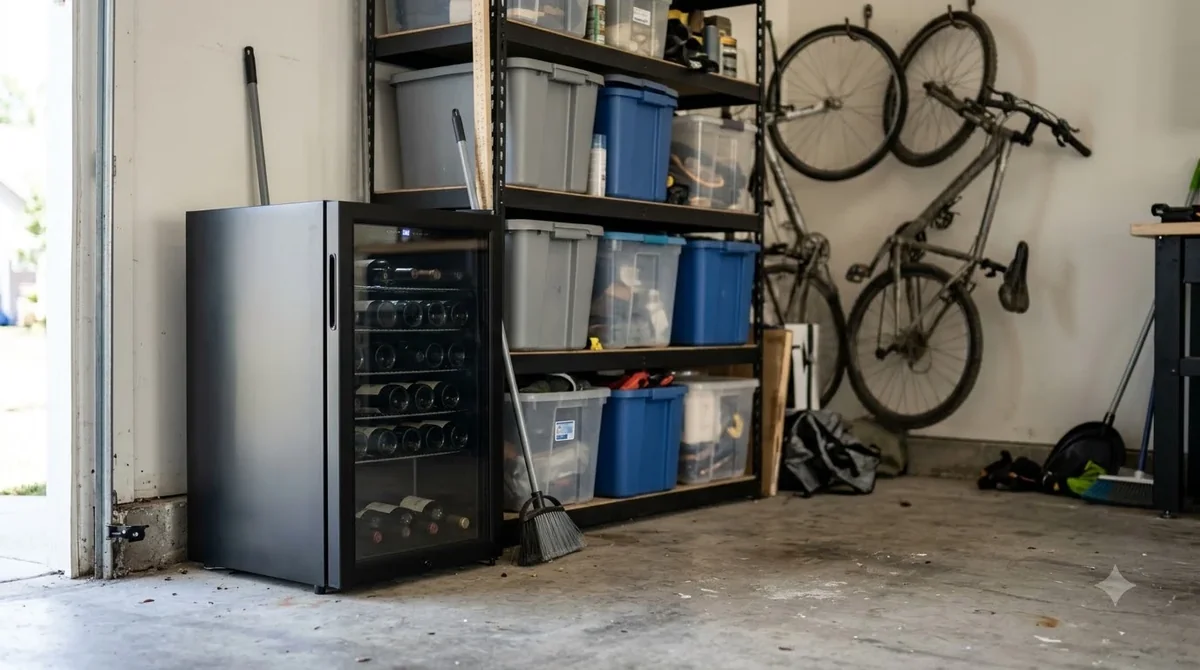
Placement is the next factor. The manual lists places to avoid: sunny spots, rooms with poor air circulation such as a garage, positions beside a dishwasher, oven, or refrigerator, and inside a cabinet or closet. Wine Enthusiast adds that strong odors from garage chemicals or cooking can alter wine’s flavor, which is another reason to keep bottles out of a kitchen or garage.
Vent clearance is a separate issue. The manual asks for at least 3 inches (76 mm) of space on both sides and at the rear, and it says the cooling vents on the right and left sides must not be obstructed. Pushing the cooler tight against a wall or cabinet is an easy way to cut that space without noticing. Pull the unit out a few inches and check that nothing sits in front of the side vents.
Clean the Condenser Coil and Confirm the Fans Are Running
Dust on the coil is one of the most frequent causes of weak cooling. Cleaning it takes a brush and a vacuum, and it often restores performance without replacing anything.
EngineerFix describes dust and grime on the condenser coils as the most frequent cause of diminished cooling. The coils carry heat from inside the cabinet into the room air, so a coated coil slows heat exchange and keeps refrigerant pressure high. The same source recommends cleaning the coils every six to twelve months with a specialized brush and a vacuum. WebstaurantStore makes the same point for commercial units, noting that a dirty condenser coil blocks airflow and inhibits cooling, so regular cleaning keeps the system efficient.
Fans come next. On compressor models the condenser fan has to run to draw air across the hot coils, and EngineerFix says a non-spinning condenser fan keeps refrigerant from cooling enough, which raises head pressure and cuts cooling power. The evaporator fan inside the cabinet has to spin to move cold air through the storage space. Unplug the unit before reaching behind it, then watch during a cooling cycle to confirm both fans turn. If the coil inside the cabinet is iced over, WebstaurantStore recommends defrosting the cooler and confirming the coil is clear before restarting it. Haier owners will find brand-specific steps in our haier wine fridge not cooling article.
Door Seals, Warm Loads, and Humidity
A leaking door and a warm load can each overwhelm a cooler that is otherwise working. Both are simple to check, and both affect the wine as well as the temperature reading.
Start with the door. WebstaurantStore warns that a door left slightly ajar lets warm air into the cabinet, and it recommends checking that the door closes fully and seals. A worn or cracked gasket causes the same problem more slowly, and it often shows up as condensation on the cabinet or on the floor beneath. EngineerFix offers a quick test: close the door on a thin strip of paper, then tug gently. If the paper slides out easily, the seal is likely failing.
Warm bottles are the next load to watch. WebstaurantStore says overloading a unit with warm bottles can overwhelm the cooling system, so it recommends letting bottles reach serving temperature before placing them inside. The CWC-1200 manual also says to keep at least three to five bottles in the unit, which is a useful check if your cooler sits mostly empty. Humidity matters more for the wine than for the cooling itself. The manual says humidity does not affect the unit’s cooling ability, while Wine Enthusiast says a consistent relative humidity between 50 and 80% keeps corks from drying out. WebstaurantStore warns that condensation can form when room humidity stays above 60%, which is a reason to consider a dehumidifier in a damp room.
Set the Right Temperature and Know When to Call a Technician
Set the cooler for storage near 55°F, confirm the reading with a thermometer, and know when a repair has become a replacement decision.
Wine Enthusiast says all wine should be stored at the same temperature, preferably between 53 and 57°F, and that the differences between red, white, and sparkling wines appear at serving time rather than during storage. The CWC-1200 manual’s plus and minus controls run from 45°F (7°C) to 68°F (20°C), so a setting near the middle of the storage range is a sensible starting point. Check the control panel as well for a Sabbath mode or showroom setting. EngineerFix says these modes can stop the cooling cycle from engaging and be mistaken for a mechanical failure.
| Check | Target or threshold | What it affects |
|---|---|---|
| Outlet and breaker | Outlet works with another appliance and is not wall-switched | Power to the cooler |
| Vent clearance | At least 3 in (76 mm) on each side and at the rear | Airflow through the cabinet |
| Room temperature | Above 75°F (24°C) keeps the unit from dropping below 51°F (11°C) | How low the unit can go |
| Storage setting | Controls run 45°F (7°C) to 68°F (20°C); aim for 53 to 57°F | Storage temperature |
| Room humidity | Keep 50 to 80% for corks; condensation risk above 60% | Cork health and condensation |
| Condenser coil | Clean every six to twelve months | Heat removal |
EngineerFix also points to the control board and temperature sensor as possible faults. A faulty thermistor can send incorrect readings to the board, which can keep the cooling cycle from starting when it should. Testing these parts needs a multimeter and careful attention to high voltage, and a sealed-system problem such as a refrigerant leak calls for a technician. EngineerFix also suggests that when a repair costs more than half the price of a replacement, a new unit is often the more economical choice. If you do call a technician, the notes from the checks above give them the room temperature, the setting, and the real reading to start from. For other brands and their common faults, browse the Brand Troubleshooting section.
Frequently Asked Questions
Is it normal for a Cuisinart wine cooler’s fan to run all the time?
The CWC-1200 manual lists a constantly running fan as a function of how the cooling system works. It also says the fan runs more at lower settings and when the room is warmer than 70°F (21°C). A fan running nonstop in a warm room is usually expected, while a fan that never starts is a different situation to check.
Does opening the door often affect cooling?
Yes. WebstaurantStore says frequent opening lets warm air into the cabinet, which makes the condensing unit work harder to hold its set temperature. The same source recommends opening the door less often and closing it securely after every use. Each opening adds warm air that the cooler must remove again.
Can light inside a wine cooler damage the wine?
Wine Enthusiast says UV rays can break down tannins, which help protect wine against oxidation. It also says artificial lights with UV output, typically non-LED bulbs, can do the same, and that light exposure can make wine cloudy and produce strong off-odors. An LED interior light is one way to avoid the non-LED lights that the source singles out.
Should I store bottles on their side in a wine cooler?
Wine Enthusiast says lying a bottle down keeps its cork moist enough for a couple of years. For longer storage, the same source says the cork still needs consistent humidity to avoid drying out. A cork that dries out can let air into the bottle and lead to oxidation.
How much electricity does the CWC-1200 use?
The CWC-1200 manual says the unit uses about as much energy as a 100-watt light bulb. The same manual says it does not use any CFCs.
A Cuisinart wine fridge that stops cooling usually responds to basic checks: power, room conditions, vents, and the condenser coil. Work from the simplest step to the most involved one, and stop when a separate thermometer reads in the 53 to 57°F storage range. If the unit still fails after those checks, the repair is probably a job for a technician.
More in Storage & Fridge Care
 How Long Can You Store Wine in a Wine Fridge? Protect Bottle QualityUpdated Nov 20, 2026
 Can You Store Beer in a Wine Fridge? Keep Both Drinks FreshUpdated Nov 20, 2026
 Is It Worth Repairing a Wine Fridge? Spot the Cheap Fixes Before You ReplaceUpdated Nov 20, 2026
 Wine Fridge Condensation: Identify Causes and Fix Moisture ProblemsUpdated Nov 20, 2026
 Wine Fridge Too Cold: Protect Your Wine and Fix the TemperatureUpdated Nov 20, 2026
 How to Reset Wine Fridge: Restore Cooling and SettingsUpdated Nov 20, 2026