

We may earn a commission when you buy through links on this page, at no extra cost to you. Learn more.
How to pronounce vinho verde: Say “VEEN-yoo VEHRD,” with a soft Portuguese “nh” sound and a lightly pronounced final vowel in “verde.” The expression comes from Portuguese and means “green wine,” although the name refers to the wine’s youthful character rather than its color. With a little attention to the two words and their individual sounds, you can pronounce this popular Portuguese wine confidently when ordering at a restaurant, discussing a bottle, or visiting a wine shop.
Wine names can be intimidating when their spelling follows another language’s pronunciation rules. Vinho Verde is a particularly good example because English speakers often pronounce the letters exactly as they appear, producing something closer to “VEE-no VERD-ee.” Portuguese pronunciation is different, especially around the combination of letters in vinho and the final vowel in verde. Understanding those differences makes the name easier to remember and provides a useful introduction to Portuguese wine terminology.
How to Pronounce Vinho Verde in Portuguese
The most useful pronunciation for an English-speaking wine drinker is “VEEN-yoo VEHRD,” with the second word ending in a short, relaxed vowel rather than a clearly emphasized English long E. European Portuguese speakers often reduce the final vowel so much that the word sounds almost like one syllable.
Break the expression into two parts instead of trying to pronounce all ten letters individually. The first word, vinho, sounds approximately like “VEEN-yoo.” The second, verde, sounds approximately like “VEHRD,” with a subtle ending that varies according to the speaker’s accent and speaking speed.
The pronunciation is not identical across every Portuguese-speaking community. European Portuguese and Brazilian Portuguese have different vowel qualities, rhythms, and consonant characteristics. For a bottle specifically associated with northwestern Portugal, European Portuguese is the most appropriate reference. The Independent also describes the Portuguese pronunciation as “VEEN-yo VER-da,” emphasizing how lightly the final vowel is spoken.
There is no need to reproduce every detail of a native accent to communicate successfully. An American speaker who says “VEEN-yoo VEHRD” clearly will generally be understood. The important points are to avoid separating the letters in nh into two sounds and to avoid giving every written vowel equal emphasis.
Breaking Down Vinho and Verde
Understanding each word separately makes the complete name much easier to pronounce. Vinho contains the Portuguese nh combination, while verde uses a softer final vowel than most American English speakers expect.
Understanding the word vinho
The first word is vinho, which means wine. Its approximate pronunciation is “VEEN-yoo,” although the first vowel is nasal in Portuguese and does not correspond perfectly to an English vowel. The nh combination is particularly important because it represents a single consonant sound rather than an ordinary n followed by an h.
Think about the middle sound in the English word canyon. The transition between the first and second syllables provides a useful starting point for the Portuguese nh. The tongue rises toward the roof of the mouth, creating a palatal nasal sound. It is not necessary to pronounce a separate, audible H after the N.
English speakers sometimes make the mistake of saying “VEE-no” because they interpret the spelling according to English conventions. Others pronounce the H separately, creating an unnecessarily complicated sound. Both approaches miss the distinctive Portuguese pronunciation.
Understanding the word verde
The second word, verde, means green. In European Portuguese, its approximate sound is “VEHRD,” with the final written E reduced to a short, unstressed vowel. The R is also different from the strong English R commonly used in words such as red or green.
Brazilian Portuguese speakers may pronounce the ending more openly, making something closer to “VEHR-jee” in some regional accents. That difference is one reason recordings can sound inconsistent when comparing Portuguese speakers from different countries.
The safest approach is to keep the second word relatively compact. Give the opening syllable the emphasis, soften the final vowel, and avoid stretching the word into an exaggerated “VER-day.”
| Portuguese Word | Meaning | Approximate Sound | Main Detail |
|---|---|---|---|
| Vinho | Wine | VEEN-yoo | Soft nasal vowel and nh sound |
| Verde | Green | VEHRD | Reduced final vowel in European Portuguese |
| Vinho Verde | Green wine | VEEN-yoo VEHRD | Two connected words |
These English spellings are pronunciation aids, not exact phonetic transcriptions. Portuguese contains sounds that do not have perfect English equivalents, so listening to native speakers is more reliable than depending entirely on written approximations.
Why Portuguese Pronunciation Sounds Different
Portuguese pronunciation follows sound patterns that are unfamiliar to many English speakers. Nasal vowels, palatal consonants, reduced unstressed vowels, and regional differences explain why Vinho Verde can sound different from its spelling.
The first important distinction is nasalization. In Portuguese, certain vowels are pronounced with resonance through the nose as well as the mouth. The beginning of vinho contains this characteristic. English approximations such as “VEEN” can help establish the rhythm, but a native speaker does not simply pronounce an ordinary English N followed by a conventional vowel.
The second distinction is the nh consonant. Portuguese uses this letter combination in several familiar words, including vinho and names such as Alvarinho. It represents one consonant, commonly written as /ɲ/ in the International Phonetic Alphabet. This is close to the sound represented by the Spanish letter combination ñ.
The third distinction involves unstressed vowels. European Portuguese frequently reduces vowels at the ends of words, particularly when they are not emphasized. This explains why the final E in verde can become very short and why some native speakers appear to finish the word almost immediately after the D sound.
Portuguese also has meaningful differences between European and Brazilian pronunciation. Brazilian speakers often maintain vowels more clearly, while European Portuguese frequently uses stronger vowel reduction. Both are valid forms of the language, but they can produce noticeably different recordings of the same wine name.
Tip: Practice the two words separately before combining them. Say “VEEN-yoo” three times, then “VEHRD” three times, and finally connect them without adding a long pause. Concentrate on the soft nh sound rather than trying to imitate an entire Portuguese accent immediately.
For a useful listening exercise, compare recordings from Portugal and Brazil on Forvo’s native-speaker Vinho Verde pronunciation page. Hearing multiple speakers helps distinguish the essential sounds from regional variations.
Common Vinho Verde Pronunciation Mistakes
Most pronunciation mistakes come from reading Portuguese as though it were English or Spanish. Correcting three common habits will make the name sound considerably more natural.
The first mistake is saying “VEE-no.” This removes the palatal nasal consonant from vinho and changes the sound of the word. Remember that nh is one consonant, similar to the sound in canyon, rather than two separately pronounced letters.
The second mistake is saying “VER-day” with a strong, extended final syllable. This is understandable as an English approximation, but it does not capture the reduced ending characteristic of European Portuguese. Keep the second word short, place the emphasis at the beginning, and let the final vowel remain subtle.
The third mistake is treating vinho verde as a Spanish expression. Portuguese and Spanish share some vocabulary and have historical linguistic connections, but their pronunciation systems are not interchangeable. Vinho Verde is a Portuguese regional wine designation, not a Spanish wine category.
Another common misunderstanding concerns the letter R. English speakers may instinctively use the strong R found in American words. Portuguese R pronunciation varies according to its position in a word and the speaker’s regional accent. For an everyday restaurant order, a softer approximation is sufficient.
It is also unnecessary to pronounce each word with equal force. Portuguese has its own patterns of stress and rhythm. The opening portion of each word should be clearer than the reduced ending, producing a smoother expression rather than two heavily separated English-style words.
Consider the following comparison when practicing:
- Less accurate: VEE-no VERD-ee, with every vowel pronounced clearly.
- Understandable English approximation: VEEN-yoh VEHR-day.
- Closer European Portuguese approximation: VEEN-yoo VEHRD.
The differences are small enough that restaurant staff and wine professionals will generally understand reasonable English approximations. Pronunciation should help you communicate, not discourage you from trying unfamiliar wines.
What Vinho Verde Means and Where the Wine Comes From
Vinho Verde translates literally as green wine, but the expression describes a wine associated with youth and freshness rather than a specific green color. The designation belongs to a historic wine region in northwestern Portugal, where Atlantic influences and local grape varieties contribute to distinctive wine styles.

The Portuguese Institute of Vine and Wine places the region in Entre-Douro-e-Minho, between the Minho River to the north, the Atlantic Ocean to the west, and mountainous areas to the east and south. Its predominantly granitic soils and varied local microclimates help explain why wines from different parts of the region can have distinct characteristics.
The historical record is also interesting. According to the Portuguese Institute of Vine and Wine, the oldest documented reference to the name dates to 1606, while the demarcated wine region was officially established in 1908. The designation covers nine subregions, including Monção e Melgaço, Lima, Cávado, and Amarante.
The phrase green wine can confuse drinkers who expect a green-colored beverage. In practice, white Vinho Verde is usually pale yellow or citrus-toned, rosé versions range from pale pink to light ruby, and red versions can have deeper ruby colors. The name does not require a particular appearance.
The traditional association with young wine comes from the region’s emphasis on freshness. Many familiar bottles are intended for relatively early consumption, with bright acidity and lively fruit rather than extensive oak aging. However, the region also produces more structured wines that demonstrate considerable variation between grape varieties and individual vineyard sites.
For a closer look at the geographical background, the article where is vinho verde from explains the region’s location and its relationship with Portugal’s wider wine-growing landscape.
Grapes, Wine Styles, and How to Enjoy Vinho Verde
Vinho Verde is a regional designation rather than the name of a single grape variety. White wines commonly feature Alvarinho, Loureiro, Arinto, Avesso, Azal, and Trajadura, while red wines can include Vinhão, Espadeiro, Padeiro, and Alvarelhão.
Alvarinho is particularly associated with the northern part of the region, especially Monção e Melgaço, close to Spain’s Rías Baixas area. Loureiro is another important white grape and is especially prominent further south. These varieties help explain the differences between bottles carrying the same regional designation.
White, rosé, red, and sparkling styles
White Vinho Verde is the style most familiar to American wine drinkers. It often combines citrus, green apple, floral aromas, lively acidity, and a light-bodied structure. Some examples have a gentle spritz, although not every bottle is noticeably fizzy.
Rosé versions typically show fresh red-fruit characteristics, including strawberry and raspberry. Red Vinho Verde is less commonly encountered in American wine shops but remains part of the region’s traditional production. These reds can have pronounced acidity and more noticeable tannin than the light white styles.
Sparkling Vinho Verde is another category, with examples ranging from youthful and fruit-driven to more developed wines with additional time in the cellar. The Portuguese Institute of Vine and Wine recognizes both still and sparkling expressions under the regional designation.
Serving temperature and food pairing
Light white Vinho Verde generally works well at 45–50 degrees Fahrenheit. This temperature preserves its refreshing acidity while allowing citrus and floral aromas to remain noticeable. Rosé versions also benefit from similar chilling, while more structured whites can be served slightly warmer, around 50–55 degrees Fahrenheit.
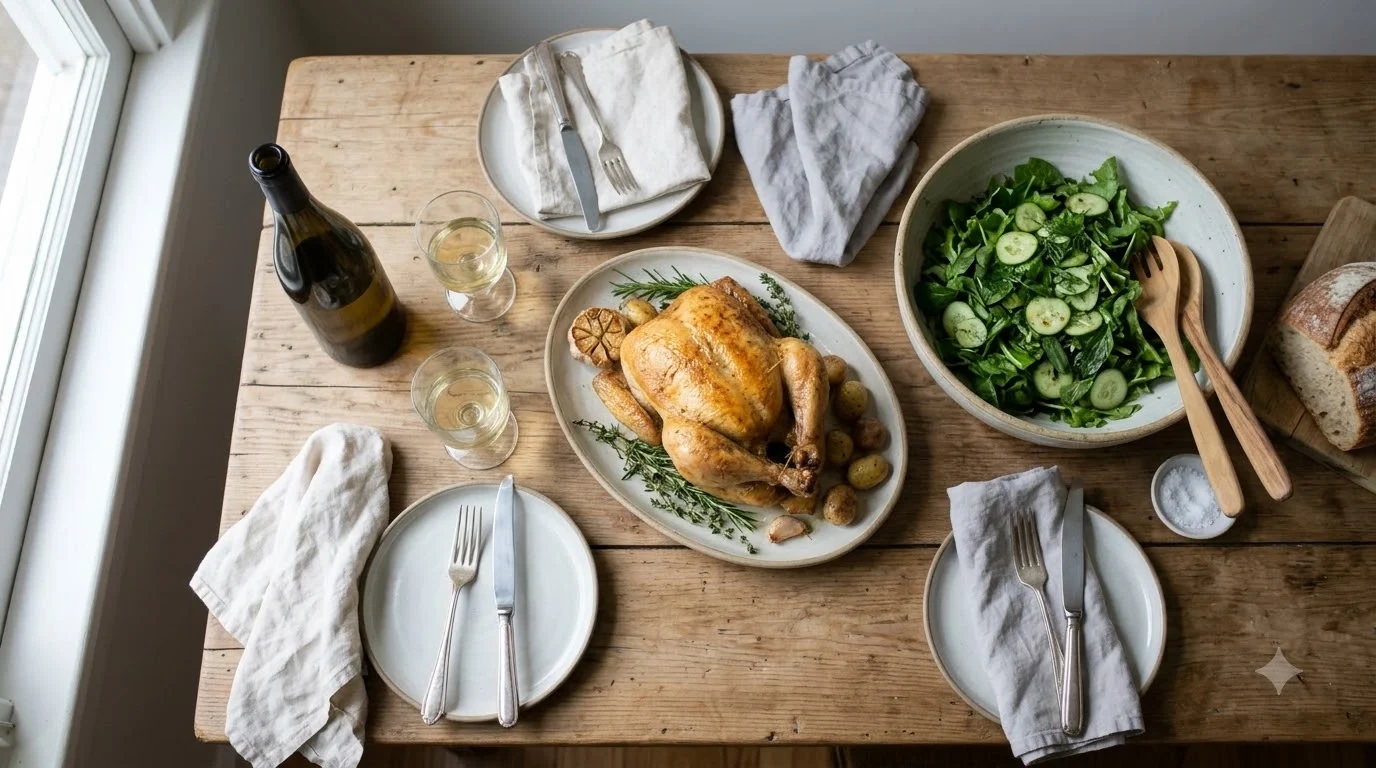
Its acidity makes white Vinho Verde particularly useful with seafood, shellfish, grilled fish, and fresh salads. Portuguese dishes such as grilled sardines and seafood rice are natural partners. The wine’s freshness also works with salty appetizers, olives, and lightly fried seafood.
For spicy dishes, choose a lower-alcohol, fruit-forward example rather than a particularly alcoholic or tannic wine. The wine’s freshness can complement flavorful food, but chili heat may become more noticeable alongside higher alcohol and tannin.
Some bottles are also suitable for mixed drinks. Their freshness and occasional light carbonation make them useful in refreshing summer combinations. The Vinho Verde sangria approach offers another way to use the wine alongside fruit and other ingredients.
Alcohol levels differ between producers and styles, so a regional designation alone does not establish the exact strength of a bottle. For a closer explanation of typical figures and the factors affecting them, see Vinho Verde alcohol content.
How to Practice the Pronunciation and Order a Glass
The easiest way to remember the pronunciation is to connect it with a practical situation. Repeating the expression aloud, listening to Portuguese speakers, and using it in a simple restaurant sentence will make the name easier to recall.
Start with a slow repetition of the two words. Say vinho as “VEEN-yoo,” paying attention to the nasal quality and the single nh consonant. Follow it with verde as “VEHRD,” keeping the final vowel short. Repeat the complete expression several times without inserting a long pause.
Next, listen to recordings from speakers in Portugal rather than relying exclusively on English-language wine videos. Forvo offers multiple recordings from Portuguese contributors, including speakers identified as being from Portugal. Comparing these recordings reveals how the same expression can sound slightly different depending on the speaker.
Another useful exercise is to say the name inside a complete sentence. This prevents you from treating the wine’s name as an isolated pronunciation exercise and helps develop a more natural rhythm.
Useful phrases for ordering wine
One simple Portuguese phrase is “Um Vinho Verde, por favor,” meaning “A Vinho Verde, please.” The approximate pronunciation is “oom VEEN-yoo VEHRD, por fah-VOR.” The phrase is useful in a Portuguese restaurant or wine bar.
You can also ask “É seco?” which means “Is it dry?” The approximate pronunciation is “eh SEH-koo?” This is a practical question because Vinho Verde includes different sweetness levels, and the name alone does not tell you whether a particular bottle is dry or slightly sweet.
If you are unsure about the grape variety, ask whether the wine is made from Alvarinho or Loureiro. These two names are especially useful to recognize because they are among the important white varieties associated with the region.
For American wine shops, a straightforward pronunciation is usually enough. You can say “VEEN-yoo VEHRD” when asking for the Portuguese wine section, discussing a restaurant list, or requesting a recommendation. Staff familiar with Portuguese wine will understand what you mean.
There is also no need to correct someone who uses a different reasonable approximation. Wine terminology is shared across countries and languages, and accents naturally influence how people pronounce regional names. The aim is to communicate clearly while recognizing the Portuguese origin of the expression.
Frequently Asked Questions
Is Vinho Verde pronounced the same way in Brazil and Portugal?
No. European and Brazilian Portuguese differ in vowel reduction and certain consonant sounds. Brazilian pronunciation can retain a more audible final vowel and may use a different realization of the R and D sounds. Both accents are legitimate Portuguese pronunciations.
Does vinho have a nasal vowel?
Yes. The first vowel in vinho is nasal, represented in the International Phonetic Alphabet by the symbol /ĩ/. This nasal quality is an important feature of Portuguese and also appears in other Portuguese words such as sim, meaning yes.
Is Vinho Verde a protected wine designation?
Yes. Vinho Verde is a Protected Designation of Origin in the European wine system. Its production requirements include geographical origin, authorized grape varieties, winemaking conditions, and quality controls administered through the regional certification system.
Can Vinho Verde be made from red grapes?
Yes. Red Vinho Verde is part of the regional tradition, and Vinhão is an important local red grape. Its dark-colored wines can be quite different from the light, crisp white examples commonly exported to American markets.
What is the Portuguese word for a glass of wine?
A glass of wine is “um copo de vinho” in Portuguese. A traditional wine glass is also called a “taça,” so “uma taça de vinho” is another useful expression when ordering wine in Portugal. These phrases are useful beyond Vinho Verde and apply to other Portuguese wine styles.
Remember the simple pronunciation “VEEN-yoo VEHRD” and the two sounds that make the name distinctive: the nasal nh in vinho and the reduced ending of verde. Once you recognize those features, ordering and discussing Vinho Verde becomes much easier. More importantly, you can focus on discovering the diverse white, rosé, red, and sparkling wines that make this Portuguese region interesting to explore.
More in Wine Types & Grapes
 What Does Mourvèdre Taste Like? Flavor Profile, Regions, and PairingsUpdated Nov 20, 2026
 What Does Marsanne Taste Like? Flavors, Styles, and Food PairingsUpdated Nov 20, 2026
 What Does Malvasia Taste Like? Styles, Flavors, and Food PairingsUpdated Nov 20, 2026
 What Does Grenache Blanc Taste Like? Flavor Profile, Styles, and PairingsUpdated Nov 20, 2026
 What Does Garnacha Taste Like? Key Flavors, Styles, and Pairing TipsUpdated Nov 20, 2026
 What Does Fruit Wine Taste Like? A Complete Flavor and Style BreakdownUpdated Nov 20, 2026