

We may earn a commission when you buy through links on this page, at no extra cost to you. Learn more.
When your vinotemp wine fridge not cooling, the most common causes are incorrect temperature settings, restricted ventilation, dirty condenser components, poor door sealing, or an iced evaporator. Start by checking the power supply, control panel, room temperature, and clearance around the cabinet before investigating internal components. Some problems can be corrected with basic cleaning and adjustments, while compressor, sensor, fan, and refrigerant problems require professional diagnosis.
A wine refrigerator needs consistent cooling to protect bottles from temperature fluctuations and premature aging. A Vinotemp unit that runs continuously, displays a rising temperature, or feels warm inside deserves attention, but a warm cabinet does not automatically mean the compressor has failed. The best approach is to identify whether the problem comes from the electrical supply, airflow, door seal, temperature controls, or refrigeration system. The following troubleshooting steps explain what to inspect, what the symptoms mean, and when to arrange a repair.
1. Check the Power Supply and Temperature Controls First
Before investigating refrigeration components, confirm that the Vinotemp wine refrigerator receives power and that its temperature setting is appropriate. A unit can appear operational while its control settings prevent it from cooling to the intended temperature.
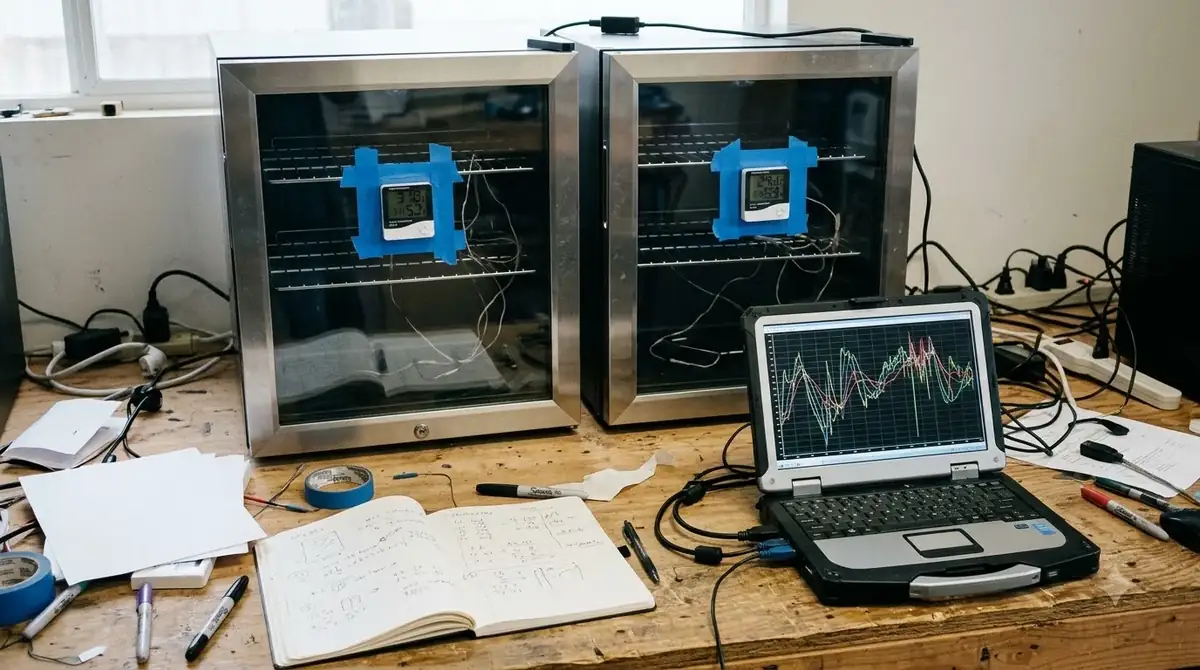
Begin by checking the power cord and electrical outlet. Make sure the plug is fully inserted and that the outlet works by testing it with another suitable appliance. If the wine cooler has no display, interior light, or operating sound, inspect the household circuit breaker and any accessible fuse associated with the appliance. A tripped breaker may indicate an electrical problem rather than a simple interruption, so repeated tripping should be investigated by an electrician or qualified technician.
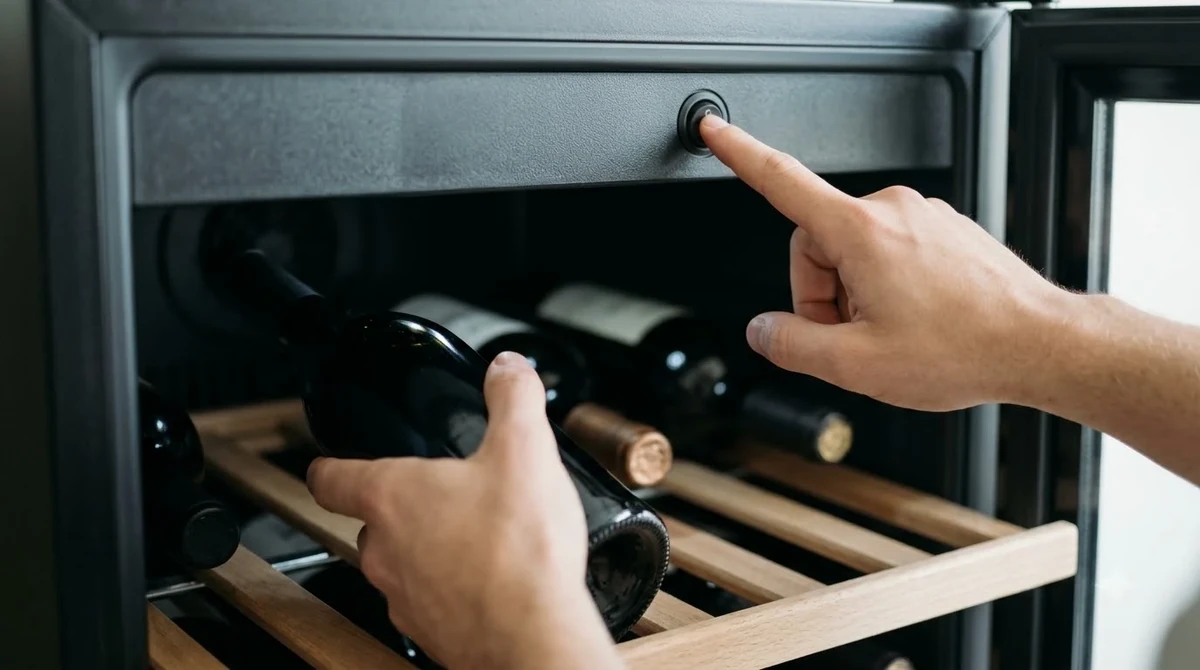
If the display illuminates but the cabinet remains warm, inspect the temperature setting. Someone may have accidentally raised the setpoint, or the control panel may have been locked after installation. Vinotemp notes that some newly delivered models require the control panel to be unlocked before temperature adjustments can be made. Consult the instructions for the exact model rather than assuming every control panel operates identically.
Also distinguish the selected temperature from the actual cabinet temperature. Some digital displays show both values, while others show only the selected setting. A setting of 55°F does not mean the interior has already reached 55°F. The refrigerator must complete its cooling cycle before the actual temperature approaches the target.
Allow time for the cooling cycle
Do not judge cooling performance immediately after switching on a unit that has been unplugged or moved. A recently installed cooler may need several hours to stabilize, depending on its design, initial temperature, room conditions, and bottle load. Check the owner’s manual for the model-specific startup and recovery instructions.
There is an important distinction between a newly delivered appliance and a unit that has been operating normally for months. Vinotemp recommends leaving newly delivered coolers upright for 24 hours before connecting them to electricity so the coolant can settle. That recommendation is especially important after transportation. It should not be confused with a general requirement to leave every refrigerator unplugged for 24 hours after an ordinary power interruption.
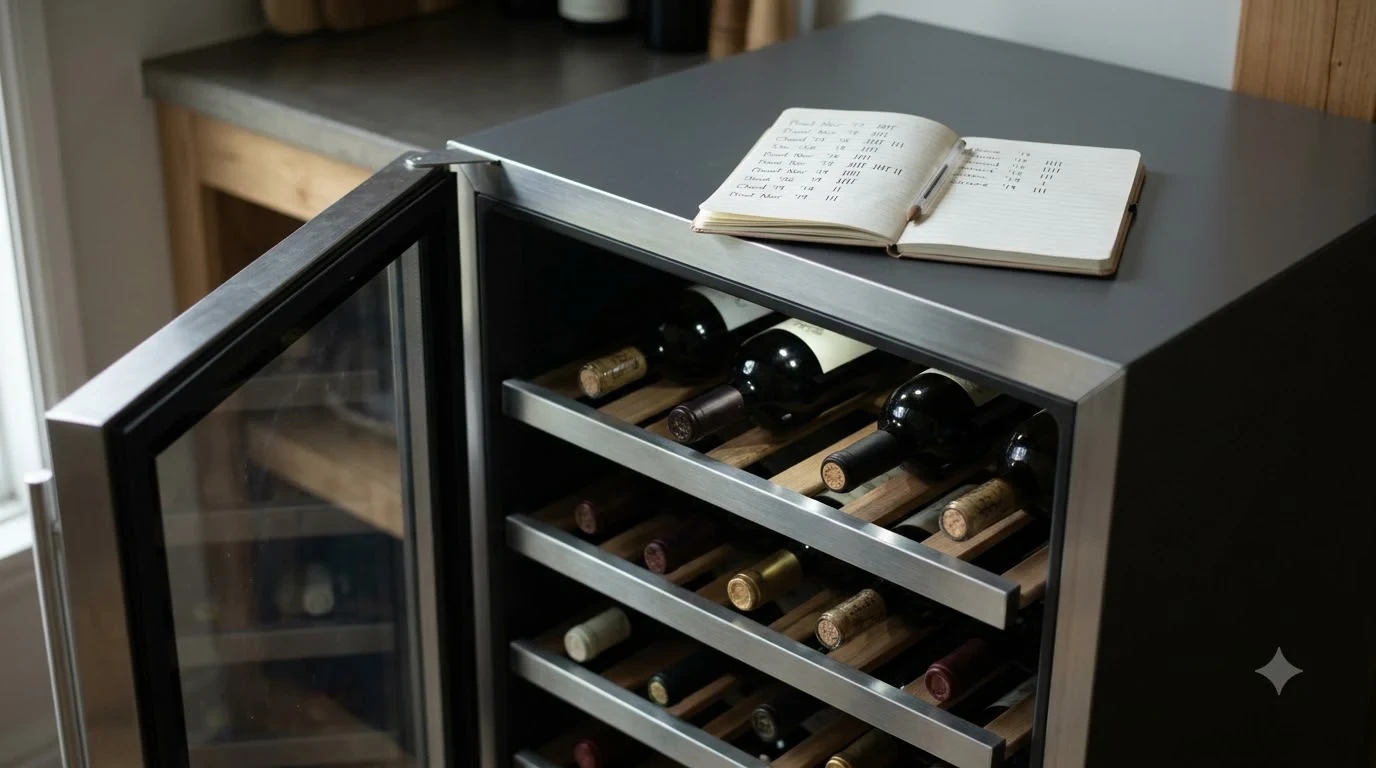
Tip: Record the selected temperature and actual temperature before making adjustments. Recheck the readings after several hours under normal operating conditions. This creates a useful baseline and makes it easier to explain the problem to a repair technician.
If the outlet works, the display is active, and the temperature setting is correct but the interior continues warming, move on to the installation and ventilation checks. These are common sources of cooling trouble and do not necessarily require replacement parts.
2. Restore Proper Ventilation Around the Wine Refrigerator
Restricted airflow can make a Vinotemp wine fridge work harder while producing less effective cooling. The condenser needs to release heat into the surrounding air, so blocked vents, insufficient installation clearance, and excessive room temperatures can interfere with normal operation.
Start by identifying whether the appliance is a freestanding or built-in model. These designs do not necessarily use the same ventilation arrangement. According to Vinotemp’s FAQ, freestanding coolers with rear exhaust require at least 6 inches of clearance behind the cabinet. Built-in models are designed to operate in confined spaces because they exhaust heat through the front.
Do not assume that a freestanding refrigerator can be installed inside a tight kitchen cabinet simply because its dimensions fit. If the rear exhaust cannot release heat, the appliance may accumulate heat around its refrigeration components. This can contribute to overheating, longer operating cycles, and poor temperature control.
Inspect the ventilation openings for dust, packaging material, stored objects, and other obstructions. Keep curtains, furniture, kitchen supplies, and decorative items away from the vents. If the unit is installed beneath a counter, verify the manufacturer’s installation requirements rather than relying on the clearance used for a different Vinotemp model.
Consider the room temperature
The surrounding environment affects how effectively a wine refrigerator can remove heat. A cooler placed beside an oven, dishwasher, heating appliance, or sunny window may struggle more than one installed in a temperature-controlled room.
Garages and patios can be particularly challenging because their temperatures may change significantly throughout the day. Wine Enthusiast explains that compressor-based wine refrigerators can be advantageous in warmer environments of 80°F and above compared with thermoelectric models. However, the actual operating limits of a Vinotemp appliance depend on its model specifications.
Check the ambient-temperature requirements in the owner’s manual. Moving the appliance to a more suitable location may correct a cooling problem without any mechanical repair. Never operate a model outside its specified environmental range simply because the compressor continues running.
Finally, make sure the cabinet stands on a solid, level surface. An unstable installation can contribute to vibration, noise, and door alignment problems. Correct leveling also helps the door close evenly against its gasket.
3. Clean the Condenser and Check for Airflow Restrictions
A dirty condenser is another important reason a Vinotemp wine cooler may run without maintaining its selected temperature. Dust and debris interfere with heat transfer, forcing the cooling system to work harder to remove heat from the cabinet.
The condenser is part of the refrigeration system that releases heat removed from the interior. Depending on the model, its components may be located near the bottom, rear, or another designated ventilation area. Locate the condenser and accessible cleaning points using the owner’s manual rather than removing panels based on appearance alone.
Before cleaning, switch off and unplug the appliance. Allow any accessible moving components to stop completely. Remove loose dust from accessible ventilation openings and condenser surfaces using an appropriate soft brush or vacuum attachment. Avoid bending delicate fins, pulling on electrical connections, or allowing moisture to enter electrical compartments.
Do not spray water or household cleaning products directly into the compressor compartment. If cleaning requires removing a protective cover or reaching wiring, stop and arrange professional service. Electrical components and refrigeration lines should remain undisturbed during routine maintenance.
Look for symptoms of restricted condenser airflow
A cooler with inadequate heat dissipation may have a compressor that runs for unusually long periods, warm air around its exhaust, or an interior temperature that continues rising. These symptoms do not identify a single failed component, but they make ventilation and condenser inspection especially important.
Vinotemp’s troubleshooting guide lists restricted condenser airflow and a dirty condenser among the possible causes of high internal temperatures. It also identifies condenser fan failure as a potential problem that may require replacement.
Listen for the fan if your particular model uses an accessible condenser fan. A fan that is completely silent, rattles excessively, or appears unable to rotate may indicate a mechanical or electrical problem. Do not reach into the fan compartment while the appliance is connected to power.
After cleaning the accessible areas and restoring clearance, reconnect the cooler and monitor its temperature. If the cabinet still cannot approach the selected temperature, a failed fan, control problem, or refrigeration-system fault may be responsible.
4. Inspect the Door Gasket, Loading, and Internal Airflow
A wine refrigerator cannot maintain a stable temperature if warm room air repeatedly enters through an improperly sealed door. Overloading the cabinet or blocking internal air passages can also create uneven cooling, even when the refrigeration system is functioning.
Begin with the door gasket, the flexible sealing material around the cabinet opening. Look for cracks, flattened areas, dirt, folds, and sections that have pulled away from their mounting position. A damaged or dirty gasket can prevent the door from sealing properly.
Clean an accessible gasket with a soft cloth and mild cleaning solution, following the manufacturer’s care instructions. Dry it completely before closing the door. Check whether the gasket sits evenly against the cabinet around all four sides.
A simple paper test can help identify an obvious sealing problem. Close the door over a strip of paper and gently pull it. Repeat at several points around the perimeter. If the paper slips out easily in one area but remains firmly held elsewhere, inspect that section for a gap or alignment issue. This is a basic screening test, not a precise measurement of gasket performance.
Reduce unnecessary door openings
Opening the door frequently introduces warmer air and allows the cabinet temperature to rise. This becomes more noticeable in a warm kitchen or during periods when bottles are being rearranged. Avoid leaving the door open while organizing a collection.
Also examine the shelves and bottle arrangement. Incorrectly positioned shelves can interfere with door closure, while bottles placed too close to ventilation openings may restrict the movement of cool air. Do not force bottles into spaces that were not designed to accommodate them.
Overfilling is another potential issue. Wine Enthusiast notes that refrigerators loaded beyond their rated capacity may struggle to maintain consistent temperatures. Follow the manufacturer’s stated bottle capacity, remembering that unusually shaped sparkling wine bottles can occupy more room than standard Bordeaux-style bottles.
For a dual-zone Vinotemp refrigerator, evaluate each compartment separately. One zone may cool normally while the other remains warm because of a sensor, airflow, or control issue. Compare the readings in both sections instead of assuming that a single temperature measurement represents the entire cabinet.
After correcting the seal and rearranging the bottles, close the door and allow the refrigerator to stabilize. If one area remains consistently warm, the problem may involve internal air circulation or a temperature sensor rather than the door itself.
5. Recognize Evaporator Ice, Sensor Problems, and Temperature Errors
Frost accumulation, incorrect sensor readings, and control-board faults can prevent a Vinotemp wine fridge from maintaining its intended temperature. These issues are more complicated than ordinary ventilation problems, but their symptoms can help identify the next troubleshooting step.
The evaporator is the component that absorbs heat from the refrigerated space. If it becomes excessively iced, airflow and heat transfer can be affected. The result may be a refrigerator that runs for long periods but fails to cool the cabinet evenly.
Inspect accessible interior cooling surfaces for unusual frost or thick ice buildup. A small amount of condensation or temporary frost may be associated with normal operating conditions, but extensive ice that repeatedly returns deserves investigation.
Defrost safely
Vinotemp’s troubleshooting instructions identify unplugging the cooler and allowing the evaporator to defrost as a response to ice-related cooling problems. Follow the exact defrost instructions for the model, remove bottles if necessary, and protect the surrounding floor from condensation or melting ice.
Do not chip away at ice with a knife, screwdriver, or other sharp object. The evaporator and nearby refrigeration lines can be damaged by forceful scraping. Do not use a heat gun or open flame to accelerate the process.
Once the ice has melted, dry the interior, restore the appliance according to its manual, and monitor its operation. If the evaporator freezes again, the underlying cause may be poor airflow, a faulty sensor, a door-seal problem, or a refrigeration-system issue. Repeated defrosting without correcting the cause is not a reliable repair.
Understand temperature sensor and display errors
The temperature sensor measures conditions inside the refrigerator and communicates information to the control system. If it provides an incorrect reading, the appliance may cool too much, fail to cool enough, or display an error code.
Some Vinotemp owner manuals identify EL and EH display codes as indications of an air-temperature sensor failure in the corresponding zone. However, error codes and their meanings are model-dependent. Consult the manual for the specific appliance before interpreting a display message.
A malfunctioning control board can create similar symptoms. For example, the display may illuminate while the compressor fails to start correctly, or the refrigerator may stop operating even as the cabinet temperature rises. Vinotemp identifies sensor and control-board replacement as service-level troubleshooting tasks.
These components should not be replaced based solely on a warm interior or an unusual display reading. A technician can test the sensor, wiring, controller, and electrical supply to determine which component has actually failed.
6. Identify Compressor, Fan, and Refrigerant Problems
If the power supply, settings, ventilation, condenser cleanliness, and door seal are all satisfactory, the remaining problem may involve the refrigeration system. Compressor, fan, electrical starting components, and refrigerant faults require more specialized diagnosis than routine cleaning.
The compressor circulates refrigerant through the sealed cooling system. Depending on the model, its normal operating sounds may include a low hum and periodic starting and stopping. A refrigerator does not necessarily have a compressor failure just because it makes an unfamiliar sound.
Vinotemp also explains that some operating noises are normal. Refrigerant circulation can produce gurgling or flowing sounds, while the expansion and contraction of interior surfaces can create occasional popping or crackling. These sounds alone do not establish that the appliance needs repair.
Compare common symptoms
| Observed symptom | Possible cause | Recommended action |
|---|---|---|
| No display or operating activity | Power supply, outlet, fuse, or electrical fault | Check the outlet and breaker; arrange electrical service if necessary. |
| Display works but cabinet stays warm | Incorrect setting, sensor, controller, or compressor problem | Verify settings and request component diagnosis. |
| Compressor runs for extended periods | Restricted airflow, dirty condenser, warm surroundings, or poor sealing | Inspect ventilation, condenser cleanliness, and gasket condition. |
| Fan does not operate normally | Fan motor, wiring, or control fault | Arrange professional fan inspection. |
| Heavy evaporator frost | Airflow, defrost, sensor, or refrigeration problem | Unplug and defrost according to the manual; investigate recurring ice. |
| Cooling remains ineffective after cleaning | Refrigerant leak or sealed-system restriction | Request professional refrigeration diagnosis. |
| Temperature changes during compressor cycles | Normal operating cycle or underlying control problem | Compare readings over time and investigate persistent large deviations. |
Pay particular attention to short cycling, which occurs when the compressor repeatedly starts and stops after very brief operating periods. Vinotemp lists incorrect voltage, restricted condenser airflow, a dirty condenser, and condenser fan malfunction among possible causes of this behavior.
A compressor that appears to run continuously while the cabinet remains warm may indicate insufficient heat transfer, restricted airflow, or a refrigerant problem. A compressor that does not start at all may have an electrical starting-component, control, or compressor fault. Neither symptom is enough to justify replacing the compressor without testing.
Why refrigerant problems need professional attention
A refrigerant leak can prevent the system from removing heat effectively. Other possible problems include a restriction within the sealed refrigeration circuit or a failed component that prevents normal refrigerant circulation.
Refrigerant is not a routine household maintenance item. Do not attempt to open refrigerant lines, add refrigerant, bypass safety controls, or repair compressor wiring without the appropriate qualifications and equipment.
A qualified refrigeration technician can check the operating system, identify leaks, test electrical components, and determine whether a repair is practical. If the compressor or sealed system is involved, ask for a diagnosis before authorizing a major component replacement.
7. Protect Your Wine and Arrange the Right Repair
While troubleshooting the refrigerator, protect the bottles from prolonged heat exposure and repeated temperature changes. Moving valuable wine to another suitable storage location is preferable to leaving it in a cabinet that is steadily warming.
For longer-term storage, approximately 55°F is a useful target. Vinotemp recommends around 55°F, while Wine Enthusiast identifies 53–57°F as the preferred range for longer-term wine storage. The important objective is stable temperature rather than repeatedly changing the setting in response to every small fluctuation.
Different wine styles do not need different long-term storage temperatures. Red, white, sparkling, and fortified wines can all be stored at the same stable temperature. Serving temperatures are a separate matter, so a bottle can be brought to its preferred drinking temperature shortly before serving.
If the Vinotemp refrigerator cannot maintain a stable environment, transfer the bottles to another functioning wine cooler or an appropriately cool, dark storage area. Avoid placing the collection beside an oven, in direct sunlight, or in a garage with substantial temperature fluctuations.
Find the correct model-specific repair information
Vinotemp publishes troubleshooting guides and service manuals for a range of wine refrigerator models. The support library includes documentation for models such as the VT-32, VT-45, VT-60, VT-155SBB, and several dual-zone units. The parts and procedures are not necessarily interchangeable.
Visit the official Vinotemp troubleshooting and repair resources to locate documentation for your appliance. Check the model number on the manufacturer’s identification label before downloading a guide or ordering a replacement component.
When contacting support, prepare the model number, approximate age of the refrigerator, selected temperature, actual temperature, and a description of its operating behavior. Mention whether the compressor and fans run, whether the display shows an error code, and whether frost has accumulated inside the cabinet.
Vinotemp lists customer support at 1-800-777-VINO, Monday through Friday, from 8 a.m. to 5 p.m. Pacific Time. The company’s published troubleshooting chart also explains that its general suggestions do not replace the training required for professional refrigeration service.
If you are comparing symptoms across refrigerator brands, the same basic diagnostic approach can help with an Allavino wine fridge not cooling, a Magic Chef wine fridge not cooling, or a Haier wine fridge not cooling. However, always use the relevant manufacturer’s instructions for installation clearances, electrical requirements, and replacement components. Additional Brand Troubleshooting information can also help distinguish general storage problems from appliance-specific faults.
Before approving an expensive repair, request an explanation of the failed component and the work needed to restore normal cooling. Compare the repair recommendation with the refrigerator’s age, condition, and availability of replacement parts. A simple fan or sensor repair may be practical, while extensive sealed-system work may warrant comparing repair and replacement options.
Frequently Asked Questions
How long does a Vinotemp wine fridge typically last?
Service life varies with the model, operating environment, maintenance, and frequency of use. Vinotemp has been designing wine storage products since 1985, but that company history does not establish a guaranteed lifespan for an individual refrigerator. The availability of model-specific parts and qualified repair services can influence whether an older appliance remains practical to maintain.
Can a Vinotemp wine fridge be transported on its side?
Keeping the appliance upright during transportation is the safer general approach because the manufacturer’s guidance specifically recommends allowing a newly delivered cooler to stand upright for 24 hours before plugging it in. If a refrigerator has been transported horizontally, consult the exact model’s manual or Vinotemp support for the appropriate recovery period. Do not assume that every compressor model has identical transportation requirements.
Why does my Vinotemp wine cooler show a temperature different from a separate thermometer?
The built-in sensor measures conditions at its own location, while an independent thermometer may be positioned elsewhere in the cabinet. Bottle placement, air circulation, and differences between the upper and lower shelves can create different readings. Some direct-cooling Vinotemp models have an upper-to-lower temperature difference of approximately 8°F, so thermometer placement matters.
Is a humming sound from a Vinotemp wine refrigerator normal?
A low compressor hum can be part of normal refrigeration operation. Vinotemp also identifies refrigerant-flow sounds, occasional gurgling, and expansion-related popping as possible normal operating noises. A sudden loud mechanical rattle, repeated electrical clicking, or unusual vibration combined with poor cooling deserves further investigation.
Does a Vinotemp wine fridge need special humidity settings?
Humidity management depends on the refrigerator’s design and the duration of wine storage. Wine Enthusiast identifies approximately 50–75% relative humidity as a useful range for longer-term storage, helping prevent corks from drying out. Not every compact wine refrigerator has an adjustable humidity control, so do not assume that a humidity setting can be changed on every Vinotemp model.
A Vinotemp wine fridge that stops cooling does not always need a new compressor or an expensive repair. Start with the electrical supply, temperature settings, ventilation, condenser cleanliness, door gasket, and internal frost before investigating sensors and sealed-system components. If basic checks do not restore stable cooling, use the model-specific support documentation and arrange professional diagnosis to protect both the appliance and your wine collection.
More in Storage & Fridge Care
 How Long Can You Store Wine in a Wine Fridge? Protect Bottle QualityUpdated Nov 20, 2026
 Can You Store Beer in a Wine Fridge? Keep Both Drinks FreshUpdated Nov 20, 2026
 Is It Worth Repairing a Wine Fridge? Spot the Cheap Fixes Before You ReplaceUpdated Nov 20, 2026
 Wine Fridge Condensation: Identify Causes and Fix Moisture ProblemsUpdated Nov 20, 2026
 Wine Fridge Too Cold: Protect Your Wine and Fix the TemperatureUpdated Nov 20, 2026
 How to Reset Wine Fridge: Restore Cooling and SettingsUpdated Nov 20, 2026