

We may earn a commission when you buy through links on this page, at no extra cost to you. Learn more.
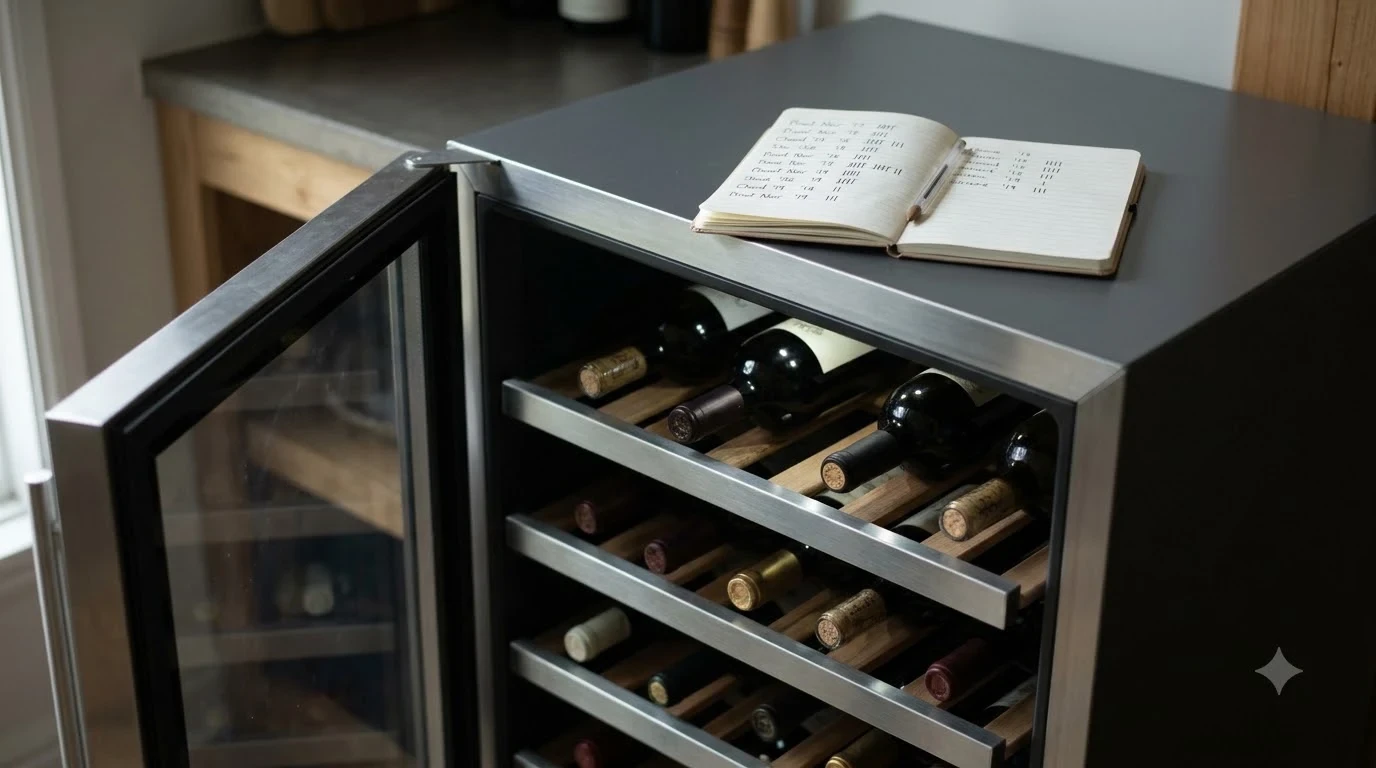
The vintec wine fridge dimensions depend on the model, so measure the exact cabinet and its installation opening before choosing a location. The compact VWS020 is about 295–300 mm wide, the 35-bottle VWSO35 is 493 mm wide, and the 50-bottle VWS050 is 595 mm wide. The tall VWM148SBA stands 1,550 mm high and needs separate planning for ventilation and door movement. Cabinet dimensions and required cavity dimensions are not the same.
Vintec makes slim under-counter cabinets, wider wine cellars, and tall freestanding units. Compare the full model code, then allow for the rear spacer, adjustable feet, ventilation gaps, and door swing. Measurements below are in millimeters, with approximate inch conversions where helpful.
Model Sizes at a Glance
Vintec footprints range from a narrow 20-bottle cabinet to a 148-bottle tall cabinet, and capacity alone does not predict width or height. VWS020, VWSO35, VWS050, and VWM148 use different installation specifications.
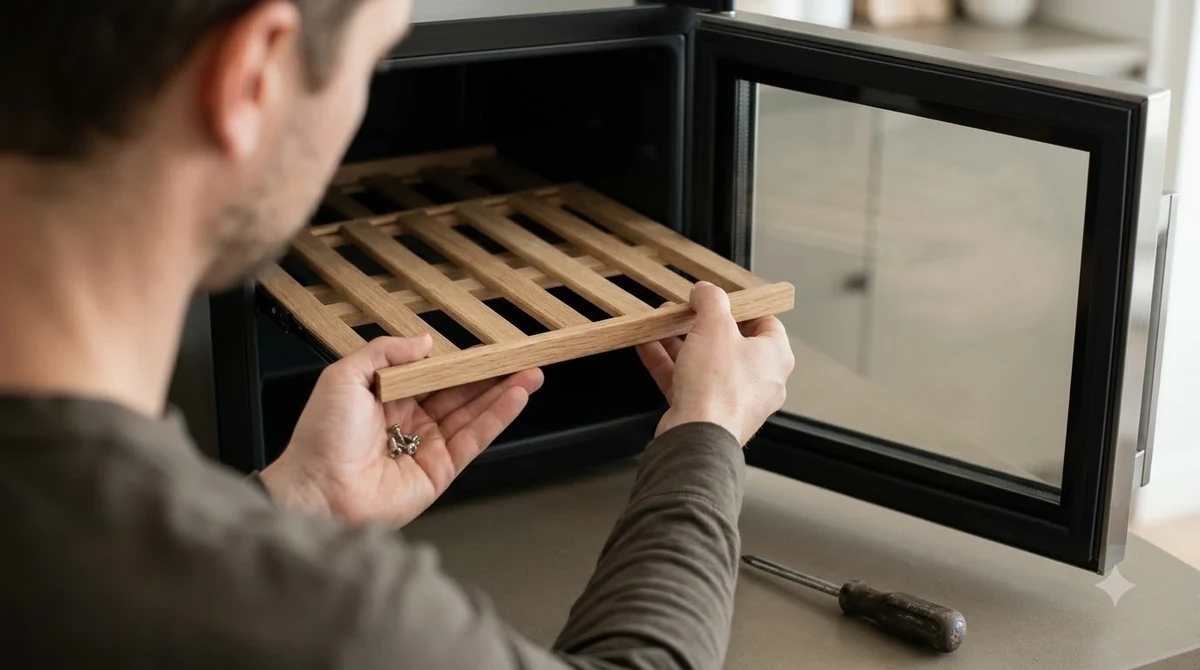
The VWS020SBA-X/VBS020SBA-X is 295–300 mm wide, 561 mm deep before its rear stopper, and 820–870 mm high with adjustable feet. The VWSO35SBB/VWSO35SSB measures 493 × 588 × 830 mm. The VWS050 family is 595 mm wide, with a manual-listed height range of 820–860 mm and a depth of 571 mm plus a 30 mm stopper. The tall VWM148SBA measures 595 × 609 × 1,550 mm.
Use this comparison as a starting point, not as a replacement for the installation sheet for the exact appliance. Depth may be listed with or without a rear spacer, and Vintec documents can differ by model suffix or market.
| Model family | Capacity class | Cabinet dimensions (W × D × H) | Key installation figure |
|---|---|---|---|
| VWS020SBA-X / VBS020SBA-X | 20 bottles | 295–300 × 561 × 820–870 mm | Minimum cutout width 320 mm; 30 mm rear stopper |
| VWSO35SBB / VWSO35SSB | 35 bottles | 493 × 588 × 830 mm | Installation envelope 533 × 618 × 860 mm |
| VWS050 family | Up to 50 bottles | 595 × 571 × 820–860 mm* | Minimum cutout width 615 mm; 30 mm rear stopper |
| VWM148SBA | 148 bottles | 595 × 609 × 1,550 mm | Approx. 640 mm cavity width and 639 mm cavity depth |
*The VWS050SBA-X product page gives 561 mm depth, while its installation manual lists 571 mm plus a 30 mm stopper. Confirm the full SKU and matching manual before cabinetry is built; do not average the two figures. For another brand’s built-in footprint, compare the Sub-Zero wine fridge dimensions reference without assuming its clearances match Vintec.
Compact VWS020 Under-Counter Measurements
The VWS020SBA-X and VBS020SBA-X are narrow under-bench models, with a cabinet width of 295–300 mm and height adjustment from 820 to 870 mm. Their depth is 561 mm before the rear stopper; the stopper adds 30 mm for a total of 591 mm.
Vintec specifies a minimum 320 mm cutout width to allow installation, removal, and service. The manual also calls for 10 mm at each side, 30 mm above, and 30 mm behind the cabinet. Do not remove the rear stopper to gain a few millimeters: it is part of the ventilation arrangement. The model vents at the front but draws air through the rear channel.
The 50 mm foot-adjustment range does not remove the need to measure the finished floor-to-counter height. Measure at the front and rear because a sloping floor or uneven counter can reduce the usable opening. The manual also says that if a kickboard covers the lower front grille, a separate grille must provide at least 150 square centimeters of airflow area.
Tip: Mark the full 591 mm depth, including the rear stopper, before cutting cabinetry. Then map the door swing and keep the lower front grille clear of trim.
VWSO35 and VWS050 Cabinet Footprints
The 35-bottle VWSO35SBB/VWSO35SSB is 493 mm wide, 588 mm deep, and 830 mm high; its installation envelope is 533 × 618 × 860 mm. The VWS050 family is 595 mm wide and needs a minimum cutout width of 615 mm.
The VWSO35 dimension sheet separates body size from opening size: it adds 40 mm to the listed cabinet width and 30 mm to its depth for the installation envelope. It also says 10 mm is the minimum opening-edge clearance, while 30 mm is recommended on the opening edge for easier finger access when flush-fit.
The VWS050 installation manual lists a height range of 820–860 mm, width of 595 mm, and depth of 571 mm plus a 30 mm stopper, or 601 mm total. It specifies 10 mm side clearance, 30 mm above, and 30 mm behind. The manufacturer says these models are not designed to be fully concealed behind a separate joinery door.
Vintec’s online VWS050SBA-X specification instead lists a 561 mm depth and minimum joinery dimensions of 850 mm high, 615 mm wide, and 555 mm deep. This differs from the older family’s installation manual, so match the model suffix, market, and document to the appliance before construction. The Vintec VWS050SBA-X specifications display its online measurements and cutout figures. Bottle capacity is based on standard Bordeaux-shaped 750 ml bottles; wider Burgundy or sparkling bottles can reduce the usable count. Vintec lists 40 bottles as the easy capacity and 50 as the maximum for this model.
Tall VWM148SBA Cabinet and Door Clearance
The VWM148SBA measures 595 mm wide, 609 mm deep, and 1,550 mm high; its installation drawing gives a cavity width of about 640 mm and depth of 639 mm. Its required top ventilation gap depends on the vertical vent space built into the surrounding cabinetry.
The manufacturer specifies 30 mm behind the cabinet. If a vertical vent space (Vx) of 100 mm is provided, the minimum top gap (Tx) is 50 mm; otherwise, the minimum top gap is 100 mm. The opening height is therefore 1,550 mm plus the applicable top gap, not one fixed figure. This is a much taller installation than an under-counter VWS020 or VWS050.
The same drawing gives a minimum door-opening distance of 1,072 mm so the retractable shelves can be pulled out. This is working clearance, not another cabinet-depth measurement. Check for a kitchen island, opposite cabinet, or doorway that could block the open door, and measure the delivery route as well as the final opening.
Ventilation Gaps and Built-In Versus Freestanding Placement
Vintec’s required gaps vary by model: the VWS020 and VWS050 manuals call for 30 mm at the top and rear, while the VWM148SBA drawing allows a 50 mm or 100 mm top gap depending on its vent arrangement. Front ventilation does not mean the cabinet can be sealed on every side.
For the VWS020 and VWS050 under-counter families, the manuals describe air entering at the rear and leaving through the grille below the front door. The rear spacer maintains the channel for airflow and heat removal; the manuals warn that it must be fitted before installation. Keep the rear channel and lower front grille unobstructed after the plinth and flooring are installed.
Confirm whether the exact model is built-in, freestanding, or approved for both. As general guidance, Wine Enthusiast says built-in coolers typically vent from the front, while freestanding models commonly need 2–3 inches of open space at the sides and rear. Those broad figures do not override Vintec’s model-specific instructions. Its wine cooler measuring advice also highlights door swing and ventilation as separate fit checks.
Keep the unit away from direct sunlight and strong heat sources such as ovens. The VWS050 manual lists an ambient range of 5–35°C, while the VWS050SBA-X product page states 5–43°C, another reason to confirm the exact model documentation. An opening can be dimensionally correct and still be a poor location if the surrounding room is too hot or airflow is restricted.
How to Measure the Opening Before Installation
Measure width, height, and depth at multiple points, then compare the smallest usable figures with the appliance’s installation requirements. A 615 mm cutout for a 595 mm VWS050 body, for example, is not the same measurement as the cabinet’s own width.
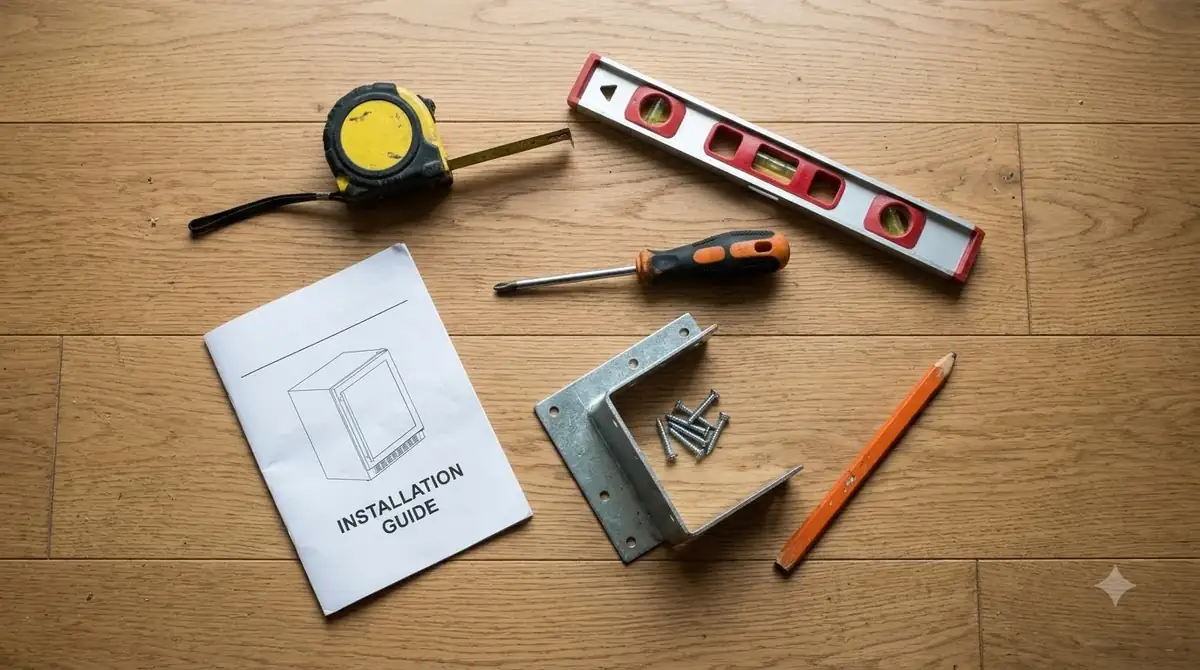
Clear the location, then measure width at the front, middle, and back. Measure height from the finished floor to the counter at the left, center, and right. Measure depth from the rear wall to the front edge of the cabinetry, noting outlets, pipes, baseboards, or trim that reduce the space. Use the smallest measurement in each direction rather than assuming the opening is square.
Keep one unit of measurement throughout the plan. One inch equals 25.4 mm, so 615 mm is about 24.2 inches and 595 mm is about 23.4 inches. Avoid rounding a tight opening upward: even 5 mm can affect whether an appliance slides into place. Include door handles and hinges in the depth and swing checks, not just the cabinet body.
Map the door’s full movement and confirm the hinge side. The VWM148SBA needs 1,072 mm of door-opening distance for shelf access; other models still need enough room for the door and shelves to move without hitting an island or adjacent appliance. Painter’s tape on the floor can outline the open-door path before installation. Also confirm the power outlet remains accessible and that the cabinet can be removed for service.
Wine Enthusiast recommends checking openings at multiple points because floors and cabinets are not always square, and lists baseboards, outlet locations, handles, and door swing among common oversights. Photograph the cleared space with the dimensions marked, then share the image, model code, and installation sheet with the installer. That simple record helps the cabinetmaker and delivery team work from the same measurements.
Fit Checks After Delivery and Common Sizing Mistakes
A correct fit means the cabinet is level, ventilated, serviceable, and able to open fully—not merely that its outer shell fits into the opening. Check the adjustable feet, rear spacer, front grille, and door movement before loading bottles.
Vintec manuals describe four adjustable feet on the covered models and recommend leveling the cabinet before loading wine. An uneven floor can affect door alignment and shelf movement. Adjust the feet within the model’s stated range rather than forcing the cabinet higher or lower than the documented limits.
After positioning the unit, make sure the rear spacer is attached, the rear channel has not been crushed against the wall, and the lower front grille is open. Test the door and every sliding shelf before filling the cabinet. Bottle capacity is based on standard Bordeaux bottles, so wider formats may need a shelf rearrangement and reduce the maximum count.
If the cabinet fits but does not cool as expected, check that ventilation openings are clear and that the room is within the model’s ambient range. See the Vintec wine fridge not cooling troubleshooting steps for a temperature problem. For a separate control or restart issue, follow how to reset Vintec wine fridge; more storage and appliance support appears under Brand Troubleshooting.
Frequently Asked Questions
The full model number is the key to resolving close measurements: VWS020, VWSO35, VWS050, and VWM148 use different dimensions and clearances. These answers cover a few additional installation points.
Are Vintec wine fridges measured in millimeters or inches?
Vintec installation drawings generally use millimeters. For perspective, a 1,550 mm tall cabinet is approximately 61 inches high, while an 830 mm cabinet is about 32.7 inches high. Keep the original millimeter measurements on the cabinetry plan to avoid rounding away clearance.
Can a Vintec wine fridge sit flush with cabinet fronts?
Flush-fit means the appliance front is aligned with the surrounding cabinet fronts, while proud-fit means it projects beyond them. The door must still be able to swing and provide access to the shelves. A flush appearance does not authorize covering ventilation openings or adding an unapproved joinery door.
Does bottle capacity change the outside dimensions?
No; capacity describes how many bottles fit inside the cabinet, not its exterior size. The VWS050SBA-X has five shelves, consisting of four full shelves and one half shelf. Wider Burgundy and sparkling bottles can reduce the count, and shelf rearrangement can change usable capacity.
Should a Vintec cabinet be switched on immediately after moving?
Some Vintec quick-start instructions advise waiting 24 hours after transport before switching on, allowing refrigerant gases to settle. The VWS050 manual also instructs users to wait 3–5 minutes before restarting after unplugging, switching off, or a power interruption. Follow the specific manual supplied with the cabinet because transport and restart instructions address different situations.
Can I remove the rear spacer to make a Vintec unit fit?
Do not remove a supplied spacer simply to gain depth. For the VWS020 in a hot-climate installation, Vintec additionally specifies a ventilation grid measuring at least 200 × 40 mm in the rear or side partitioning to supply fresh air to the rear gap. Change the opening or ask an authorized installer about a model-approved solution instead.
The right Vintec wine fridge dimensions include the cabinet itself plus the model-specific space for ventilation, installation, and door movement. Confirm the complete model code and use its own installation drawing before cutting cabinetry or arranging delivery. Measuring the opening at several points is easier than correcting it after the cabinet arrives.
More in Storage & Fridge Care
 How Long Can You Store Wine in a Wine Fridge? Protect Bottle QualityUpdated Nov 20, 2026
 Can You Store Beer in a Wine Fridge? Keep Both Drinks FreshUpdated Nov 20, 2026
 Is It Worth Repairing a Wine Fridge? Spot the Cheap Fixes Before You ReplaceUpdated Nov 20, 2026
 Wine Fridge Condensation: Identify Causes and Fix Moisture ProblemsUpdated Nov 20, 2026
 Wine Fridge Too Cold: Protect Your Wine and Fix the TemperatureUpdated Nov 20, 2026
 How to Reset Wine Fridge: Restore Cooling and SettingsUpdated Nov 20, 2026