

We may earn a commission when you buy through links on this page, at no extra cost to you. Learn more.
A common reason for summit wine fridge not cooling is an incorrect setting, restricted ventilation, a door that is not sealing, frequent opening, or a power issue—not automatically a failed compressor. Begin with the temperature inside the cabinet, then work through the checks that do not require tools or opening the appliance. Because Summit sells several wine-cellar designs, use the manual for your exact model before changing installation clearances or attempting any repair.
A warm wine cooler can put a collection at risk, but a rising display does not tell you which part has failed. A careful sequence helps separate a setup problem from a component fault, and it gives a service technician useful information if the cabinet still cannot hold temperature.
Measure the Actual Temperature Before Changing Settings
Start by confirming that the cabinet is genuinely too warm and that its control is asking for the temperature you expect. Summit’s troubleshooting FAQ lists incorrect controls, hot surroundings, frequent door opening, poor sealing, and inadequate ventilation among the possible reasons a cellar may not reach its set temperature.
Read the control panel and note the setpoint before pressing any buttons. On a dual-zone model, record both zone settings separately; do not assume that changing one display changes the other compartment. Use a separate refrigerator thermometer on a middle shelf to compare the air temperature with the display. Place it away from the door, back wall, and direct contact with a bottle, since those positions can give a misleading reading. Keep the door shut during the observation period, and record the time and the reading rather than opening the cabinet every few minutes.
For context, Wine Enthusiast recommends a constant 50–59°F for short-term wine storage and 53–57°F for longer storage. Those are wine-storage recommendations, not a promise that every Summit model can reach every temperature in every room. The cabinet’s published operating range and the correct setting for your model take priority. If the display is already at the intended setting but the shelf thermometer remains several degrees warmer, record both readings and continue with the airflow and door checks.
| Reference | Temperature or time | How to use it |
|---|---|---|
| Summit troubleshooting FAQ | Above 60°F and below 80°F | General room-condition guidance for a well-ventilated installation |
| Summit recovery guidance | Up to 48 hours | Allow a recently powered-on, bottle-loaded cooler time to stabilize |
| Wine Enthusiast, short-term storage | 50–59°F | Reference range for storing wine for less than six months |
| Wine Enthusiast, longer storage | 53–57°F | Reference range for longer-term wine storage |
| Selected Summit manual models after moving | About 2 hours upright | Let the cabinet stand upright before reconnecting after transport |
If the cabinet is slightly above the setpoint, allow a controlled recovery period before adjusting it again. Record the model number, setpoint, independent thermometer reading, and elapsed time; a rising reading or error code is useful information for service.
Restore Clear Airflow Around the Cabinet
Restricted airflow is one of the first installation problems to rule out because a refrigeration system has to release heat somewhere. Summit notes that some wine cellars are front-vented and others are rear-vented, so the required space depends on the model rather than on a universal rule.
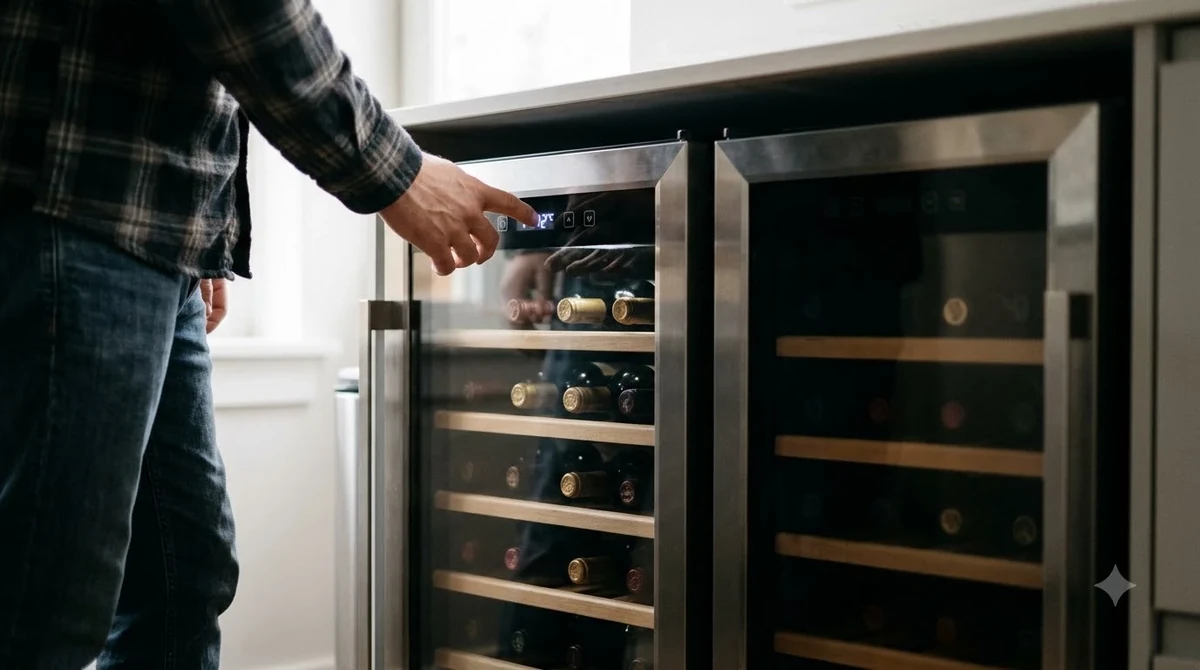
Look at the toe-kick, grille, and rear area without removing a panel. Make sure curtains, kitchen mats, cabinet trim, stored boxes, dust, or a nearby wall are not blocking the opening specified in the manual. A front-vented built-in unit needs its front grille clear; a freestanding or rear-vented design needs the rear and side clearances stated by its manufacturer. Do not push a wine cellar tightly into a recess simply because its width fits. A blocked heat outlet can leave the compressor running longer while the interior stays warmer than the set temperature.
Next, consider the room itself. Summit’s general troubleshooting guidance recommends a well-ventilated location above 60°F and below 80°F, away from direct sunlight and strong UV lighting. The instructions for some listed models include a different, model-specific upper ambient limit, which is why the manual for the precise model must decide the installation range. Avoid placing the cooler beside an oven, range, radiator, clothes dryer, or another appliance that exhausts heat. A cabinet in a sunny window can face a much heavier cooling load in the afternoon than it does overnight.
Clean only owner-accessible areas described in the manual. Switch off and disconnect the appliance as directed before removing dust from an exposed grille. Do not reach into a fan opening, remove a cover, spray liquid into vents, or clean sealed refrigeration parts; Summit directs owners to leave other servicing to a qualified technician. After clearing the opening, monitor the temperature without repeatedly moving the cabinet.
Inspect the Door Seal and Bottle Load
A door that looks shut may still leak cool air if its gasket is dirty, folded, damaged, or held away from the cabinet by a misplaced shelf or bottle. Summit specifically lists an improperly closed door, a poor door seal, and frequent opening as common reasons its wine cellars may not stay cold.
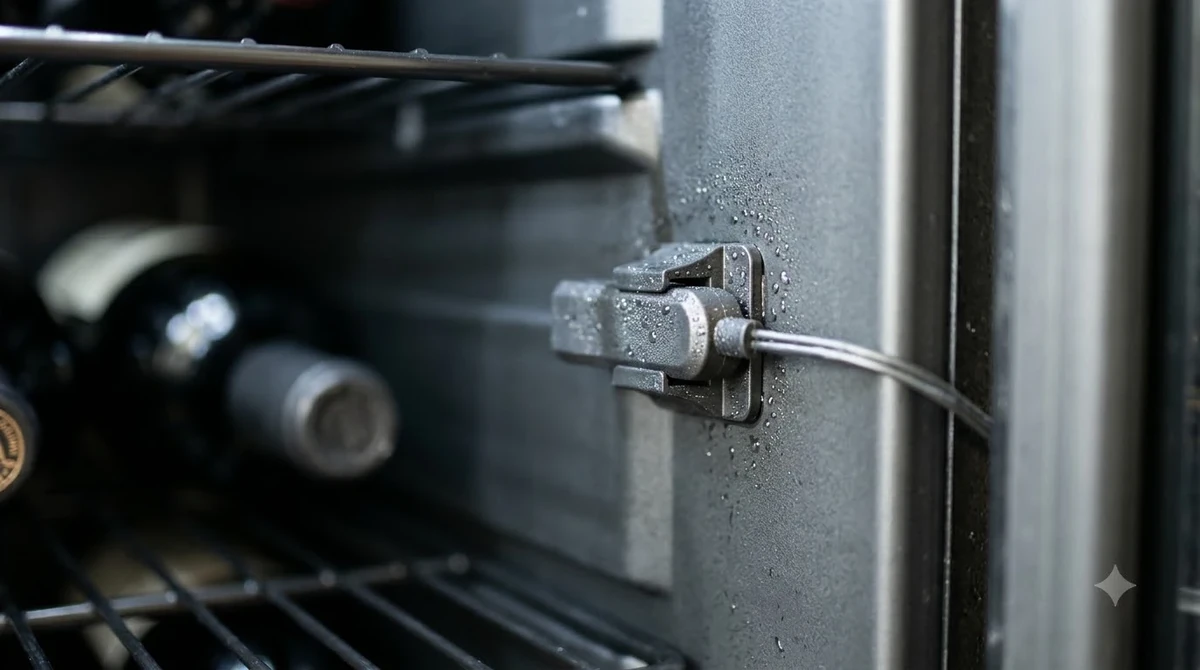
Inspect the gasket around all four sides for spills, twists, cracks, or sections pulled from the channel. Wipe an intact seal with a soft, damp cloth and dry it; avoid solvents and abrasives. Confirm bottles sit within their racks, shelves are seated, and no oversized bottle blocks the door. Summit also lists misplaced shelves and contents obstructing the door as closure problems.
Close the door and look for even contact around the opening. If the gasket remains separated, torn, or loose, request the correct model-specific replacement rather than trying glue or heat. A poor seal can keep the compressor running longer and cause temperature swings.
Consider how many bottles were added and how quickly. Summit lists a large new load and frequent access as reasons for repeated compressor starts and stops. Room-temperature bottles add cooling demand, so remove bottles above rated capacity, keep air channels clear, and avoid packing bottles against vents. Let the cabinet run with the door closed while the temperature settles.
Tip: For the next few hours, keep a simple log: room temperature, cabinet setpoint, shelf-thermometer reading, and how often the door is opened. A stable room and a closed door make it much easier to tell whether cleaning the gasket or clearing a vent has helped.
Verify Power and Allow a Full Cooling Cycle
When the display is dark or the cabinet does not seem to run, begin with the external power supply before assuming a sealed-system failure. Summit’s manuals list an unplugged unit, an appliance switched off, incorrect supply voltage, and a tripped breaker or blown fuse among the possible causes of a wine cellar that will not operate.
Confirm the plug is seated and the outlet has power. Do not use an extension cord or adapter, and do not use a damaged cord or hot receptacle. The Summit manual for its SWC/LWC model group specifies a grounded three-prong outlet and recommends a dedicated circuit. Compare the rating plate with the household supply; if a breaker trips again after one reset, stop and arrange qualified service.
After plugging in or loading bottles, allow time for the cabinet to cool. Summit says it can take up to 48 hours to reach the desired temperature, particularly with room-temperature bottles. Keep the door closed and avoid repeated control changes. Do not wait through that period if the unit is silent, shows an error, smells hot, or continues warming.
There is also a special rule after moving a cabinet. For the models covered by its SWC/LWC manual, Summit says to let the appliance stand upright for approximately two hours before connecting it, reducing the chance of a cooling-system malfunction from transport. That instruction should not be generalized to every Summit model, so use the exact manual if the cabinet has been laid on its side or transported. Once it is positioned and powered according to the manual, make one controlled temperature check and record the result.
If the compressor never starts or clicks repeatedly without cooling, do not remove the rear cover to inspect wiring or refrigerant parts. Summit says repairs beyond owner procedures belong with a qualified technician, who can test the controls, sensor, fan, compressor components, and sealed system.
Separate Normal Sounds From Signs of a Fault
Noise can provide clues, but not every hum, click, or gurgle means the wine cellar has stopped working. Summit explains that refrigerant moving through the system, water circulating at the end of a cycle, and the expansion or contraction of interior walls can create normal sounds.
A compressor hum or fan sound may be noticeable in a quiet room, especially on tile or hardwood. Summit says compressor and temperature-equalizer fans produce normal operating noise, and hard floors can reflect that sound. The cabinet should still be level and installed as the manual directs.
A new scraping, grinding, repeated rapid clicking, or fan noise paired with rising temperatures deserves attention. From outside, see whether a loose bottle, shelf, or nearby object is vibrating. Never put fingers or tools through a grille; contact service for an internal fan problem.
Frequent compressor cycling can follow a hot room, a recent large bottle load, repeated door opening, or a door that is not sealing. Those are all listed in Summit’s troubleshooting material, so first remove the easy causes and observe the pattern. If the compressor starts and stops every few minutes after the room is within the model’s operating range, the vents are clear, the seal is sound, and the load is reasonable, report the cycle pattern to a technician. Include whether the interior temperature rises between cycles and whether any error code appears.
Protect Wine and Prepare for a Service Call
While troubleshooting, protect the bottles from repeated warm-and-cold swings and make the next service step straightforward. A temporary move to a stable, cool indoor location is better than leaving wine in a hot room or repeatedly opening a malfunctioning cabinet.
For short-term holding, Wine Enthusiast recommends 50–59°F for less than six months and 53–57°F for longer storage. Reds, whites, sparkling wines, and fortified wines can share a storage temperature; serving temperature is a separate matter. Keep bottles away from sunlight, radiators, ovens, and large daily temperature swings. See Wine Enthusiast’s storage-temperature guidance for more detail.
Do not overfill a temporary wine fridge. A regular refrigerator may be useful briefly, but its temperature is generally colder than ideal wine-serving conditions; chilling one bottle is different from storing a collection for months. Decanter notes that glass thickness, air movement, and alcohol level affect how quickly a bottle cools, so there is no exact formula. Use a thermometer rather than judging by touch.
What to record before requesting service
Record the model and serial numbers, display reading, setpoint for each zone, independent thermometer reading, and room temperature. Note whether the compressor and fans run, whether the sound changed, and whether clearing the vents affected the temperature. A short timeline is more useful than simply reporting that the unit does not cool.
Also note whether it is built in or freestanding, the vent clearance, nearby heat sources, recent moves, and any power interruption. These details help narrow the fault to installation, airflow, a sensor, fan, or refrigeration component.
Stop and contact service if the cord is damaged, the outlet is hot, there is a burning smell, a breaker trips repeatedly, or you suspect refrigerant damage. Summit’s SWC/LWC manual identifies R600a as flammable; if the cooling system is damaged, it instructs owners to disconnect power, avoid ignition sources, ventilate the room, and contact service. Do not open the sealed system or handle refrigerant tubing.
For model-specific support, start with Summit’s wine-cellar troubleshooting FAQ and retrieve the correct manual by model number. If cooling resumes after clearing a vent, correcting the setting, or improving the seal, monitor it until the temperature is stable. Otherwise, give the recorded readings to a technician rather than dismantling the cabinet.
For other brands, compare the model-specific checks in our Allavino wine fridge not cooling, Magic Chef wine fridge not cooling, and Haier wine fridge not cooling articles. The broader Brand Troubleshooting section covers more storage-care problems.
Frequently Asked Questions
These answers cover a few model-specific questions that can be mistaken for a cooling fault. Summit’s single-zone and dual-zone designs do not all share the same controls or alerts.
Can I use a Summit wine cooler in an unheated garage?
Summit describes its residential wine cellars as home appliances and gives 68–79°F as the ideal room-temperature range. It warns that moisture can reach unprotected electrical connections, risking shorts or premature component failure. An unheated garage may also fall outside a model’s specified operating range.
Why does my Summit wine cooler display an alarm even after the door is shut?
Only selected Summit units have a temperature alarm, and some models have a door alarm that sounds after the door has stayed open for more than one minute. A temperature alert may remain until the interior returns to its programmed range. The exact model manual explains its alarm behavior.
Does every Summit wine fridge have two temperature zones?
No. Summit offers single-zone and dual-zone designs; its SWCP1988T/LWC3Z98 manual identifies separate upper and lower zones. A single-zone model has one compartment setting, while a dual-zone model allows separate temperatures within the limits in its manual.
Can I clean a Summit wine cooler with a stainless-steel scrubber?
No. Summit advises against steel wool and steel brushes on stainless steel because particles can rust. Its care guidance recommends mild cleaners, warm water or a baking-soda solution for suitable interior surfaces, and a soft cloth for wooden shelves. Keep water away from controls and disconnect power before cleaning.
Should I reset the cooler by unplugging it overnight?
Do not treat an overnight power-off as a universal fix. Summit does not prescribe that reset for every model. Record any error, follow the reset instructions in the exact manual, and request service if the unit still fails to start or cool.
A Summit wine cooler that is not cooling often has a fixable airflow, setting, door, or operating-condition problem, but persistent warming needs a proper diagnosis. Confirm the temperature, follow the model-specific manual, and keep the wine in a stable location while the issue is resolved. If the basic checks do not restore cooling, the temperature log and model details will help a qualified technician identify the fault.
More in Storage & Fridge Care
 How Long Can You Store Wine in a Wine Fridge? Protect Bottle QualityUpdated Nov 20, 2026
 Can You Store Beer in a Wine Fridge? Keep Both Drinks FreshUpdated Nov 20, 2026
 Is It Worth Repairing a Wine Fridge? Spot the Cheap Fixes Before You ReplaceUpdated Nov 20, 2026
 Wine Fridge Condensation: Identify Causes and Fix Moisture ProblemsUpdated Nov 20, 2026
 Wine Fridge Too Cold: Protect Your Wine and Fix the TemperatureUpdated Nov 20, 2026
 How to Reset Wine Fridge: Restore Cooling and SettingsUpdated Nov 20, 2026