

We may earn a commission when you buy through links on this page, at no extra cost to you. Learn more.
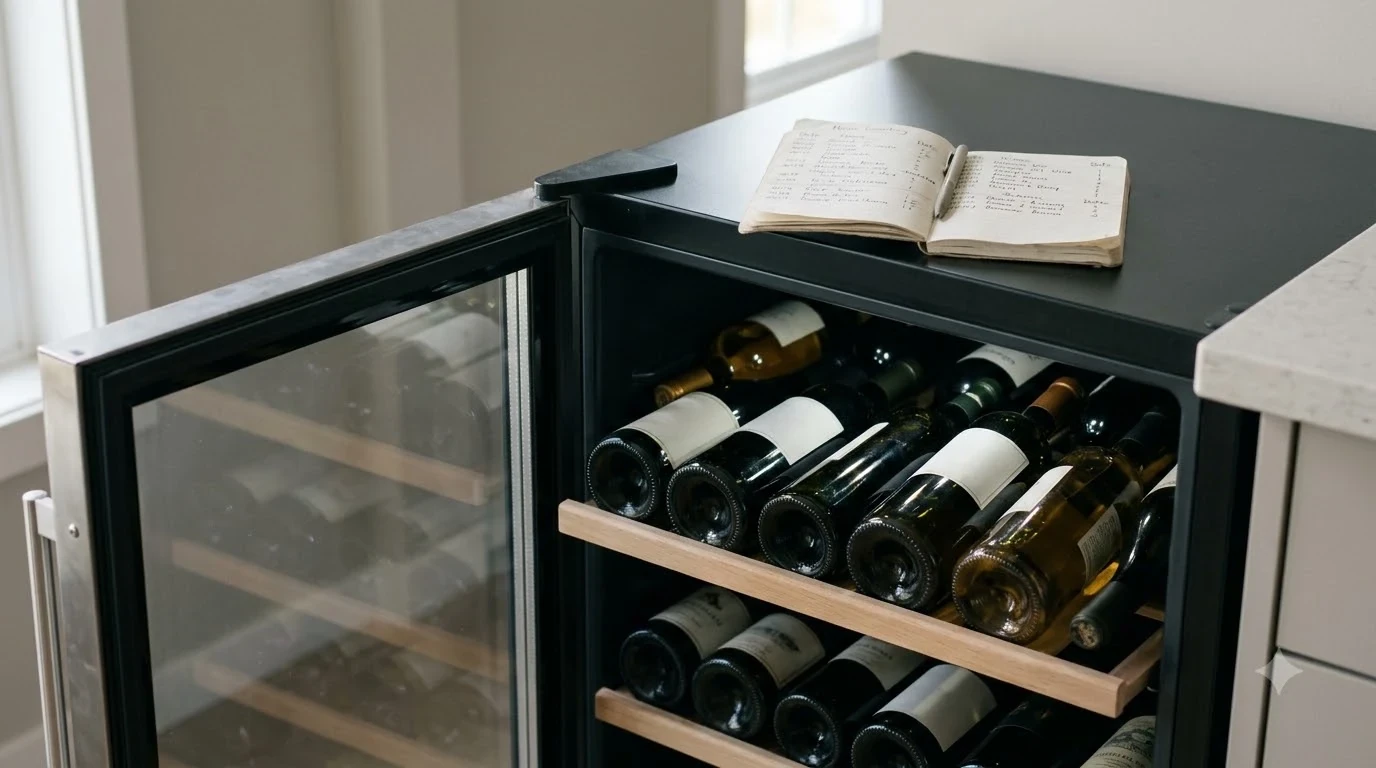
danby wine fridge not cooling? Start by checking the power supply, temperature settings, door seal, and ventilation before assuming the compressor has failed. A blocked exhaust vent, excessive room temperature, or recently added bottles can prevent a Danby wine cooler from reaching its target temperature. Many problems can be identified through simple external checks, although a failed fan, temperature sensor, compressor, or refrigerant system requires professional attention.
A wine refrigerator needs consistent airflow, an appropriate operating environment, and a properly sealed door to maintain its internal temperature. When a Danby unit stops cooling, the display, compressor sounds, and actual cabinet temperature can provide useful clues about the cause. Start with the basic checks below, identify your model number, and work through the troubleshooting process before arranging a repair.
1. Check the Power Supply and Temperature Controls
Begin with the electrical connection and thermostat because these are among the simplest causes of a Danby wine refrigerator failing to cool. A loose plug, interrupted power supply, switched-off appliance, or incorrect temperature setting can create the same initial symptoms as a more serious cooling-system problem.
First, check whether the interior light, digital display, or control panel is operating. If everything is dark, make sure the power cord is fully inserted into a properly grounded wall outlet. Check the household circuit breaker and fuse if the outlet appears to have lost power. A tripped breaker should not be repeatedly reset if it trips again, because that may indicate an electrical problem that needs professional attention.
Next, verify that the appliance is switched on and that the temperature control has not been accidentally changed. Danby uses different control arrangements across its wine coolers and beverage centers. Some models have digital buttons, while others use mechanical dials. The direction and meaning of the settings can vary, so use the instructions for the specific model instead of assuming that every dial works identically.
A useful diagnostic step is to compare the displayed temperature with an independent refrigerator thermometer placed inside the cabinet. Allow the thermometer to stabilize before drawing conclusions. If the displayed temperature and measured temperature disagree substantially, the problem might involve a temperature sensor or control system rather than insufficient compressor operation.
Distinguish between no power and insufficient cooling
A completely inactive wine cooler needs a different diagnosis from one that runs continuously without becoming cold. If the lights and display are working but the bottles remain warm, investigate the temperature setting, ventilation, door seal, and cooling cycle. If the entire appliance is inactive, concentrate first on the outlet, plug, breaker, and power controls.
Danby’s official troubleshooting guidance recommends checking the power supply and thermostat before moving on to other causes. Its wine cooler troubleshooting recommendations also identify door sealing, condenser cleaning, and adequate ventilation as important checks.
2. Improve Ventilation and Check the Room Temperature
Restricted airflow is a common reason a Danby wine fridge struggles to cool properly. The compressor and condenser need to release heat, and insufficient ventilation can make that process less effective, particularly when the appliance is installed in a warm room or confined space.
Start by examining the space around the wine cooler. Look for furniture, boxes, cabinets, curtains, or other objects obstructing the ventilation openings. Remove anything blocking the exhaust grille or restricting the intended air circulation. Also check whether the appliance has been pushed too close to a wall.
Danby’s general FAQ recommends approximately 2–3 inches of clearance around the sides and back of a typical wine fridge, but this is not a universal installation specification. Individual manuals can require more room. For example, the DBC031L1SS manual specifies 5 inches at the back and sides, while the older DWC114BLSDD manual specifies 5 inches at the back, sides, and top. Model-specific instructions take priority over general clearance recommendations.
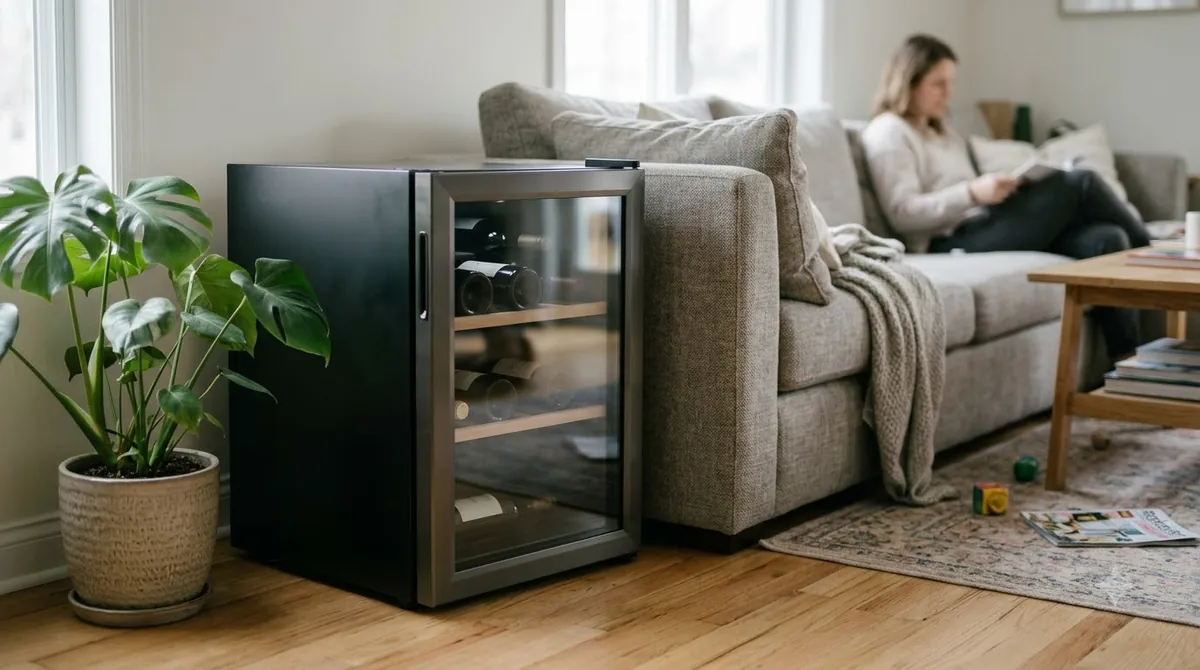
Room temperature matters just as much as physical clearance. A freestanding wine refrigerator placed beside a stove, radiator, heater, or sunny window may struggle to remove heat. Moving it away from these sources can improve operating conditions. Avoid placing a residential Danby wine cooler in an outdoor kitchen, unheated garage, porch, or another uncontrolled environment unless the particular model is explicitly designed for that location.
Check your model’s operating environment
Different Danby models have different permitted ambient-temperature ranges. The DBC031L1SS manual specifies a recommended surrounding temperature of 64°F–100°F (18°C–38°C). It also warns against installation in locations where the temperature falls below 64°F. This is an important distinction because a wine cooler is not designed to operate like a conventional refrigerator in every possible room condition.
A room that becomes unusually hot can also make the appliance run for extended periods. High ambient temperatures place additional demands on the cooling system, and poor ventilation makes the situation worse. If the unit is installed inside a tight enclosure, determine whether it is actually a built-in model before changing the installation. A freestanding wine cooler should not be treated as a built-in appliance simply because it fits underneath a counter.
| Danby model or guidance | Documented requirement | Why it matters |
|---|---|---|
| General Danby FAQ | Typically 2–3 inches at sides and back | General ventilation recommendation; not a substitute for the manual |
| DBC031L1SS | 5 inches at back and sides | Allows airflow around the compressor and condenser |
| DWC114BLSDD | 5 inches at back, sides, and top | Required clearance for this freestanding model |
| DBC031L1SS ambient range | 64°F–100°F | Recommended surrounding operating temperature |
| DBC031L1SS after transportation | Approximately 6 hours upright | Recommended waiting period before connecting power after transport |
The table illustrates why checking the model number is important. Applying a generic 2-inch clearance to an appliance whose manual specifies 5 inches can leave it without sufficient airflow. Correcting the installation may resolve an apparent cooling problem without replacing any components.
3. Inspect the Door Seal and Bottle Arrangement
A Danby wine refrigerator needs a properly closed door to maintain a stable internal temperature. A damaged gasket, poorly positioned shelf, or bottle preventing the door from closing can allow warm air to enter and force the cooling system to work harder.
Open the door and examine the rubber gasket running around its perimeter. Look for cracks, flattened areas, dirt, loose sections, and visible gaps. A gasket that no longer makes consistent contact with the cabinet can allow cold air to escape. Even a relatively small opening can interfere with temperature stability when the appliance operates continuously in a warm room.
Clean the gasket and the surrounding contact surface using a soft cloth and mild soapy water. Remove any residue that might prevent the seal from sitting correctly. Dry the area and close the door carefully. Check the entire perimeter rather than concentrating only on the handle side, because damage can occur along the top, bottom, or hinge side as well.
Make sure bottles and shelves do not obstruct the door
Overloading the cabinet can create more than one problem. Bottles that extend beyond their intended shelf positions might prevent the door from closing, while crowded shelves can interfere with internal airflow. A large quantity of room-temperature wine added at once also introduces additional heat into the cabinet.
Danby’s DBC031L1SS troubleshooting guide specifically identifies frequent door opening, improper closure, and a large bottle load as potential causes of cooling difficulties. Its manual also identifies repeated compressor starting and stopping as a possible response to high external temperatures, frequent opening, and recently loaded bottles.
Rearrange the bottles so that they fit securely within the shelves and leave the door unobstructed. Avoid pushing bottles against ventilation openings or placing them in positions that interfere with the circulation of cooled air. If you are restocking several cases, introduce the bottles in manageable batches rather than loading a large number of warm bottles simultaneously.
Check whether the door closes evenly
A wine refrigerator that is not level may have difficulty maintaining a consistent door seal. Examine the appliance feet and the floor beneath it. The unit should stand securely without rocking. If the door appears misaligned, do not force it shut or attempt to bend its hinges. Consult the model instructions for leveling and door adjustments.
Tip: Close the door slowly after rearranging the shelves and inspect the gasket around all four sides. A bottle touching the door or a folded seal can cause cooling problems even when the compressor and thermostat are functioning normally.
Replace a damaged gasket with the correct part for the model. Choosing a visually similar seal is not enough because the dimensions and mounting arrangement must match the appliance. If the gasket is severely deformed or the door does not align correctly, professional service may be more appropriate than attempting an improvised repair.
4. Understand the Compressor and Cooling Fan Symptoms
The compressor and fans are essential to the cooling process, and their operating behavior can help identify a more serious fault. A Danby wine fridge that runs continuously, repeatedly clicks, or produces unusual noises without lowering the temperature may have a failing component.
The compressor circulates refrigerant through the cooling system. The condenser releases heat from the refrigerant, while the evaporator absorbs heat from the interior. Depending on the model, one or more fans help move air across these components or distribute cooled air around the cabinet.
If the unit is powered and its compressor appears to be running but the internal temperature remains high, consider the possibility of an airflow problem or failed cooling component. A fan that is not operating correctly can interfere with heat exchange or the distribution of cool air. A temperature sensor or electronic control problem can also prevent the appliance from maintaining its intended setting.
Common compressor symptoms
A compressor that runs for unusually long periods may be responding to a warm room, insufficient ventilation, an incorrectly closed door, or a substantial load of warm bottles. These conditions should be corrected before concluding that the compressor itself is defective.
Repeated starting and stopping is another symptom worth investigating. Danby’s DBC031L1SS manual identifies high external temperatures, frequent opening, an improperly closed door, and large bottle loads as potential contributors to repeated compressor cycling. In other words, cycling by itself does not prove that the compressor has failed.
Clicking, humming, or a compressor that tries to start but repeatedly stops can indicate a problem with the starting components, electrical controls, or compressor. A technician may need to investigate the start relay, overload protection, wiring, or compressor operation. These are not suitable components for trial-and-error replacement by an untrained owner.
When a cooling fan may be responsible
A cooling fan problem may become more likely when the appliance makes unusual fan noises, runs without effectively lowering the cabinet temperature, or has an abnormal airflow pattern. However, a fan that cannot be heard is not automatically defective. Fan operation can vary by model and cooling cycle.
General appliance troubleshooting references identify condenser fan motors and evaporator fan motors as possible failure points in refrigeration systems. They also identify faulty temperature sensors, control boards, and electrical starting components as potential causes of insufficient cooling.
Danby’s older DWC114BLSDD manual specifically lists evaporator fan failure, compressor failure, and a possible refrigerant-system leak among potential explanations for an internal temperature that remains too high. These are service-level concerns, not routine cleaning tasks.
Why refrigerant problems require professional service
A refrigerant leak or restriction in the sealed cooling circuit can prevent the appliance from removing enough heat, even when the compressor appears to be operating. A technician may need specialized equipment to determine whether the refrigerant circuit, compressor, or another sealed-system component has failed.
Do not puncture tubing, open refrigerant lines, or attempt to refill the system. Danby identifies flammable refrigerant in its newer DBC031L1SS manual and warns against damaging the refrigeration circuit. Refrigerant-related work should be left to appropriately qualified service personnel.
For additional troubleshooting context, the iFixit refrigerator cooling diagnostic reference explains how dirty coils, damaged seals, fan failures, temperature sensors, starting components, and compressor problems can affect refrigeration performance.
5. Interpret Danby Wine Fridge Display Codes and Warning Signs
Display codes can help narrow down a Danby wine refrigerator problem, but their meanings are not necessarily identical across every product family. For example, the DWC114BLSDD manual describes HI, LO, and CL indications with specific possible causes, so these meanings should not automatically be applied to another Danby model.
A HI indication on the DWC114BLSDD can be associated with a cabinet temperature that is too high. Danby’s troubleshooting guide lists an improperly closed door, obstructed exhaust vent, recently added warm bottles, direct sunlight, nearby heat sources, and high ambient temperature among the potential explanations.
The same manual also identifies a possible refrigerant leak, evaporator fan failure, or compressor failure when the unit cannot cool properly. That means a persistent high-temperature warning deserves attention even after the obvious airflow and door-seal problems have been addressed.
What LO and CL can indicate
The DWC114BLSDD manual associates LO or CL warnings with excessively low ambient temperature, sensor failure, or evaporator temperature that is too low. These warnings do not necessarily mean the cooling system is unable to produce cold air. In some cases, the problem may be related to how the appliance measures and interprets temperature.
Start by examining the room environment and the actual cabinet temperature. Check whether the appliance is operating in a location that is too cold for the model. If the warning remains after correcting the surrounding conditions, the temperature sensor or another control component may need professional inspection.
When a reset is appropriate
For the DWC114BLSDD specifically, Danby provides a power-reset procedure when HI, LO, or CL remains on the display for more than 5 minutes. The manual instructs users to unplug the appliance, wait 5 minutes, and reconnect it. If the code remains after this procedure, the next step is to contact consumer care or an authorized service agent.
Do not assume that the same reset procedure applies to all Danby wine coolers. Different models can use different controls, fault-detection systems, and restart instructions. Consult the correct manual before disconnecting power to clear an error.
Repeated resets are not a repair for a damaged sensor, failed fan, restricted refrigerant circuit, or malfunctioning compressor. Record the warning code and the circumstances in which it appears. That information can help a technician distinguish between an installation problem and an internal component failure.
6. Clean and Maintain the Wine Refrigerator Safely
Regular maintenance can help prevent airflow restrictions, poor door sealing, and unnecessary strain on the cooling system. Dust accumulation, dirty cabinet surfaces, and neglected ventilation areas can make a wine refrigerator less effective, especially when it operates in a warm or dusty location.
Before cleaning, switch off and unplug the appliance as directed by its manual. Remove the bottles and accessible shelves where necessary, taking care not to damage the shelving or interior surfaces. Clean the interior using a soft cloth and an appropriate mild cleaning solution. Avoid abrasive materials and harsh chemicals that might damage the finish or gasket.
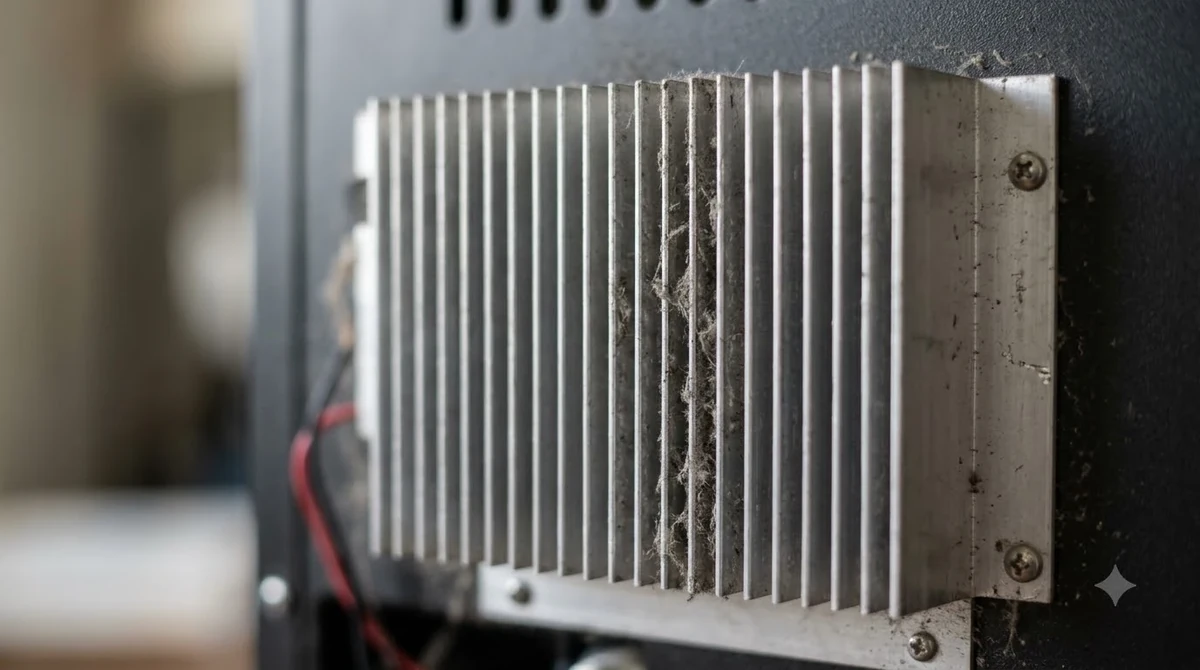
Inspect the ventilation openings and accessible condenser area for dust buildup. Danby identifies condenser-coil cleaning as one of the checks to consider when a wine cooler is not cooling properly. Follow the cleaning instructions for the specific unit, because condenser access and component arrangements vary by model.
Clean accessible ventilation areas
Use a soft brush or vacuum attachment only where the model instructions permit it. Remove loose dust without forcing objects into the grille or pressing against refrigerant tubing. Do not bend delicate components, loosen electrical connections, or remove internal covers merely to reach a dirty surface.
Some wine refrigerators have different condenser arrangements, and a component that is accessible on one unit may be enclosed on another. If cleaning requires removing a rear panel or exposing electrical components, stop and consult Danby or an authorized technician.
Keep the surrounding floor and ventilation space free from dust and stored objects. This is especially important when an appliance is installed in a utility room or another area where boxes, cleaning supplies, and household items can gradually accumulate around it.
Maintain the door and shelves
Clean the gasket periodically so that it remains flexible and makes proper contact with the cabinet. Inspect the hinges and shelf positions whenever the door seems difficult to close. Do not use sharp objects to scrape ice or debris from the inside of the appliance, because they can damage internal surfaces or refrigerant components.
Some Danby models have automatic defrost functions, while other models may use different arrangements. Follow the instructions in the appropriate manual rather than assuming that every unit needs manual defrosting.
Keeping a simple maintenance record can also help. Note when the appliance was cleaned, whether the gasket was inspected, and whether the unit has experienced temperature fluctuations. If the problem returns, this information can help distinguish an ongoing installation issue from a developing component failure.
7. Know When to Contact Danby or an Appliance Technician
Professional service is appropriate when basic troubleshooting does not restore cooling or when the symptoms suggest an electrical, fan, compressor, sensor, or refrigerant-system failure. Continuing to operate a wine fridge that cannot maintain its temperature may leave the stored bottles exposed to unsuitable conditions.
Before requesting service, record the complete model number and serial number. These identifiers are generally found on the appliance rating label. Also note the approximate installation date, the current display reading, the room conditions, and whether the compressor or fan appears to be operating.
Describe the symptoms accurately rather than simply reporting that the refrigerator is broken. For instance, explain whether the display works, whether the compressor starts, whether the cabinet becomes slightly cool, whether the door seals evenly, and whether an error code appears. Mention any unusual clicking or repeated starting and stopping.
Situations that need professional attention
Arrange professional service when the appliance repeatedly trips the electrical breaker, has a damaged power cord, makes persistent abnormal compressor noises, or remains warm despite adequate airflow and a correctly closed door. A visible refrigerant leak, suspected sealed-system restriction, or failed electronic component also requires qualified diagnosis.
Do not attempt to bypass electrical controls or test components while the refrigerator is connected to power. Even after disconnection, some electrical components can retain a charge. Danby’s instructions also warn against damaging refrigerant tubing, and these safety considerations make compressor and refrigeration-system repairs inappropriate for casual DIY work.
Prepare the information needed for service
A useful service request should contain the following information:
- The complete Danby model and serial numbers.
- The temperature displayed by the control panel and an independent thermometer reading.
- Any HI, LO, or CL code and how long it remains visible.
- Whether the compressor or internal fan appears to run continuously, intermittently, or not at all.
- Any recent transportation, installation changes, ventilation restrictions, or unusually large bottle loads.
- The results of basic checks involving power, settings, door sealing, and airflow.
Danby provides model-specific support resources through its website. Looking up the exact model is more useful than relying on a generic troubleshooting list because installation clearances, temperature limits, warning codes, and service procedures can differ substantially between product generations.
For additional appliance troubleshooting topics, see our Brand Troubleshooting resources. The same diagnostic approach can also help identify similar symptoms in an Allavino wine fridge not cooling or a Haier wine fridge not cooling, although their model-specific instructions will differ.
Frequently Asked Questions
Why does my Danby wine fridge fan cycle every few seconds?
Danby’s general FAQ states that a fan cycling every 8–12 seconds can be part of normal operation on applicable appliances. This behavior should not automatically be treated as a motor failure. The important distinction is whether the cabinet is maintaining its intended temperature and whether other warning signs are present.
Is a rattling sound from a Danby wine cooler always a problem?
No. Danby’s DBC031L1SS manual explains that a rattling sound can come from refrigerant flowing through the cooling system. It also describes water-circulation sounds after a cooling cycle and cracking noises caused by expansion and contraction of interior walls as possible normal operating sounds.
Does every Danby wine refrigerator require manual defrosting?
No. The DBC031L1SS manual identifies an automatic defrost function and explains that the appliance does not require manual defrosting. Defrost arrangements vary by product, so instructions for another Danby model should not be assumed to apply to this one.
Can I plug my Danby wine fridge into an extension cord?
Danby’s DBC031L1SS manual specifically warns against using extension cords or ungrounded adapters. It calls for an exclusive, properly grounded wall outlet. A qualified electrician should assess an outlet that does not meet the appliance’s grounding requirements.
Where can I find the correct troubleshooting manual for my Danby wine fridge?
Danby recommends searching its website using the appliance’s model number to access the appropriate manuals and support resources. The manufacturer also provides customer care at 1-800-263-2629. Having the model and serial numbers available helps ensure that the assistance relates to the correct appliance.
A Danby wine refrigerator that stops cooling does not necessarily need a new compressor. Start with the power supply, thermostat, ventilation, room temperature, and door seal, then use the model-specific manual to interpret warning codes and installation requirements. When basic checks do not restore cooling, arrange professional service rather than attempting electrical or refrigerant-system repairs yourself.
More in Storage & Fridge Care
 How Long Can You Store Wine in a Wine Fridge? Protect Bottle QualityUpdated Nov 20, 2026
 Can You Store Beer in a Wine Fridge? Keep Both Drinks FreshUpdated Nov 20, 2026
 Is It Worth Repairing a Wine Fridge? Spot the Cheap Fixes Before You ReplaceUpdated Nov 20, 2026
 Wine Fridge Condensation: Identify Causes and Fix Moisture ProblemsUpdated Nov 20, 2026
 Wine Fridge Too Cold: Protect Your Wine and Fix the TemperatureUpdated Nov 20, 2026
 How to Reset Wine Fridge: Restore Cooling and SettingsUpdated Nov 20, 2026