

We may earn a commission when you buy through links on this page, at no extra cost to you. Learn more.
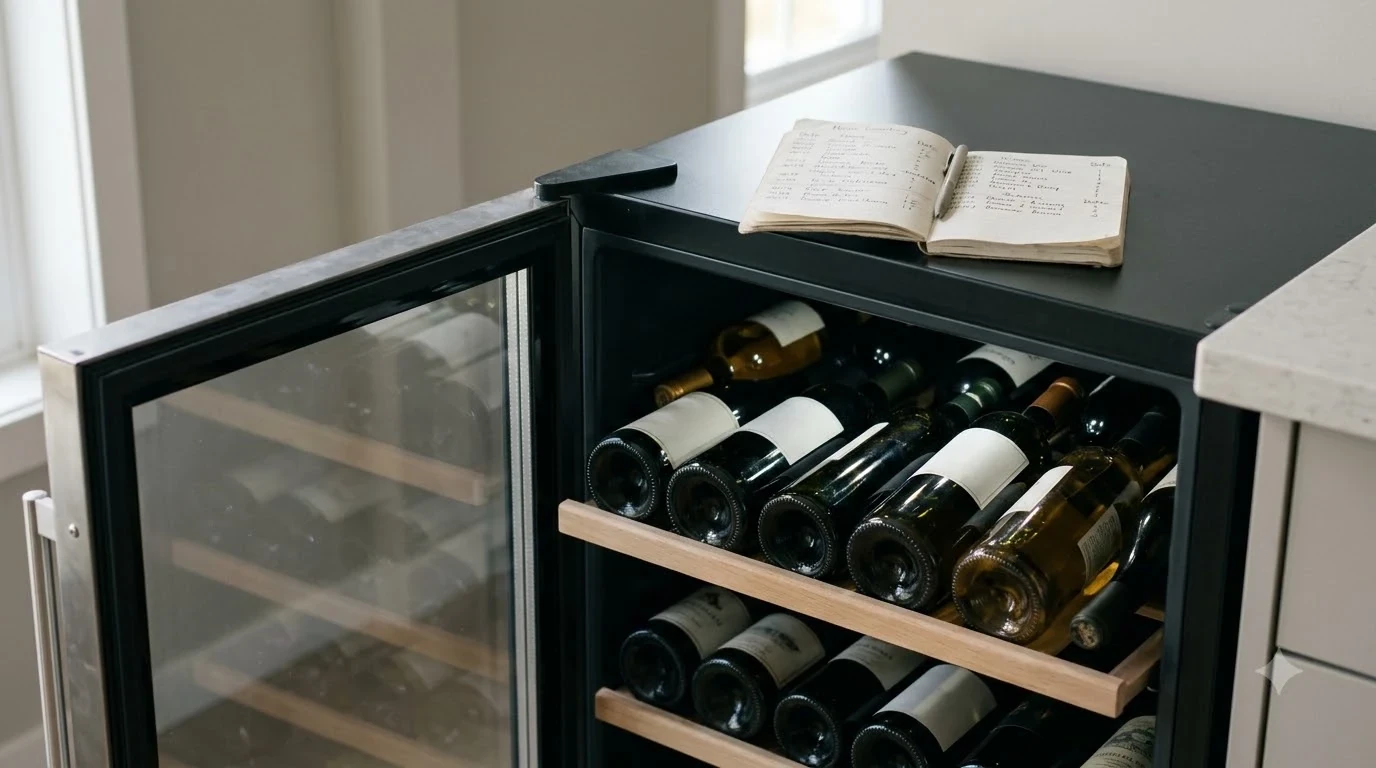
A newair wine fridge not cooling is often caused by a temperature setting, blocked ventilation, a warm room, frequent door openings, or a door seal that is not closing properly. Start with the model number and its manual, because Newair makes both thermoelectric and compressor wine coolers with different installation and operating requirements. Check the simple external causes first, then measure the cabinet temperature before deciding that a cooling component has failed.
A wine fridge that feels warm does not always have a failed compressor or cooling module. A recently loaded cabinet, a hot room, or a door that is not fully shut can all make the temperature rise. The checks below separate operating conditions from likely service problems and help protect the bottles while you troubleshoot.
Identify the Cooling Technology Before Troubleshooting
The first step is to identify the model and cooling system, since Newair does not use one universal design across its wine-fridge range. Its manuals directory lists compressor models as well as thermoelectric coolers, and the controls, ventilation needs, and temperature ranges are not interchangeable.
Find the model number on the appliance identification label, then look up that exact model in Newair’s product manual directory. Two examples show why this matters: the AW-181E is an 18-bottle thermoelectric cooler, while the NWC076SS00 is a 76-bottle compressor model with an inverter compressor. The NWC076SS00 manual lists a 40°F to 65°F control range; the AW-181E manual lists 54°F to 66°F. A setting that is possible on one model may not be available on another.
| Newair reference model or guidance | Cooling and temperature details | Installation detail |
|---|---|---|
| AW-181E, 18-bottle model | Thermoelectric; adjustable from 54°F to 66°F | Its manual describes a 1-inch clearance around the unit for recessed installation |
| NWC076SS00, 76-bottle model | Inverter compressor; control range 40°F to 65°F | Freestanding installation; manual says not to build it into closed cabinetry |
| Newair thermoelectric overview | General ambient-temperature guidance: 50°F to 80°F | At least 5 inches of clearance around a freestanding unit |
Use the figures in your own model’s manual, not a number copied from another Newair cooler. For example, Newair’s general thermoelectric overview gives broad ambient and clearance guidance, while the AW-181E manual gives installation figures for that specific appliance. Different cabinets, vents, and cooling systems can have different requirements, so the table is a comparison of documented examples rather than a universal specification.
The distinction changes what “not cooling” looks like. Compressor models run a refrigeration cycle; thermoelectric models use a heat-pumping module and fans. A fan running often or a warm exterior alone does not prove a failed part. Record the model before troubleshooting or contacting a technician.
Verify the Temperature Setting, Power, and Restart Sequence
Check the display and power supply before moving the bottles or opening the cabinet for inspection. A cooler that is switched off, set too warm, or not receiving stable power can appear to have a cooling-system problem even when the refrigeration components are intact.
Confirm that the appliance is on and that the correct zone is selected. Newair’s NWC076SS00 manual describes a five-second simultaneous button press to turn that model on or off, and its two zones each have a 40°F to 65°F setting range. The manual also specifies that the lower zone setting must be the same as or higher than the upper zone setting, with at least a 4°F difference recommended for best performance. These controls are model-specific; do not assume another Newair panel uses the same button combination. Choose a storage temperature within the range printed for the model: 40°F to 65°F for the NWC076SS00 or 54°F to 66°F for the AW-181E. If the control was accidentally raised, correct it in small steps rather than changing the setting every few minutes.
Check that the plug is firmly seated in a grounded wall outlet and that the household breaker has not tripped. The NWC076SS00 is rated at 110–120 volts, 60 Hz, and 1.6 amps; use the requirements for your own model, not these figures as universal values. Never remove the grounding prong or open an electrical panel. A breaker that trips again, a hot or damaged cord, or a burning odor calls for professional attention.
If the unit was unplugged or power was interrupted, follow the restart interval in its manual. For the NWC076SS00, Newair specifies waiting 3 to 5 minutes before restarting; an immediate restart can prevent that model from starting correctly. Restore power once, allow the appliance to resume normal operation, and monitor it rather than rapidly switching it on and off.
Give the Cooler Room to Reject Heat
Restricted ventilation is a common reason a wine fridge struggles to lower its temperature. The cooling system has to release heat somewhere, so a unit pressed against a wall, boxed into the wrong cabinet, or placed beside a hot appliance may run without bringing the bottles down to the set point.
Check the installation against the exact manual. Newair’s thermoelectric overview recommends an ambient range of 50°F to 80°F and at least 5 inches of clearance around a freestanding thermoelectric cooler. It warns against putting a freestanding thermoelectric unit inside cabinetry; a built-in model needs a front-venting design. The Newair explanation of thermoelectric wine fridges describes why airflow matters. Do not apply the 5-inch recommendation to every model: the AW-181E manual gives that unit a 1-inch clearance for recessed installation and an ambient recommendation of 77°F to 80.6°F. Follow the model manual. The NWC076SS00 compressor model, for example, is freestanding and must not be recessed into closed cabinetry.
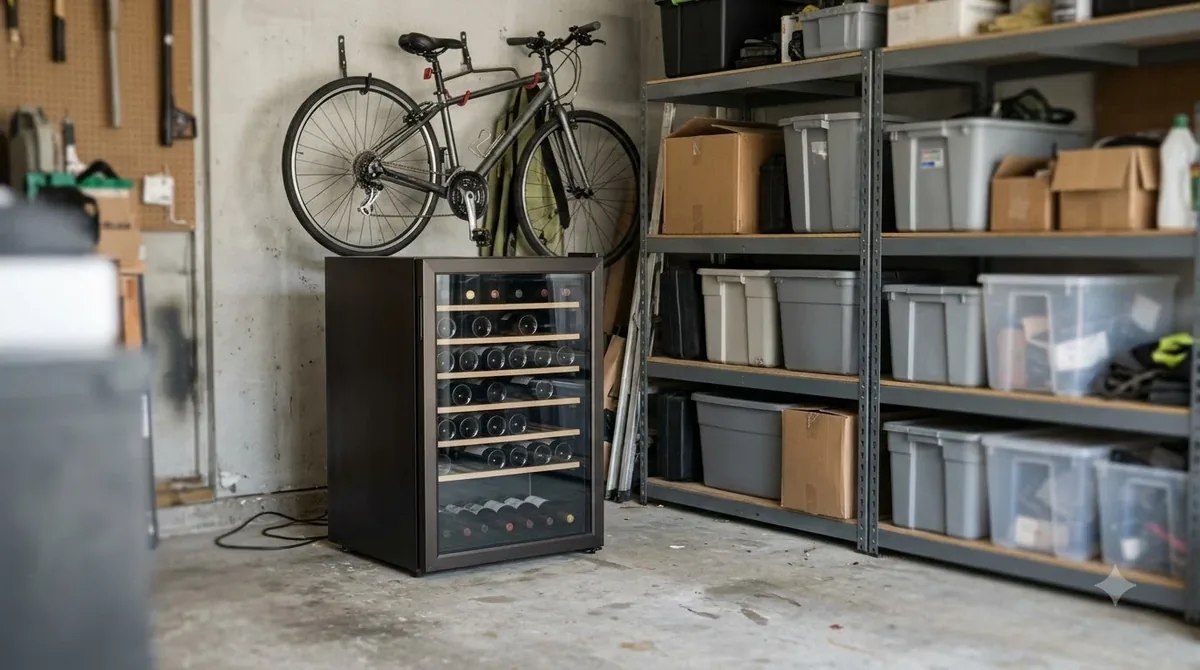
Move a freestanding cooler away from direct sunlight, a stove, an oven, a radiator, or a sunny window. Check whether room temperature rises sharply during the afternoon or when other appliances are operating. A cooler placed in a garage, laundry room, or enclosed bar may face hotter or colder conditions than the main living space. The NWC076SS00 manual specifically cautions against extreme cold ambient temperatures, and the AW-181E manual warns that temperatures outside its recommended ambient range can prevent it from reaching its intended interior range.
Keep the front grille and any rear or side air openings clear of packaging, curtains, stored items, and cabinetry panels. Leave the required space open after repositioning the appliance; pulling it forward for a short test will not solve a permanent ventilation problem. A built-in model needs the specified opening and vent path, not just a cabinet wide enough to hold it.
Check the Door, Seal, Shelf Layout, and Bottle Load
A door that looks closed may still allow warm room air to leak into the cabinet. A dirty or damaged gasket, a bottle caught near the frame, or a shelf that has not seated correctly can keep the door from closing tightly and make the cooler work harder.
Open the door and inspect the full gasket, including the upper corners and hinge side. Look for dried spills, dust, folds, cracks, or sections that have pulled away from the frame. Wipe away dirt with a soft damp cloth and dry the seal before closing the door. Then close it slowly and check for an even contact line around the perimeter. If the gasket is torn, permanently deformed, or no longer seals, contact Newair about the correct replacement rather than improvising with tape or household adhesive.
Check that every shelf is fully seated and that no bottle neck, foil capsule, or oversized sparkling-wine bottle is preventing the door from shutting. Newair’s NWC076SS00 manual says bottles must not touch the back of the cabinet. It also gives that model a maximum load of 55 pounds per shelf and cautions against stacking more than three rows of bottles on a shelf if shelves are removed to increase capacity. Those limits apply to the named model, but the general lesson is to follow your cooler’s shelf and loading instructions rather than forcing in extra bottles.
Reduce door openings while the cabinet recovers. Each opening replaces some cool air with warmer room air. Decide what you need first, remove several bottles at once, and close the door fully; do not leave it open while organizing bottles or cleaning shelves. Frequent openings in a busy kitchen or bar can cause temperature swings even when the cooler is working properly. A cabinet filled with room-temperature bottles has more heat to remove than one holding bottles that were already cool. Do not compensate by setting the control below the model’s permitted range; leave the designed air paths clear and give the appliance time to cool the contents.
Measure Actual Cabinet Temperature, Not Just the Display
Before concluding that the fridge has stopped cooling, compare the display with an independent appliance thermometer. A display can show a set point rather than the temperature of every bottle, and the air inside a cabinet does not necessarily have one identical temperature at every shelf.
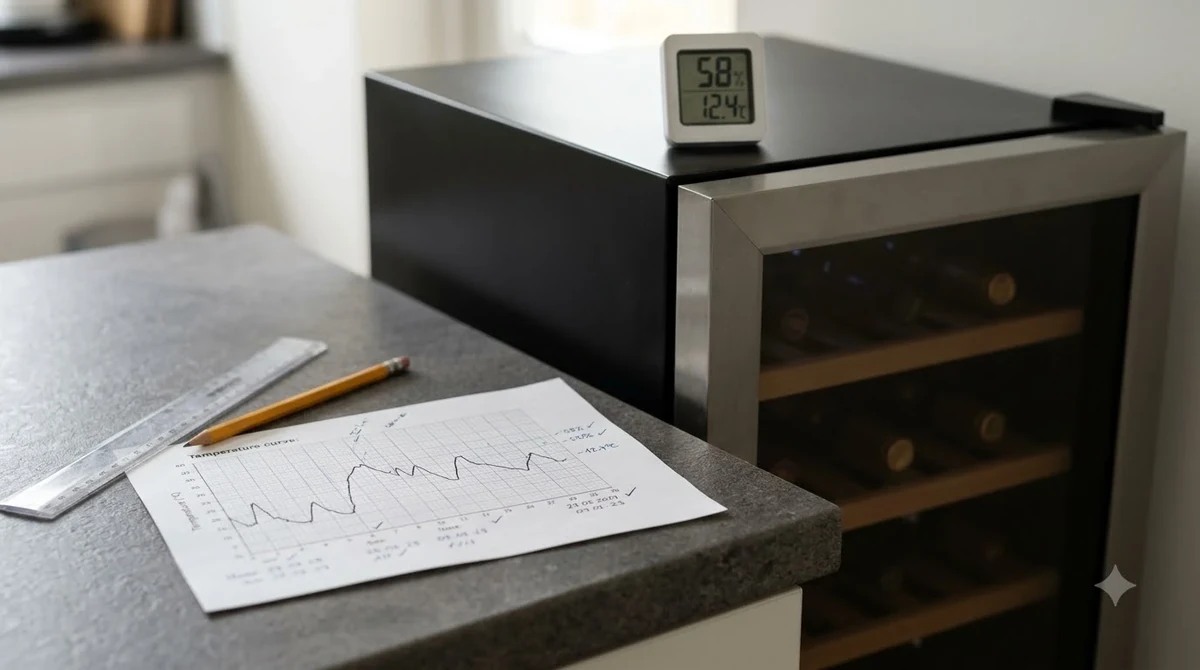
Place a small refrigerator thermometer near the middle of the cabinet without touching the back wall, a cooling plate, or a bottle. Record the reading and the display value, then repeat the check later under similar conditions. For a dual-zone model, measure each zone separately and note which shelf holds the thermometer. Keep the door closed between readings so the measurement process does not create the temperature swings being investigated.
Allow the cooler time to respond after changing its setting, correcting ventilation, or loading several bottles. A sudden drop on the panel does not mean the wine inside the glass bottles has already reached that temperature; air temperature changes faster than wine. For long-term storage, Newair’s AW-181E manual gives 53°F to 57°F as a general range for red and white wine. Treat it as a reference, not a reason to force a cooler below its available range or confuse storage temperature with serving temperature. Choose a stable setting within the appliance’s specifications.
Record room conditions too. A cabinet that cools overnight but warms in the afternoon may be affected by room heat or ventilation. If the thermometer remains well above the set point with the door shut and installation corrected, a mechanical, electrical, sensor, or control fault may need diagnosis.
Tip: Keep a simple log with the model number, set temperature, thermometer reading, room conditions, and time. Two or three consistent readings taken with the door closed are more useful to a service technician than a single report that the shelves feel warm.
Know When to Stop Troubleshooting and Request Service
If power, settings, ventilation, the door seal, and loading are correct but cooling remains poor, arrange professional diagnosis. A wine fridge contains electrical parts and, on compressor models, a sealed refrigeration system; owners should not open panels or attempt refrigerant work.
Arrange service if the cabinet stays warm despite correct installation, if the compressor does not run when cooling is needed, or if an internal fan cannot be cleared without removing a panel. Repeated clicking, grinding, a fan that stops, a blank display, or a persistent error code are useful symptoms to report. They do not identify one failed part on their own, so do not order a compressor, sensor, fan, or board based only on a sound or display message.
Stop using the appliance and seek qualified help promptly if the power cord is damaged, the plug or outlet becomes unusually hot, you smell burning, see smoke, or the breaker repeatedly trips. Do not bypass a safety device or use an extension cord as a workaround. If water has reached electrical components, disconnect power only if it is safe to do so and have the unit inspected before using it again.
Before contacting support, record the model and serial numbers, set point, thermometer reading, room temperature, any error code, and the checks already completed. A short video of an unusual sound or a photo of the display can help explain the symptom; do not remove covers to film internal components. Newair’s support center lists 1-855-963-9247 and [email protected], offers live chat, and directs warranty-service requests to support for diagnostics and return-material authorization. Ask the team to confirm the warranty terms for the exact model and purchase. For more storage-appliance help, browse the Brand Troubleshooting library; the site’s guides to Allavino wine fridge not cooling and Magic Chef wine fridge not cooling offer comparisons, while your model’s manual still controls repair decisions.
Frequently Asked Questions
Several model-specific details often cause confusion: transport may require a 2-hour upright rest, an NWC076SS00 restart requires a 3-to-5-minute pause, and shelf temperatures can vary. These answers explain what those instructions mean for everyday use.
Should I wait after transporting a Newair wine fridge?
Yes. The AW-181E and NWC076SS00 manuals both instruct owners to let the appliance stand upright for approximately 2 hours before connecting power after handling or transport. Keep the cabinet upright during the move and follow the exact instructions supplied with your model.
Is humming, gurgling, or popping always a sign of failure?
No. The NWC076SS00 manual describes faint humming, gurgling as a cooling cycle ends, and occasional popping or crackling from the cabinet walls expanding and contracting as sounds that can occur during normal operation. A new grinding noise, repeated hard clicking, or a fan that stops deserves closer attention.
Why can the top and bottom shelves have different temperatures?
The AW-181E manual says its display reflects the temperature near the center racks and that upper or lower rack readings may vary by approximately 7°F. That figure is specific to the AW-181E; it should not be treated as a guaranteed variation for every Newair cabinet.
Can I plug a Newair wine cooler into an extension cord?
The AW-181E manual says an extension cord is not recommended and specifies a grounded three-prong 110-volt, 60-hertz outlet. Check the electrical section of your own model’s manual and have an electrician address an outlet that is loose, damaged, or incorrectly grounded.
How often should I clean the grille and rear of the wine fridge?
The NWC076SS00 manual recommends cleaning the unit inside and out, including the front grille and back, at least once a year. Unplug the appliance before cleaning, keep moisture away from controls and electrical parts, and follow the cleaning instructions for the specific model.
Most Newair cooling complaints are worth checking methodically before assuming a major component has failed. Confirm the model, restore the correct airflow and door seal, verify the temperature with a thermometer, and give the cabinet time to stabilize. When those checks do not restore cooling, provide the model details and recorded readings to Newair support or an authorized technician.
More in Storage & Fridge Care
 How Long Can You Store Wine in a Wine Fridge? Protect Bottle QualityUpdated Nov 20, 2026
 Can You Store Beer in a Wine Fridge? Keep Both Drinks FreshUpdated Nov 20, 2026
 Is It Worth Repairing a Wine Fridge? Spot the Cheap Fixes Before You ReplaceUpdated Nov 20, 2026
 Wine Fridge Condensation: Identify Causes and Fix Moisture ProblemsUpdated Nov 20, 2026
 Wine Fridge Too Cold: Protect Your Wine and Fix the TemperatureUpdated Nov 20, 2026
 How to Reset Wine Fridge: Restore Cooling and SettingsUpdated Nov 20, 2026